
Albany Transit System reduces emissions, maintenance costs with CNG buses
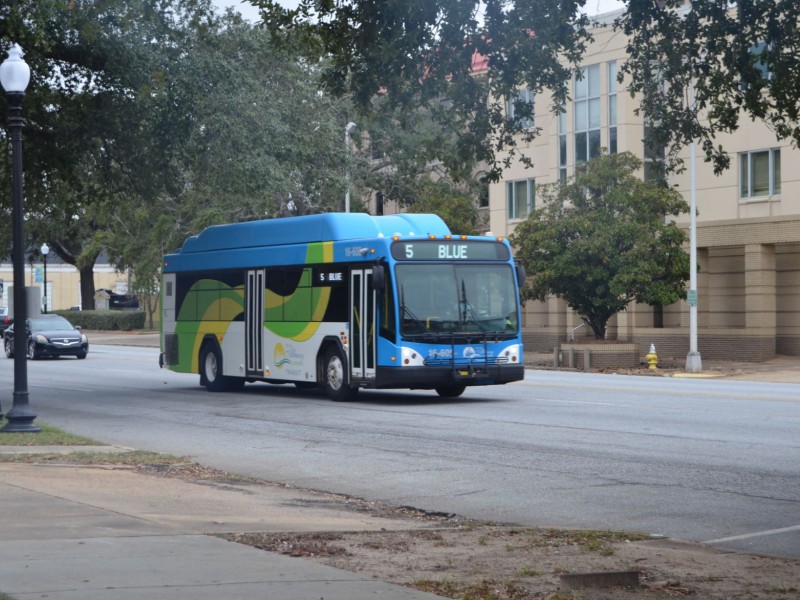
File Photo: Alan Mauldin
By Alan Mauldin
[email protected]
ALBANY — Albany’s new fleet of city Transit buses will make the city green in more ways than one.
Not only are the compressed natural gas buses better for the environment, they cost less to operate and maintain.
Currently the city has 13 of the buses using compressed natural gas. With the arrival of an additional eight in early 2020 the entire fleet of large-route buses will run on natural gas instead of diesel.
The CNG fleet includes six smaller paratransit buses and seven of the larger fixed-route buses.
“We are excited about it,” Albany Transportation Director David Hamilton said. “One of the main reasons why, of course, we wanted to go to CNG is it’s environmentally friendly.”
In addition, compressed natural gas is less expensive than diesel. But the real cost savings are in the maintenance. That has been evident with the first of the gas-powered buses purchased in 2016, Hamilton said.
“We’ve had very little repair costs with CNG,” he said. “The diesel fleet had been failing for years. We’ve been having $4,000 (to) $5,000 a year maintenance costs with diesel buses. We expect that to decline 65 to 70 percent.
“We had a lot of mechanical issues with the older diesel buses, so we wanted to phase them out.”
Initially, the CNG buses cost about 20 percent more than diesel buses. The buses, being built in California, cost between about $579,000 and $600,000.
The higher end of the price scale reflects additions that flash announcements about road closures, bus-route changes, public meetings or advertisements. They also will announce location of the bus to assist riders who are sight-impaired.
“They pay for themselves in about five to seven years in reduced maintenance and fuel costs,” Hamilton said. “The CNG buses also are a lot cleaner, so it enhances the quality of life for Albany citizens.”
The city had planned to slowly replace the aging diesel buses with the newer gas models. However, that process was pushed forward with a $4.2 million grant that will help pay for the buses and some of the costs of the new bus station that is in the planning stage.
The grant funding allowed the city not only to replace the remainder of the fleet of larger buses quickly but also to acquire three spare buses. Those will be available for use when other buses are out of service for repairs.
“It also gives us an opportunity to stay up on our maintenance and thoroughly inspect our 2016 buses.,” Hamilton said.
The diesel buses were rated for 12 years of service, or 350,000 miles, while the new ones should be on the road for 14 years, or 500,000 miles.
For safety, the fuel tanks in the CNG buses are mounted on top so the tanks won’t be damaged in a collision. The buses also won’t operate if there is a leak in the tank.
“By March 2020, we will have a whole new fleet,” Hamilton said. “You see these (CNG) buses all over where transit agencies are looking for more environmentally friendly buses.”
Author

Related Articles

Albany police officials offer update on Repeat Offender Initiative
The Albany Police Department gave an update on its Repeat Offender Initiative on Monday to the Dougherty County Commission. The initiative is meant to assist repeat offenders with overcoming some of their problems and to ensure that dangerous recidivists are kept behind bars while awaiting trial.

Classifieds – June 16, 2026
New Temple Praise Lawn Care: Raymond Kennebrew 229-603-5899 [email protected]

Three summertime fun nights planned for young people at Albany Civic Center
“I think any time you invest in children and youth, you’re always making a great investment. I think it should be a good experience.”

