
Albany’s treatment plant removes waste from wastewater
ALBANY – Whether one brushes their teeth at a Blaylock Street residence, flushes a toilet at a hotel in northwest Albany….
ALBANY – Whether one brushes their teeth at a Blaylock Street residence, flushes a toilet at a hotel in northwest Albany or takes a shower at the Dougherty County Jail, the water swirls down the drain – barring a clogged drain pipe – and disappears forever. Like magic, right?
Actually, it has less to do with Harry Potter-type spells and more to do with bacteria, oxygen, gravity, heat, mechanical processes, a tad of chlorine and the patience to allow those elements to perform their roles in converting waste water, including the “solid materials” that put the “ew” in sewage, into H20 suitable for discharge into the Flint River.
Wherever that wastewater is generated in the city of Albany, it eventually moves through the city’s network of pipes and drains by a combination of gravity and pump stations to 2726 Joshua Street, home of Joshua Wastewater Treatment W.P.C.P, a couple of blocks off Martin Luther King Jr. Drive in south Albany.
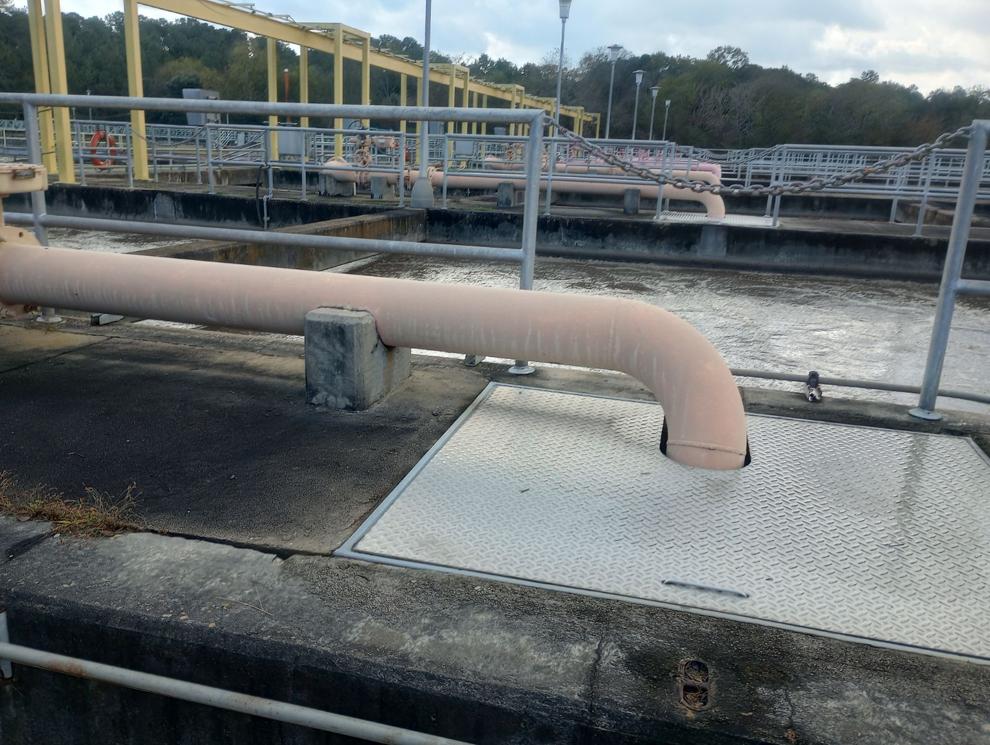
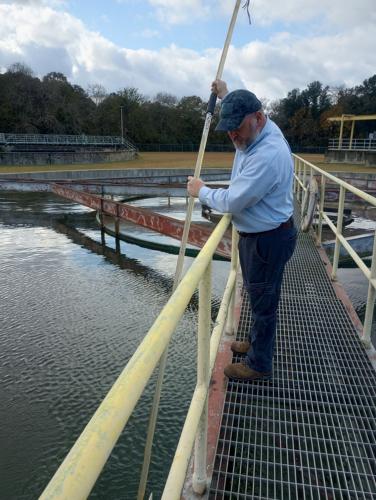
This week, a Herald reporter got a tour of the facility, originally built in 1959 and upgraded in the 1970s and again in the 1990s, from Andy Griffis, water pollution control/plant manager at the site, and Deputy Public Works Director Don McCook. Griffis ran through the steps that turn sewage into water that meets requirements for discharge during the walk through the facility that takes up part of a 33-acre fenced area owned by the city, starting with the headworks.
“All of the city (water) goes here,” he said.
When water arrives, a bar screen removes organic material a quarter-inch in size or larger and it’s then moved into a grit basin to remove small rocks and sand in the liquid.
In all, the plant handles an average of 15 million gallons of wastewater per day and can handle up to 45 million gallons. The Joshua Street plant, which is working around the clock, is operated and maintained by a staff of 15, plus two supervisors and Griffis.
Once the large solids and rocks and grit are removed, the water flows to the plant’s primary sedimentation facility.
“Once it’s screened, it flows up here and sits in a calm condition,” Griffis said.
The water sits in the huge tanks and a raking mechanism at the top scrapes off floating materials, and gravity does the work on the heavier matter.
“A large part of solids sink to the bottom,” Griffis said. “The goal of the whole thing is to get most of the solids out of the water. This is one of the areas that allows the solids to settle.”
The next step on the journey is the aeration basins. There are seven of these large tanks at the facility, and each can hold up to 5 million gallons. Inside the tanks, bacteria and air do the work of taking care of remaining solids.
“This is where a large part of the work in a wastewater plant takes place,” Griffis said. “The idea here is you have millions of bacteria that consume the organic solids. In order for the bacteria to remain happy, they have to have food, which is the solids coming in, and air. There are three blowers that keep air fed to aeration basins.”
Once the active blowing is done, it’s on to the secondary clarifiers for another period of waiting. In the calm state, the remaining solids are allowed to settle to the bottom in the six tanks and are pumped out.
At the thickener step in the process, the solids from the primary sedimentation facility and aeration basins arrive in a mixture that is about 0.5% solids.
“It looks like chocolate milk,” Griffis said. “It gets air added to it. Air bubbles attract to solids, and it all floats to the top. It makes a cake that gets scraped off the top.”
From there, the remaining solids and water diverge, with the solids pumped to the slurry digester for a heat treatment and more bacteria.
“The idea there is to keep the bacteria happy,” Griffis said. “We try to keep it at about 95 degrees. The sludge spends about two months in the digester. Any organic material left breaks down.”
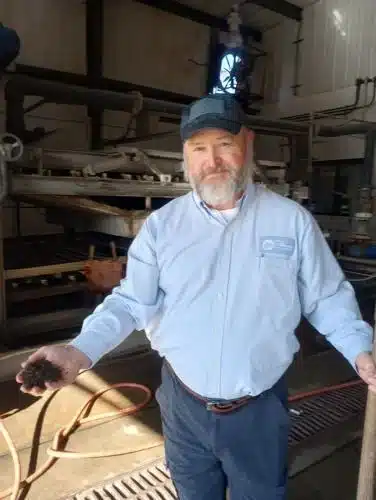
The resulting material is destined for land application, and the city pays a company to remove the material that is trucked to Alabama for application on non-food crops. The material looks like mulch, and Griffis had no issue with picking up a handful to display.
“People think it’s nasty,” he said. “It’s nothing of the sort. It’s primarily the dead and dying bodies of the bacteria that were used up. I would wash my hands before I ate” after handling it.
For the remaining water, the penultimate process occurs at the contact chamber. Here, chlorine is added in two chambers.
“It sits for about 30 minutes and allows the chlorine to work,” Griffis said. “It’s a very low amount. One of the things we’re required to monitor for is E. coli, and the chlorine helps keep that down.”
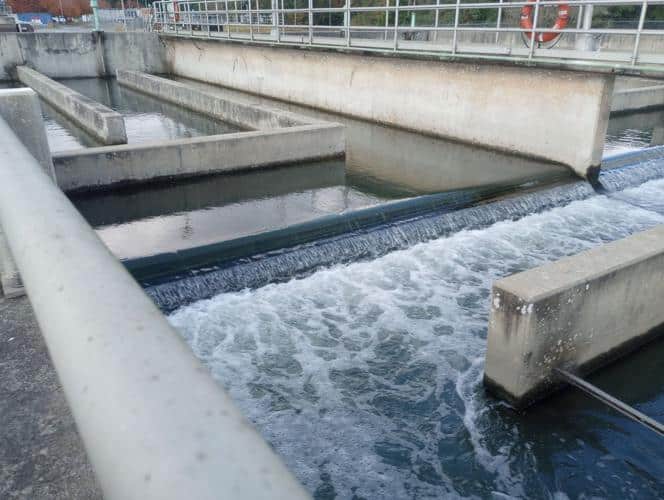
From there, the water gets its final push to the east, where it cascades over granite rocks to add more air on its way to join the flow of the Flint River.
“This is the finished product here,” Griffis said. “Once it removes the chlorine, it flows underground and it flows to the river.”
In November, the city was awarded a $12 million loan by the Georgia Environmental Finance Authority to help renovate the aging infrastructure at the plant, with up to $3 million of that loan forgivable.
The plant initially treated all of the wastewater from the sewage system as well as stormwater, except on occasions when heavy flow kicked in the overflow system to carry it to area streams.
The city is also in the process of a combined sewer overflow project that has a price tag of well over $100 million. The underground system dates back to the early 1900s
Currently, on heavy rain days the overflow system takes untreated water to the river.
The city is under a mandate to achieve 85% separation of stormwater and sewage by June 2025 or face steep fines of up to $10,000 per day.
Once that work is done “stormwater will to go the river and all the sewage will go to the treatment plant,” said David Dixon, an honorary board member of Flint Riverkeeper, which spurred the city into taking action.
On heavy rain days, whatever individuals flush down the toilet ends up in the river and dumps harmful loads of bacteria into the river.
“We’ve seen prophylactics, tampons,” Dixon said. “Everything flows in the river when they have a large rain, or even a medium rain. We’ve even found blood vials as far south as Newton. There was the hint of a threat (of a lawsuit) if they didn’t do anything.”
And that material isn’t just an issue for Dougherty County, as the water inevitably flows downstream.
Albany was among the last three cities that had the combined overflow system that allowed combined water and sewage to flow into waterways, the others being Atlanta and Columbus. Atlanta has pretty much finished its work, and Columbus has worked on its system, Dixon said.
Overall, he said he is satisfied with the city’s efforts. Due to the impacts of COVID-19, the city has faced challenges in getting materials and contractors on the job to do the required work.
In conversations with Georgia Environmental Protection Division officials, Dixon said he has been assured the city has shown sufficient progress to avoid penalties if it runs a little late in meeting the deadline.
“There’s just been a lot of things that slowed down the project, but it hasn’t stopped the project,” Dixon said.
Author

Related Articles

Albany Rescue Mission in recovery but still can use some help
“We can’t do this without the community. We are so grateful for the willing vessels. We just can’t thank them enough. We also appreciate the other ministries that have sown seeds into our ministry.”

Plenty of oil, not enough diesel — and southwest Georgia farmers are paying for it
Sedrick Rowe doesn’t spray herbicides on his 10 acres of organic peanuts. He fights weeds with his tractor instead, which means he runs it more often than most farmers — and burns at least 30 gallons of diesel on a typical day. This harvest season, every one of those gallons costs more than it has at any point on record.

Dougherty schools plan task force as SNAP changes raise concern over free meals
The Dougherty County School System plans to create a task force to help families retain food assistance and navigate new reporting requirements as district officials warn that declining SNAP participation could eventually affect the federal provision that allows every student to eat free at school.
