
As Medicaid support shrinks, rural Georgia braces for health care fallout
As healthcare professionals assess the impact of Trump’s recently signed “big, beautiful bill” and its reduced federal support for Medicaid, some argue Georgia will fare better than states that expanded Medicaid.

CUTHBERT – Tyrae Campbell lay, bleeding out, with a gunshot wound to the torso at least 30 minutes before an ambulance arrived to transport him to receive emergency medical care.
Raquel Warren, the 16-year-old’s mother, arrived at the scene before the actual ambulance. She watched as her son’s friends and paramedics from a non-transport emergency vehicle tried to save Campbell. However, she knew her son was already dead before the ambulance arrived.
“Watching my son lay there lifeless and knowing that there was nothing I could do to help him, was, I don’t think there’s a word that exists for how I felt,” Warren said. “I believe if an ambulance had gotten there immediately … maybe he would’ve had a chance.”
Emergency services are stretched thin in rural southwest Georgia, where counties often share ambulances and the nearest hospital may be 40 miles away. Georgia is one of ten states that didn’t expand Medicaid under the Affordable Care Act, and rural providers say their hospitals have suffered because of it. Cuthbert’s only hospital, the Southwest Georgia Regional Medical Center, closed in 2020 due to high costs, aging infrastructure and a growing number of underinsured patients. It’s one of nine rural hospitals in Georgia to close since 2010, with more at risk.
As healthcare professionals assess the impact of Trump’s recently signed “big, beautiful bill” and its reduced federal support for Medicaid, some argue Georgia will fare better than states that expanded Medicaid. Still, KFF projects that by 2034, 310,000 Georgians will lose access to health insurance.
Liz Coyle, the executive director of Georgia Watch, said she worries because the bill doesn’t provide an extension for enhanced tax credits for those insured through the Affordable Care Act, which expires this year.
“Those subsidies were put in place a few years ago during the pandemic, and they have been shown to really help middle class families in the face of rising health care costs,” Coyle said. “If those tax credits expire … Georgians who’ve been able to have coverage through a Marketplace plan … could see a 200% increase in the cost of that monthly premium, causing many to ultimately have to give that up.”
With more uninsured patients, Georgia’s hospitals will face lower rates of reimbursement for services.
“When you’ve already got a number of rural hospitals that are at risk of closure, this would be further tipping the scale, making it hard to keep the doors open when they have fewer patients that are covered,” she said.
Reopening the hospital
Warren moved to Cuthbert in 2013. Even when the hospital was still open, it wasn’t equipped for childbirth, so she had to travel 45 miles to Albany to give birth.
Warren was scheduled for a C-Section, but her water broke earlier. She had to call an ambulance to transport her 45 miles to Albany.
“I had to pray to God that I got there in time, and that I was safe,” Warren said.
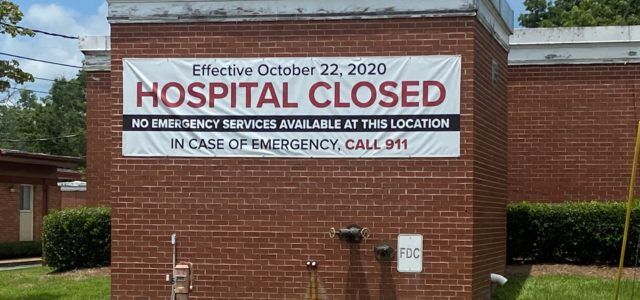
Congressional appropriations passed in 2024 secured $11.8 million for the Randolph County Hospital Authority to re-establish a hospital in town. Steve Whatley, the chairman for the hospital authority, said many surrounding counties relied on the Cuthbert hospital, and its closure was devastating for the community.
The new hospital will have a 24-hour emergency room, outpatient services and potentially some inpatient beds. He said they’re still waiting to receive the federal funds as it’s a “laborious process.”
Sen. Freddie Powell Sims (D-Dawson) said Federal funding is in a holding pattern until “we figure out what it is the federal government is going to do about health care, education and other things that are crucial to everyday living.”
Dr. Karen Kinsell, a physician in Fort Gaines, GA, said it’s difficult for rural hospitals to reopen.
“These are permanent closures in almost all cases,” Kinsell said. “The ones that are most at risk for closing are usually the ones in poor areas and with aging physical plants and so you can’t just turn the lights back on and expect it to function again.”
“People are going to die.”
Kinsell is outspoken against Medicaid cuts.
She sees more than 30 patients a day, four days a week at the small Clay County Medical Center where she is the only physician for a town of 3,000 people. In 27 years, she hasn’t taken more than five consecutive days off. On a Monday morning in July, she had 38 patient meetings scheduled.
“At this point we’re seeing one to two new patients a day, which is crazy as an established practice, but several of the doctors surrounding us have retired or left; so, there is this huge unmet need,” she said.
She’s usually the first who’s called when a local has broken their leg or is feeling ill. She has to send these patients away to the emergency room – many opt to drive themselves rather than face the long wait times or high costs of an ambulance – that is a 30 minute drive away.
Most of Kinsell’s patients are senior adults on Medicare. About 10% – mostly under 19, pregnant or disabled adults – are on Medicaid, she said. About 20% are uninsured, a number that used to be higher until the Marketplace helped reduce that number. Still, she said when the ACA expires this year, she’ll expect many patients to go back to being uninsured.
Her clinic is not for profit and doesn’t turn anyone away. When a patient is uninsured, she eats the cost – a model she said is not conducive for rural hospitals to operate under.
Kinsell said she expects conditions for rural hospitals in Georgia to worsen, and to states who chose to expand Medicaid, look no further than southwest Georgia for a glimpse of what Medicaid cuts will do to rural hospitals around the country.
“People are going to die, they’re going to be scared and injured longer,” she said. “There are going to be a lot more people more permanently disabled because they weren’t able to access health care properly.”
She said she expects more hospital closures as rural hospitals are faced with more uninsured patients and a worsening provider recruitment crisis.
A promised “rural transformation program”
Within the pages of the “big, beautiful bill” is a $50 billion Rural Health Transformation Program. Its goal is to support rural health care providers, including hospitals, clinics and community mental health centers. It’s designed to improve access to care, enhance health outcomes, prioritize technology and identify causes for hospital closures.
“I would like to see Medicaid expansion take place,” Sims said. “If you think about $50 billion and 50 states, is that enough? Depending on the size of the state, that’s just a drop in the bucket.”
Jimmy Lewis, CEO of Hometown Health, a network of rural hospitals, said state leaders need to establish a plan that actually goes after these funds. Lewis said state leaders also need to ensure that these rural transformation funds are distributed to the areas most in need.
“In southwest Georgia, there is a serious need because of the situation with respect to economics, education and all of the shortfalls,” he said.
Lewis said he’d like to see increased support for telemedicine – something that became crucial in rural areas during the COVID-19 pandemic – and internet access to sustain those services. He said he’d also like to see rural health centers and hospitals tap into Artificial Intelligence to address workforce shortages.
Kinsell said funding for a regional rural hospital would make a real difference in health outcomes in southwest Georgia. Although, it would need a long-term plan for funding as it cares for uninsured patients.
“Hospitals are closing because you’re not paying to keep them open,” Kinsell said. “Health care is important. Health and health care are both fundamental human rights.”
Author

Related Articles

Voters will decide on Dougherty County Commision District 4 in Nov. 3 election
Only one competitive Dougherty County Commission race remains to be decided on Nov. 3. Democratic challenger Anthony Patterson is the challenger for incumbent Republican Russell Gray in District 4.
Lee commissioners adopt 29.71-mill tax levy, including school bond payments
Lee County commissioners adopted a combined county and school property tax rate of 29.71 mills Monday, formalizing a levy that includes 17.96 mills for school operations and a separate 0.58-mill charge to repay school bonds.
PHOTOS: Albany State and Phoebe Ceremony
Click the arrow to scroll through the images.
