
‘Blue tsunami’ makes history, rebukes President Trump as voters express dissatisfaction with status quo
In 2006, President George W. Bush described the Republican defeat in Congressional elections as a “thumping.” Four years later, President Obama dubbed what happened to his party a “shellacking.”
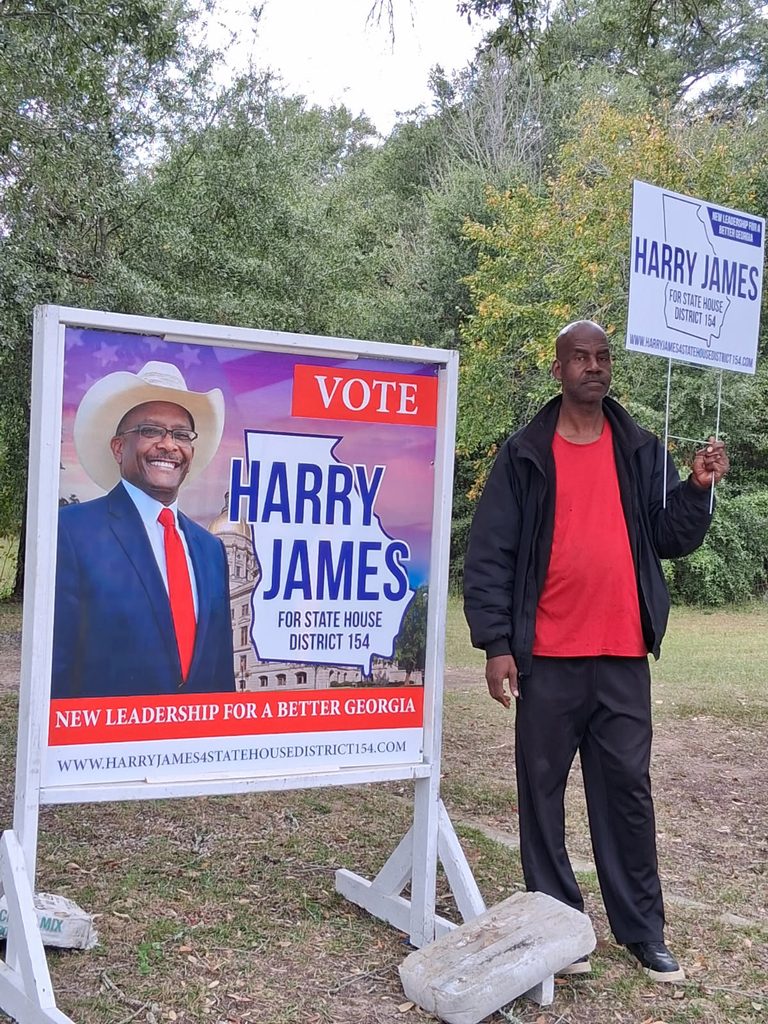
Robert Davenport holds a campaign sign for Democratic candidate Harry James outside the Shiloh Baptist Church precinct on Tuesday. James defeated Republican Gerald Greene, who had held the House District 154 seat since 1982, in the race. Staff Photo: Alan Mauldin
ALBANY – In 2006, President George W. Bush described the Republican defeat in Congressional elections as a “thumping.” Four years later, President Obama dubbed what happened to his party a “shellacking.”
No term has emerged for what happened on Tuesday, but the term “blue tsunami” has been a popular one online. One thing it can be called is one of the most dramatic swings in political fortunes in the nation’s history, especially considering some of the statewide results.
In Georgia, that included electing Keisha Lance Bottoms as the first African American woman governor in U.S. history and seven other black women to statewide offices. Democrats won all constitutional offices in the state and two Public Service Commission seats.
Several factors played into the giant wins for Democrats, University of Georgia Political Science Professor Charles Bullock said. Those included a popular U.S. Senate candidate in Jon Ossoff, whose popularity helped buoy down-ballot candidates, a massive repudiation of Republicans by young voters who turned out for Democrats, and perhaps most of all, the public’s desire to move on from the presidency of Donald Trump.
“This is at least a generational election,” Bullock said. “Maybe more than that. Maybe two generations. There was clearly dissatisfaction with Donald Trump and his administration, but I think once we dig into the results it is going to be a big black and youth turnout. Had they come out the same in 2024, (Kamala) Harris probably would have carried Georgia.”
In the 2006 election, Democrats picked up 31 U.S. House seats to gain a 233-202 advantage and picked up five U.S Senate seats. In 2010 Republicans gained 63 House seats to build a 49-seat majority and won six Senate seats, although that did not give them the majority.
As of Friday, Democrats were poised to have at least 253 House seats at the national level, with other races still not called.
The early momentum was seen building even before the election with more than 2.8 million Georgians casting ballots early, Bullock said. And many apparently voted a straight-Democratic ticket.
Turnout in rural areas, which have voted dependably Republican, also was depressed.
“Maybe there are a number of Republicans who are dissatisfied with Trump,” Bullock said. “They said, ‘I’m not happy with that, but I won’t vote for a Democrat. Maybe I’ll stay home today.’”
Georgia’s political world was rocked in 2002 when Sonny Perdue became the first Republican to win the governorship since Reconstruction. But it would take another eight years for the party to take control of all of the state’s constitutional offices.
The 2026 Democratic sweep occurred in one night. And the Democrats are poised to take control of the state House for the first time in 22 years. Democrats had won or were ahead in 94 races as of Friday in the 180-seat legislative body, with Republicans on the path to win 85.
In District 151, Republican state Rep. Mike Cheokas faces a runoff against Democrat Ethan Wolff.
The Georgia Secretary of State has until Nov. 22 to certify the election results.
“2002 was certainly significant, but it’s not as significant as what we saw (Tuesday) night,” Bullock said.
On the national level, Democrats will see many of their initiatives blocked by the president’s veto pen, but there are still some areas where they can make a quick impact, the professor said. One of those is the Iran war, and another is tariffs.
Congress’ cuts of funding for the Vietnam War was what helped bring that conflict to an end, he said, and Democrats can do the same to funding for military operations in Iran.
Tuesday’s results indicate that Republicans are going to have to do some soul-searching, Colquitt County Republican Party Chairman Dennis Futch said. The party did not read the mood of the country, which was decidedly more focused on economic issues.
The party that holds the presidency traditionally loses seats during off-year elections, he said, but the 2026 election was a bigger rebuke than what is normally seen.
The Iran war and tariffs, which hit farmers and small businesses hard, had an effect, Futch said.
“We were talking about how bad the other side is and not about what we’d do for taxpayers,” he said. “When you get down in the weeds, people are not doing well. We have to give them hope. This (election) is bigger than Georgia.
“I’ll be the first to say that if we’re going to make fundamental changes to the economy and we’re going to bring jobs back, we’ve got to explain that to people and communicate that sacrifice is going to happen in the near-term. We have to tell voters what we’re going to do for them and how we’re going to make the country better instead of just vilifying the other side.”
While Georgia is one of the better-run states, that wasn’t enough to overcome the political wave, he said. That was evidenced in the pre-election polling showing a dead heat at 49% each for Bottoms and Republican opponent Rick Jackson.
“A lot of folks that voted in 2024 changed their vote or maybe they didn’t vote at all,” Futch said. “We were making assumptions that people who always voted Republican would vote Republican, and we were wrong. The voters basically told us the cost of living was the big issue. The second thing they told us was that they want the Iran war concluded.”
Moving forward, Republicans need to take those lessons to heart, he added.
“Tuesday was a hard night for Republicans in Georgia and America,” Futch said. “Georgia voters made their choice. I can respect that, and I can congratulate the governor(-elect) and wish her well.”
The Democratic Party had the message that resonated on Tuesday, Dougherty County Commissioner Gloria Gaines said. While the election was historic in the choice of African American women, that was not the big takeaway.
“They had their finger on the pulse of ordinary people without regard to race or creed or color,” she said. “I think that’s what got them over the hump. It’s great that they are black, but I think that the emphasis should be on the issues. This was a triumph of everyday Georgians.
“I certainly had my hopes always that we would have a color-blind society. That was the hope when I was growing up in the ‘60s and ‘70s. It pleases me that she (Bottoms) is black, but what I find very interesting is the issues.”
The president did not do himself any favors asking people to pretend he was on the ballot, Gaines said.
“In an economic downturn, black people are the first to feel it,” she said. “It was a reaction to that kind of bumbling and incompetence coming out of the White House. I think everybody coalesced around the proposition that we are better than this.”
Bottoms’ message was one of access, equality and opportunities, and the voters responded to that, Gaines said. They also were tired of the division and being ignored.
“Her color does not matter,” she said, “Although it was important, that’s not what mattered. We’re not that stupid. It was just an appeal to the needs of ordinary people. I think people felt that we had had enough of the millionaires and billionaires and trillionaires, and our pockets are empty.”
Democrats are buoyed by the wins, but it was not a foregone conclusion, Dougherty County Democratic Committee Chair Joyce Barlow said. Trump was not concerned about education, healthcare and small businesses, and that showed in the final results.
His appeal to pretend that he was on the ballot also did not go over well, she said.
“That sentence came back to haunt him,” Barlow said.
Bottoms comes from a working family and will work to improve the lives of all of the state’s residents, she said. During the campaign, the governor-elect made three stops in Albany and traveled extensively through the state, exhibiting her interest in the people.
“(Voters) want someone who would not just give lip service,” Barlow said. “They want action.
“I’m just enthused. Our work paid off. We worked really hard and got the voters out. We canvassed. We did all the things you need to do to educate the voters about why and how and when to vote. That takes a lot of hours.”

Author

Related Articles
PHOTOS: Fountain City Classic – Albany State vs. Fort Valley State
More than 300 photos from Columbus by Reginald Christian. Click the arrow to scroll through the photos.

Terrell County denies wrongdoing in lawsuit over 12 dogs
A Terrell County resident says 12 French bulldogs were taken from his property without a warrant or a meaningful opportunity to contest their loss, allegations county officials deny as they ask a federal judge to dismiss his civil rights lawsuit.
Election-night error leads to investigation, change in state House 154 race vote totals
The results of the Georgia House District 154 race were shifted from blue to red after results from a data card in Seminole County were downloaded. With those additional votes, incumbent Repucpublican Gerald Green has a 262-vote lead over Democrat Harry James of Albany in unofficial results.
