
City and county begin sales tax negotiations
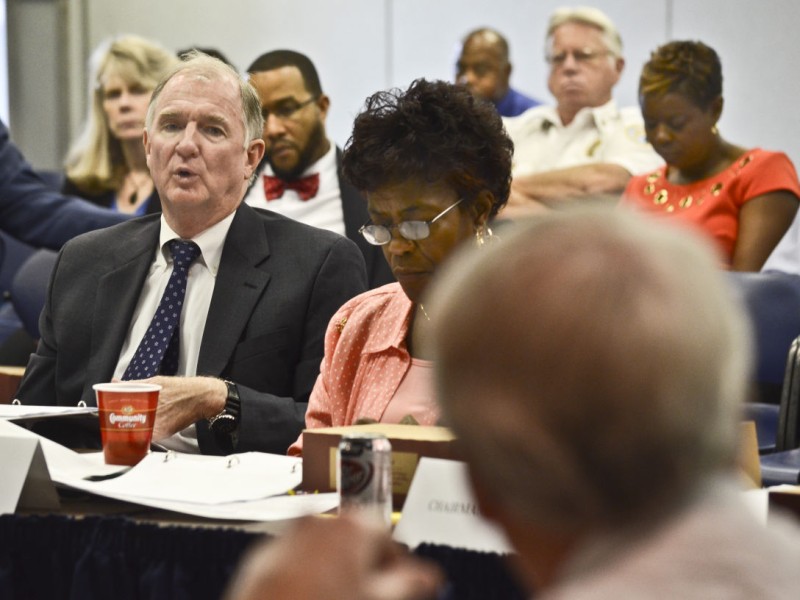
Albany city officials and Dougherty County leaders began negotiations on how locally-collected sales taxes are split amongst the two.
The City of Albany contends that they are justified in seeking 79 percent of local sales taxes while the Dougherty County Commission is seeking a 53 percent cut.
Currently, the taxes are split 60/40 with the city receiving the majority of the funds.
If the two governments can’t work out an agreement within 60 days, they then enter into non-binding mediation. If there is still no agreement, a judge from a different judicial circuit would hear the best offer from both and select one to be binding for the next 10 years.
Michael Brown, a former city manager for Savannah and Columbus-Muscogee County, pitched the city’s case, arguing the city is the predominant service provider within Dougherty County and is home to the majority of the industrial, retail and residential tax base and should therefore receive at least 80 percent of the sales tax split.
According to Brown, Albany has 81 percent of the total population, 86 percent of the total daytime population, 90 percent of the county’s total share of those below the poverty level, 96 percent of the total county accommodation and food service sales, 92 percent of the total county commercial tax digest, 58 percent of the county’s total industrial digest, 69 percent of the county’s total residential digest, 57 percent of the county’s total number of non-profit agencies, 99 percent of the county’s total Healthcare revenues and 90 percent of the total jobs in the county.
“Based on the figures, it would be justified for the split to be in excess of 80 percent,” Brown said. “I think that when you look at the predominant nature of services and population…for the city to ask for any figure in excess of 80 percent would not be unfair.”
Countering that argument is Dougherty County, whose consultant, Phil Sutton — a former county administrator in Hall and Athens-Clarke County, pitched the concept that Dougherty County residents on the whole provide services to everyone within in the county, including those who live within the city limits and should therefore be entitled to a majority share of the sales taxes.
Using this logic, Sutton took the total number countywide for any one statistical area and used it as a comparison against the data for the city alone.
For example, in terms of residential population, Sutton contends that Dougherty County has 55 percent of the total population by taking the total number of people who live in the city — 77,434– and adding the population of the unincorporated portion of the county — 17,131 — for a total of 94,565. He then added that figure by the city’s population again to come up with 171,999 — a number Brown called him out on.
“The census data shows that the population of Dougherty County is not 171,000,” Brown said. “We all wish it were, but that just isn’t the case.”
“The fact remains that that the county provides its general fund for the benefit of everyone in the county,” Sutton said. “It’s really a service district comparison more than an unincorporated area versus the City of Albany.”
It’s a move suggested by the Association of County Commission to make sure that local governments avoid what the organization calls the “unincorporated” trap — a move where cities only include unincorporated areas as the parts of counties and neglect the cities themselves.
State law mandates that every 10 years local governments come together to negotiate the split of sales taxes based on at least eight different criteria. Those criteria include population, service delivery responsibilities, the effect of a change in the sales tax split on a government’s ability to pay its debt, point-of-sale and use data and any subsidized services paid by one government to the benefit of another.
Previously, most local governments used population as the sole determiner of sales tax splits.
The purpose of LOST funds are to defray property taxes by supplementing the general funds of local governments.
“It’s important from the county’s perspective that the end result be fair to the taxpayer because ultimately, this is a property tax rollback,” Sutton said.
Related Articles
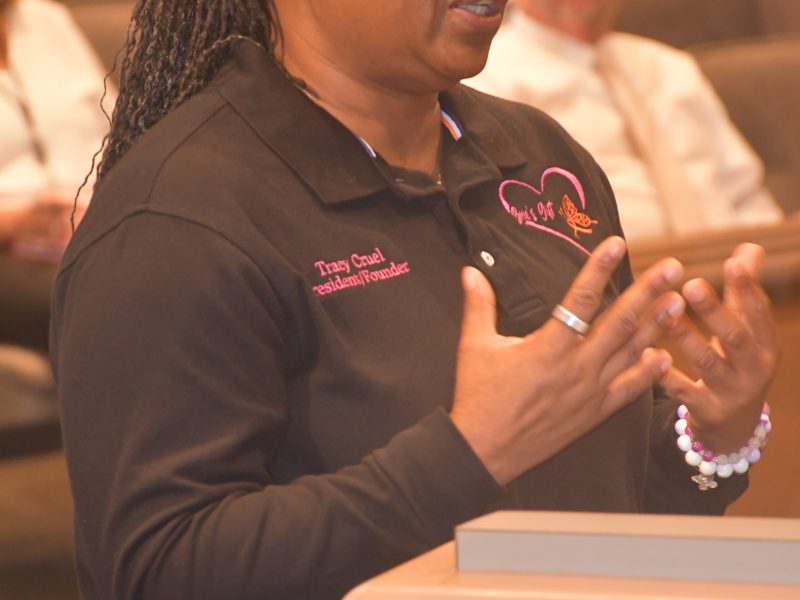
Brie’s Gift offers a helping hand for families affected by leukemia
“I think that would be beautiful. Brie loved her school, she loved her city. I think that would be wonderful.”

Classifieds – June 30, 2026
JOBS: Full-Time – Fire Fighting Pilot for Thrush Aircraft, LLC… SERVICE … DIRECTORY: Health – Private Caregiver… Home Repair/Remodeling: Enhanced Remodeling & Drywall…
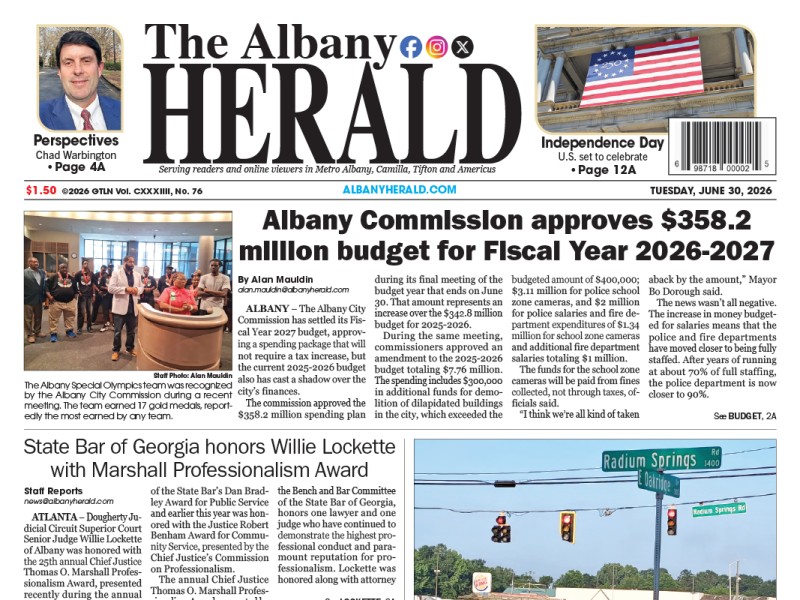
Albany Herald – June 30, 2026
Albany Commission approves $358.2
million budget… State Bar of Georgia honors Willie Lockette with… Red light violations will bring citations at…
