
City of Albany approves telecommunications deal with SGRITA
Carlton Fletcher
ALBANY — After months of fine-tooth combing the potential deal with the South Georgia Regional Information Technology Authority from every possible angle, the Albany City Commission gave approval Tuesday to a resolution that will allow the city’s Water, Gas & Light Commission and telecommunications personnel to work with the authority to provide broadband and information technology services to a rural seven-county region in Southwest Georgia.
Over the course of the project, city personnel will work with SGRITA contractors to build some 22 towers and lay a 150-mile fiber loop that will bring advanced telecommunications capability to portions of rural Baker, Mitchell, Calhoun, Terrell, Early, Miller and Seminole counties.
“It starts now,” interim City Manager Tom Berry said after the commission’s Tuesday-evening business meeting. “We now have the capability of expanding our footprint in the region in a manner that will bring new revenue into the city and provide opportunities for parts of the region that they’ve never had before.
“It’s amazing, but some of those places still have dial-up Internet access only. We’re going to do everything we can to change that. There’s certainly no guarantees in this, but we’re going to do our best to make this process work.”
Mayor Dorothy Hubbard said the city’s opportunity to play “big sister or big brother” to the communities that are part of the project may not exist when a new federal Telecommunications Act is passed.
“There may be federal and state regulations that prevent us from doing something like this in the future,” Hubbard, who also serves as chair of the WG&L board, said. “We’re needed in these smaller communities to serve as a big sister or big brother. It’s crucial, I think, that this work.”
The commission voted 5-1 to pass the resolution, the one dissenting vote coming from Ward I Commissioner Jon Howard. Howard questioned staff about the cost the city would absorb in the first couple of years of the program before it generated enough revenue to reimburse city of Albany staff members for their work and to generate income for the city.
Assistant City Manager Wes Smith told the board the project is expected to generate more than $10 million in new revenue for the city over a 25-year period, and Berry said he expects costs to run around $125,000 annually before the project starts generating revenue.
Also at Tuesday’s meeting, the commission:
— OK’d the use of Special-Purpose Local-Option Sales Tax VI funds for the relocation of the Albany Fire Department’s Fire Station 7, the purchase of vehicles and construction of a compressed natural gas fueling station at city Transit facilities, and the purchase of computer servers;
— Approved four-hour parking limits downtown (instead of the current two) between the hours of 8 a.m. and 6 p.m.;
— Signed off on rezoning for properties at 2800 Old Dawson Road and at 215 S. Madison St.;
— OK’d an alcohol license transfer for Neighborhood Grocery at 716 Johnson Road and a license application for the Yellow Store at 903 S. Madison St., as well as blanket 2015 approval for 211 businesses in the city that hold valid alcohol licenses; and
— Authorized a $149,000 three-year contract with PayScale Inc. to build and maintain a compensation structure for the city.
Ward II Commissioner Bobby Coleman opposed the final bit of business, saying he’d prefer a less expensive vendor for the job.
Related Articles
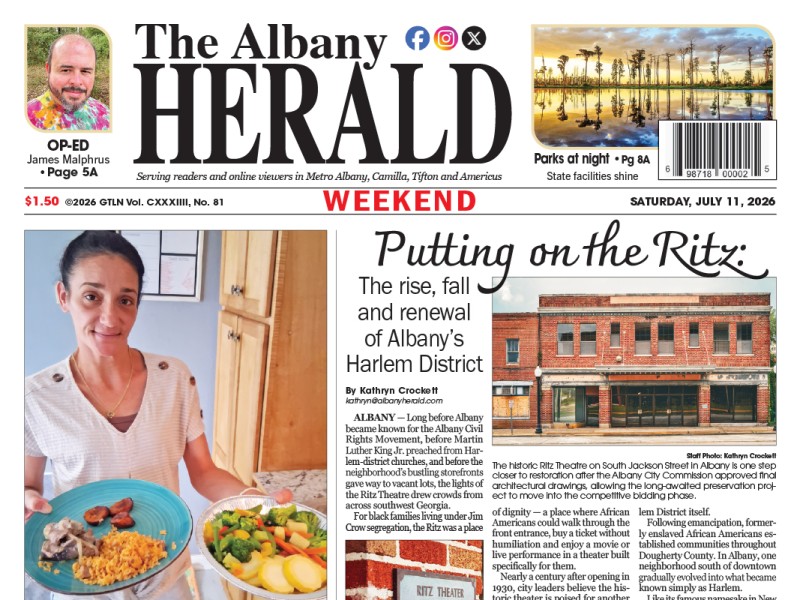
Albany Herald – July 11, 2026
Putting on the Ritz… Food, mini menagerie provide… Albany City Commission set to vote on… Following Lee’s lead, Terrell County hits…

Classifieds – July 11, 2026
Albany Classifieds and Legals: Real Estate; Merchandise, Misc…

Small actions can help save big on utility bills
The high temperatures of July and August can bring scorching utility bills as air conditioners hum to keep houses cool. Albany Utilities Residential Conservation Auditor Willie Jackson offered some tips on making summer cooling bills more manageable.
