
City of Albany asks for community input on disaster resiliency plan
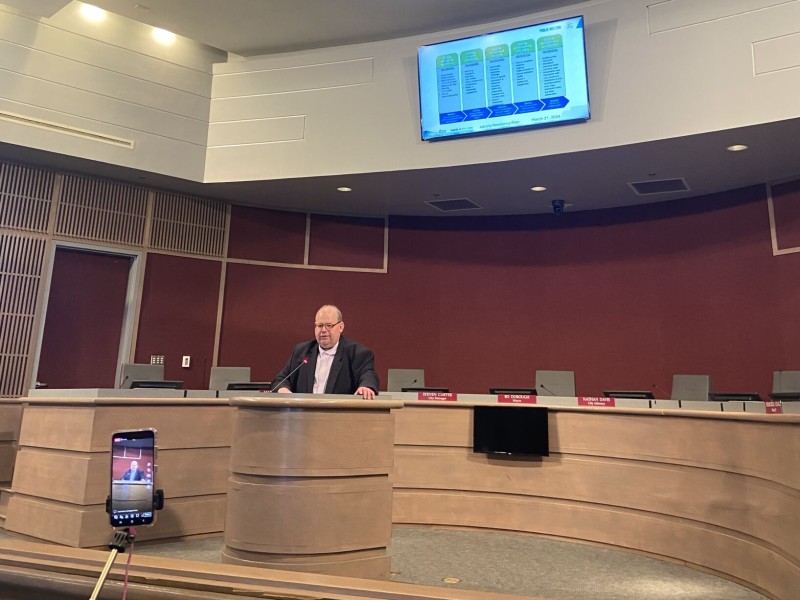
Staff Photo: Lucille Lannigan
By Lucille Lannigan
[email protected]
ALBANY – The city of Albany Planning and Development Services Department held the first of three public meetings for discussion of the creation of the Albany Resiliency Plan Thursday night.
The plan is meant to steer Albany’s development toward a sustainable and resilient path that will be well-prepared for “short-term disruptions and long-term challenges,” whether environmental, economic or social. It’s funded by a Community Development Block Grant Disaster Recovery Planning Grant that the city received to improve its resiliency. The grant is from the Georgia Department of Community Affairs through the U.S. Department of Housing and Urban Development.
Paul Forgey, the Planning and Development Services Department’s director, said Albany received the grant because of impacts from tornadoes in 2017.
The resiliency planning process involves multiple steps, including data collection and analysis – currently, the consulting agency in charge of the plan, Metro Analytics, is collecting data on the condition of each city parcel — and seeing potential threats or long-lasting damage.
Thursday’s meeting focused on community engagement. The plan implements a Public Engagement initiative to better understand impacts from disruptive events. Albany residents are asked to share their pictures and stories through a Lived Experiences Survey, which can be accessed at www.albanyga.gov/AlbanyResiliencyPlan.
Mary Huffstetter, an agent with Metro Analytics, said the group wants to hear from people who have been directly impacted by these events and what their response and recovery experience was like – what went well and what should be different.
“No one knows the local experience better than the local community,” she said.
Chandler Duncan, a senior consultant for Metro Analytics, said Albany is a community that has a history of trauma. The city has taken numerous hits with the Flood of 1994, tornadoes in 2017, Hurricane Michael in 2018 and the COVID-19 pandemic in 2020, where the city became a hot spot.
“In some ways, it’s come back, and in some ways, it still struggles,” Duncan said during Thursday’s presentation. “Everything that the people in this room – all your friends and neighbors and co-workers – know about that is very important. We’re trying to bring that information into a plan … so Albany can be a stronger community.”
Albany’s Resiliency Plan is the first of its kind in Georgia.
Duncan said hazard mitigation plans have been implemented throughout Georgia but not any with the holistic approach being used in Albany’s Resiliency Plan.
He said it stands out from other plans because it looks at the entire community resilience ecosystem: the physical realm along with cascading effects that impact the institutional and user realm. The physical realm consists of infrastructure and its potential vulnerability.
Duncan said most hazard mitigation plans look at the physical realm.
“The problem is if that’s all that you do … you don’t start understanding how ready we are to respond if that happens,” he said. “How ready are businesses? How ready are institutions?”
The institutional realm deals with the people in charge of keeping the physical realm in order. The users include the people who are impacted. Hufstetter said all of the realms impact each other in a trickle-down effect.
Duncan said it goes beyond trying to stop failing systems but rather says there will be failures in the event of something like a hurricane, and how can the city prepare for them even down to individual households?
“Down to the user, there are a lot of things you can teach the public just to be ready on their own should you expect that damage is coming,” Hufstetter said.
The agency also conducted interviews with four agencies to gain feedback on lessons learned during previous disruptive events as well as efficient coordination practices among these agencies. The agencies were the Albany Fire Department, City Public Works, Facilities Management and MEAG Power.
The meeting extended past its scheduled two-hour window as Duncan and Hufstetter answered questions from public attendees. The attendees brought up concerns over staffing issues among hospitals and law enforcement agencies, the effectiveness of the city’s communication systems and whether the plan would be equitable for all parts of the city.
Multiple people pointed out that Albany’s east and south side were disproportionately affected by natural disasters and are still recovering.
Joshua Anthony, a candidate for Georgia’s House of Representatives District 153, was present and suggested that the next public meeting be held on the east side to better include residents who may not be able to travel to the city’s government center.
Hufstetter said they would plan to hold the second public meeting in east Albany and asked for recommendations as far as where to hold the meeting.
The next meetings are scheduled for April and June. Hufstetter said specific dates will be set at the end of the week of March 25 once Metro Analytics has completed more data analysis as far as individual parcel conditions and potential weak spots.
She encouraged community members to continue filling out the survey. Those without the ability to fill out the online survey were invited to visit the Planning Department’s office at 240 Pine Ave., Suite 300, to share their stories. The office phone number is (229) 438-3901.
Author

Related Articles

Classifieds – July 18, 2026
Classifieds; Legals;
Albany Herald – July 18, 2026
Georgia Trust for Local News partners with… Adult leadership group spreads concept to… Lee County homeowners have until Aug. 1 to claim…

Albany police make arrests in murder, robbery cases
Officials with the Albany Police Department have announced a number of arrests in cases that involved a homicide and a pair of thefts.
