
Commissioner, school leaders clash over Dougherty custodial transition
Brown repeatedly criticized what she described as a growing tendency among governments to outsource services, saying, “We’re too busy, we want to outsource everything we get. I’m just seeing it across the board, even in the city, in the county, outsource it.”
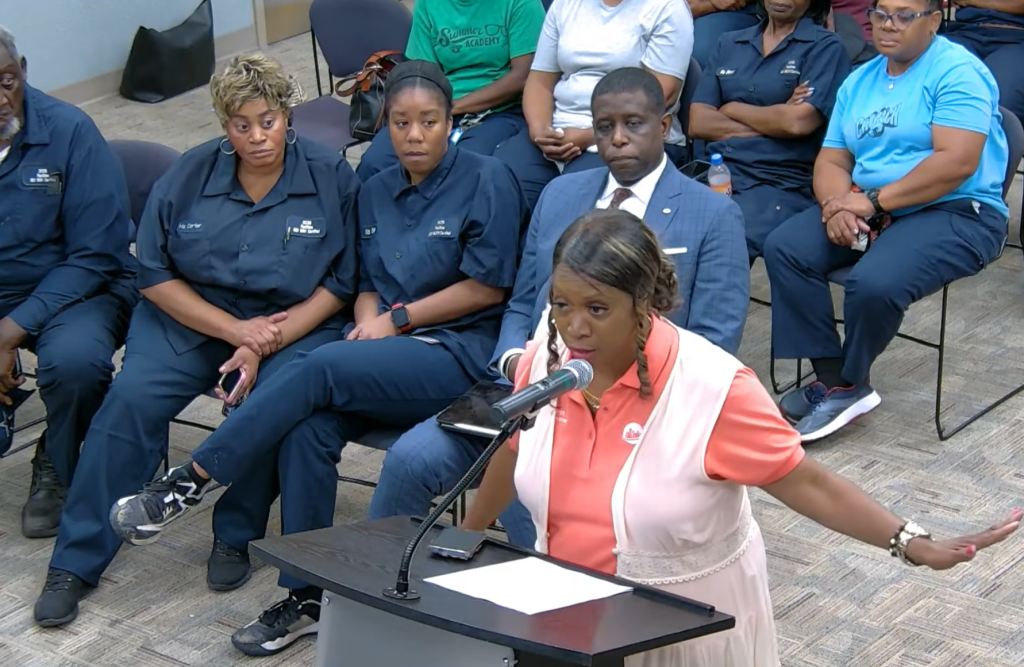
ALBANY — Dougherty County Commissioner Diana Brown delivered an impassioned defense of school custodians during last week’s Dougherty County Board of Education meeting, accusing district leaders of placing low-wage workers at risk and questioning the priorities of local government as the school system moves forward with plans to outsource custodial services.
Speaking as “a taxpayer and a citizen of Dougherty County,” Brown said she had received calls from employees concerned about the transition and argued that custodians provide “an essential service that is often overlooked.”
“These custodians go above and beyond,” Brown said. “They are the first one our children see, beside the bus driver and the cafeteria workers. They are the ones who clean our toilets, clean our walls and keep our schools sanitized.”
Brown repeatedly criticized what she described as a growing tendency among governments to outsource services, saying, “We’re too busy, we want to outsource everything we get. I’m just seeing it across the board, even in the city, in the county … outsource it.”
Her remarks carried broader undertones of economic inequality and frustration with public institutions. Brown argued that government leaders are supported by taxpayers while lower-paid workers bear the burden of difficult decisions.
“It’s heavy at the top, and we get pennies … at the bottom,” Brown said. “When are we going to stop running this city, this county, and the school system off the backs of the people?”
She also questioned the district’s priorities by contrasting the proposed transition with student literacy challenges.
“Our children out here can’t read,” Brown said. “Children can’t even read a Bible … but this body wants to cut back on and outsource these workers that come here every day, work hard while we sleep.”
Brown urged board members to reconsider the transition, warning that some employees could lose jobs, benefits or insurance coverage. However according to DCCS documents regarding the transition, these claims appear to be without merit.
The district’s plan would transition custodial services to facilities management company ABM beginning Aug. 1. According to the district, no custodian, team leader or head custodian would lose employment because of the transition, and current pay rates will remain unchanged. Employees would move from semimonthly to weekly pay and have access to medical, dental, vision and other benefit plans through ABM.
Superintendent Kenneth Dyer responded immediately following Brown’s remarks, saying some of her statements were factually inaccurate.
“First of all, no one’s on the chopping block,” Dyer said. “Our commitment … was that every employee is offered a job.”
Dyer said employees with at least five years of service will have the option to remain on the school system’s payroll or transition to ABM, while employees with fewer than five years of service would move to the contractor’s payroll. He said pay would not decrease and that employees would continue to have access to health, dental, vision and supplemental benefits.
“In no way are we putting anybody on the chopping block,” Dyer said. “In no way are we throwing away any employees.”
Dyer, who appeared visibly frustrated by the allegations, said he objected to suggestions that the district was disregarding employees.
“I’m trying to maintain my cool … because I don’t appreciate anyone suggesting that we’re throwing our employees under the bus or putting them on the chopping block indiscriminately,” he said. “We have difficult decisions to make.
“I certainly appreciate anyone who advocates on behalf of my employees. In fact, I’m arguably their biggest advocate, but I think the responsible thing to have done would have been to call to get accurate information before making a presentation.”
The transition affects approximately 150 custodial employees districtwide. Of those, 83 have at least five years of service and would be eligible to remain on the district payroll, while 68 have fewer than five years of service.
Dyer later said rising health care costs for classified employees are among the primary factors driving the recommendation.
“Healthcare currently costs the district around $23,000 per employee,” Dyer said, referring to the cost differences associated with employee benefits and describing the change as “one major cost savings.”
He said the district has realized more than $3.5 million in savings over the last decade through a shared savings health plan but that the savings have not kept pace with increasing premiums. Dyer noted that until 2012, the state funded 25% of health insurance costs for classified employees before discontinuing that contribution.
“That leaves the entire cost of this classified health insurance on the school systems, and those decisions are out of our control,” Dyer said.
According to Dyer, district leaders faced a choice between continuing to draw down reserves or making structural changes intended to preserve long-term financial stability while continuing to invest in classroom instruction.
“We can kick the can down the road and continue to draw from our reserves … or we can make the difficult decisions that are not popular, take some courage, and protect the long-term financial stability of the district,” he said.
The superintendent acknowledged that outsourcing custodial services was not the district’s preferred option.
“Certainly, it’s not our first option, and certainly not a preferred option,” he said, “but at this point we think we’ve done everything we reasonably could be expected to do to look at other options. Above all, we want our employees to know that we care about them to the point where we look at every little thing we can to enhance their lives.”
District materials presented to employees state that the transition is intended to provide increased staffing support and recruiting capacity, additional training opportunities, specialized custodial expertise and improved operational flexibility while preserving employment and pay. Individual meetings are planned with employees to review benefits, retirement options, leave payouts and scheduling concerns on a case-by-case basis.
Related Articles

United Way of Southwest Georgia halts funding for regional restructuring
The United Way of Southwest Georgia plans to withhold typical funding for a whole year during a “restructuring” period.

Federal agency to investigate Monday paragliding fatality
The death of a 63-year-old man who was killed in a paragliding accident on Monday is under investigation by the National Transportation Board, according to Dougherty County Coroner Michael Fowler.

Audit of police surveillance cameras results in arrests of five former APD officers
“The bottom line is when we find people who have misused resources that they have, we’re going to hold them accountable. These resources help fight crime, but we will not tolerate when they are misused.”
