
Complicit in a murder … of crows
As a result of daughter Morgan Carpenter’s murder, I no longer have the desire to shoot a crow. In fact, the opening of Georgia’s crow season this Saturday has left me conflicted.
Special Photos
ALBANY — As a result of daughter Morgan Carpenter’s murder, I no longer have the desire to shoot a crow. In fact, the opening of Georgia’s crow season this Saturday has left me conflicted.
It all began innocently enough a few months ago as Morgan walked from the parking lot toward her office.
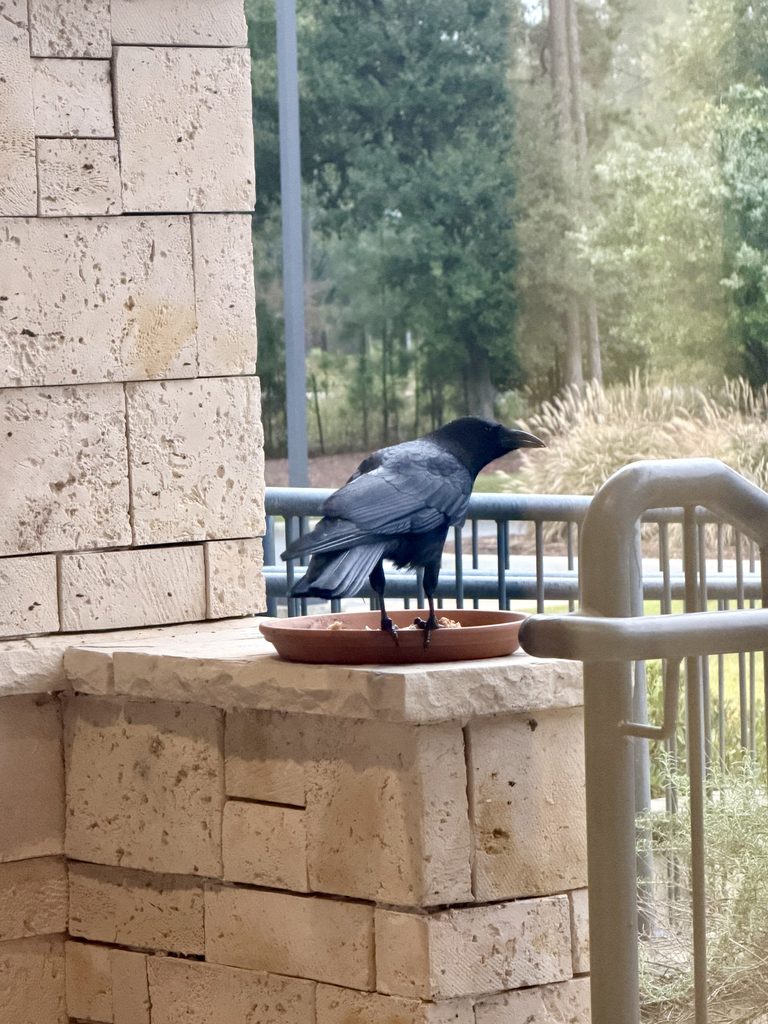
“I had noticed a couple of crows hanging around, and I always liked and admired crows,” she said. “So one day when I was getting out of the car, I noticed there was one on the light post. I whistled so he would see me as I threw a few kernels of the popcorn I was eating. After that, anytime I saw him I’d throw him a treat.
‘Suddenly, he started flying down when I pulled up into the parking lot.”
Over the following weeks, Morgan provided the treats as she got closer to her office until the crow started boldly approaching her office window.
“Now he will come to see me and sit outside my office window,” she said. “He has come up and tapped on it when I wasn’t quick enough to get out to give him his treats,
“He and his mate got bold enough to come up together. Then they started bringing their two fledglings from last year. So then there were four and now there are six.”
Her feathered menagerie quickly became what is now known as “Morgan’s Murder.” This collective noun is a non-scientific classification rooted in folklore where crows were not seen as scavengers but as agents of death who were thought to peck out the eyes of the dead in an effort to improve their own vision. Paradoxically they also symbolize rebirth, loyalty, and intelligence.
Crows are one of the most widely recognized species of birds in the United States. Both the American crow and the fish crow are native to Georgia. American crows can be found across the state in large numbers in both urban and rural environments. They are most abundant in areas with a mixture of open land, making ground feeding possible, and scattered woodlands, where they can safely nest and roost.
When it comes to safety, crows live precariously in close proximity to humans. Historical records reveal that over the centuries, they have developed a reputation as despicable predators and agricultural pests. Their reputation as a nest predator of more popular songbird species has not always endeared them to bird lovers.
This reputation, deserved or not, has led to large-scale efforts to eradicate crows.
In Georgia, crows may be legally harvested as a game animal as specified in the “Georgia Guide to Hunting & Fishing” regulations. The 2026-2027 crow season runs from Nov. 7 through Feb. 28. Surprisingly, there is no limit on crows, even though they are classified as a federally regulated migratory bird. They may also be taken outside these dates when it is determined they are doing agricultural damage.
The Migratory Bird Treaty Act was created in 1918 to provide a legal force to international treaties between the U.S., Canada, and Mexico to conserve migratory bird species. Crows breed in an area ranging from Newfoundland and Manitoba to Florida and Texas. Since crows seasonally travel great distances in their migratory routes (particularly those living in northern ranges), they were included on the list to ensure these migratory habits are not disrupted.
This international protection applies no matter how common the bird in question might be. Theoretically the MBTA protects the mourning dove, waterfowl, and the American crow equally at the federal level with penalties for violations including fines that can reach $15,000 and possible jail time.
Crows are also unique in the fact that as a game species, they are deemed to be acceptable to hunt with both small-caliber rifles and shotguns. Crows can present a challenge to the rifleman attempting to make long-range shots on feeding crows. The techniques and skill sets required for success are comparable to shooting prairie dogs at long ranges in Western states.
Decades ago, crow hunting was considered a right of passage for wing-shooters, and veteran waterfowl hunters considered hunting them as a warm-up for duck season.
“The New Hunter’s Encyclopedia,” published 50 years ago, states, “It has been proved time and time again that crows are poor mathematicians. For example, if there is a permanent blind set up in a cultivated field adjacent to a woodlot and two people head for the blind while crows are feeding in the field, the birds will, as expected, fly to the woods. But, if after the pair has entered the blind and one leaves, it is safe to bet that the crows will return to the field not long after this man’s departure.”
In the late 1980s, Bubba Pippin, a local pecan grower, hired a professional crow hunter to reduce the crow population in his orchards. It was estimated at that time that a single crow could eat up seven pounds of pecans a day. Jerry Tomlin from Milledgeville, who produced the how-to video “Eating Crow,” arrived and was tasked with training a few local hunters to assist him in the crow elimination.
Tomlin started shooting crows “attacking” his uncle’s pecan orchards at the age of 12. He provided his services as a mercenary in the war on crows and is credited with killing as many as 137 crows in a single day. To say that he took crow hunting seriously would be an understatement.
He took his charges to the orchards and directed them in the construction of blinds and decoy setup. He then explained how they would return and what number of hunters wearing full camouflage would enter the blind. He then explained that only a few of the hunters would remain while others made a grand show of leaving the blind to deceive the crows.
To his credit, in an effort to maintain a field-to-table ethos Tomlin also offered a variety of recipes for cooking crow. The crow jerky he provided as those gathered sat waiting for the crows to come into the orchard was tasty. Evidently, the crows in southwest Georgia are highly intelligent, as no shots were fired during two intense days of trying to outwit them.
Pecans aren’t the only things crows eat. They are omnivorous feeders, consuming both plant and animal matter. Their diet includes insects, invertebrates, fruits, berries, seeds, nuts, as well as small mammals, nestling birds, amphibians and eggs. They also scavenge the remains of dead animal remains in rural areas and garbage and food scraps in urban environments. Their diverse feeding habits not only support their own survival but the overall ecological welfare through scavenging and seed dispersal.
While Tomlin was concerned over the crows’ ability to count how many people were in a blind, the crows may have been more concerned over who was in the blind. The fact that no shots were fired in the two days hunted might have been due to the fact the crows actually knew Tomlin was in the blind.
We now know that crows can recognize individual people, differentiating between those who are considered to be a threat and those who have befriended them. They also appear to have the ability to teach their offspring who to trust and who to avoid as evidenced by Morgan’s growing murder.
“They definitely recognize me and my vehicle,” she noted. “I have a whistle, and if they are close enough I can whistle and sometimes they will come. They also have started recognizing co-workers. When I go out of town I leave treats for them for someone else to give. When a stranger walks up the sidewalk, they’ll sound an alarm at them. But they know the regulars.”
Crows have more than 250 vocalizations and appear to have regional dialects specific to their own communities.
“I’ve started to learn their calls and their behaviors and what they’re trying to communicate,” Morgan said. “Sometimes I’ll go a week without seeing them at all. But it’s the same ones, and they have their own routines. The first one that appeared is always the boldest and now comes up to my window.”
Another unusual crow behavior is their habit of exchanging gifts with the individuals they befriend.
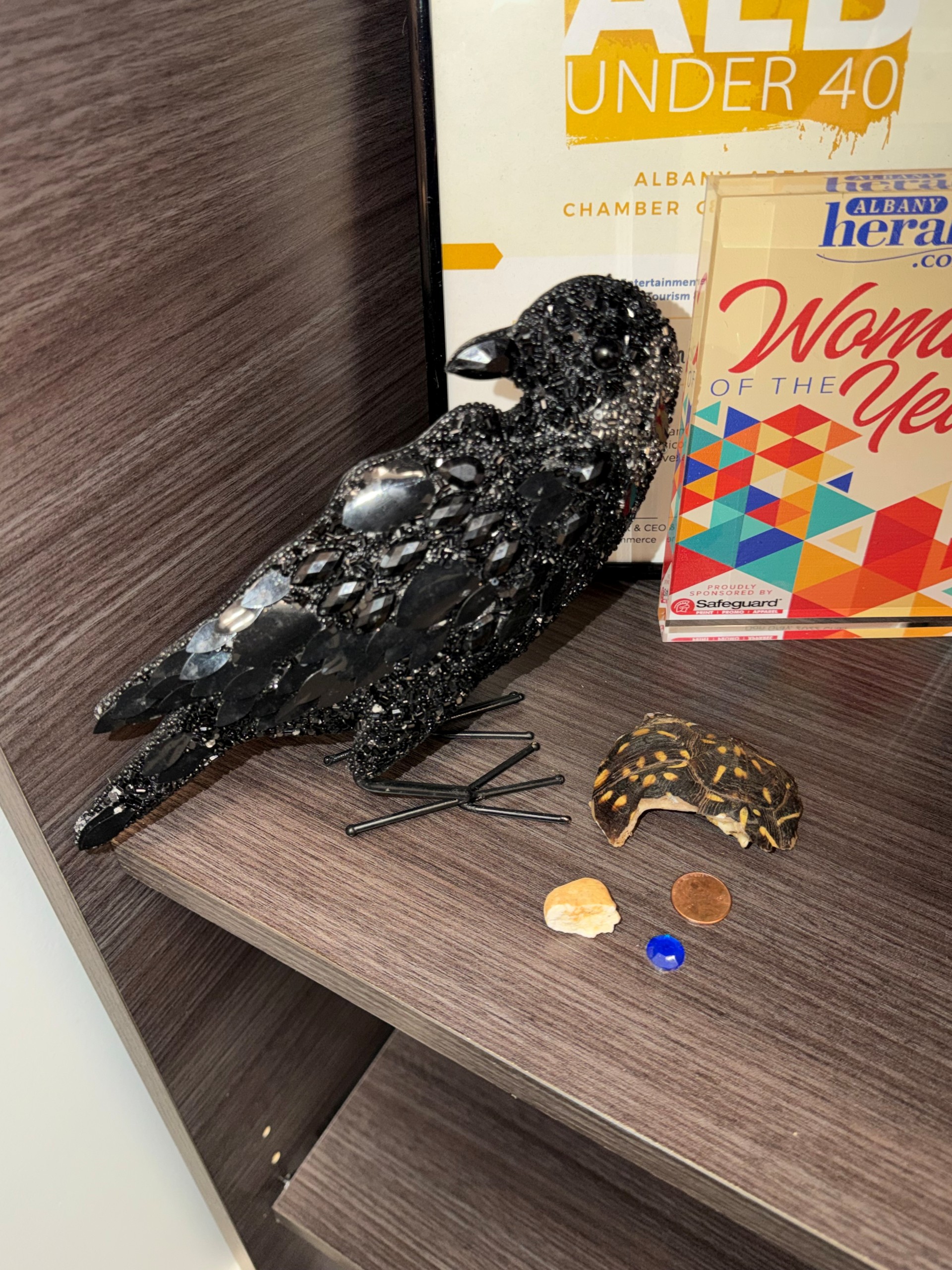
“I only feed them little treats, Morgan said. “I don’t want them to become dependent on me. I just want them to have a little treat when they see me. Cat food is a favorite treat or some leftovers. They have started bringing me little gifts. They are known to do that. I don’t know if it’s a coincidence, but I’m going to call them gifts.
“I’ve gotten a little piece of a turtle shell, a couple of interesting rocks; they brought a little rhinestone. The main one also has come up to the window and left me crop pellets before, which are disgusting. I don’t keep those. Crop pellets are the regurgitated content of their crop. I just clean those up.”
While Carpenter and others view crows as an amazing and amusing species, others still see them as annoying pests. And while the virtues of crows may be debatable, there is no denying their inquisitive and intelligent nature.
“I don’t think of them as my little murder of crows,” Carpenter said. “I’m just the crazy aunt that throws out treats. I do think the office thinks I’m the crazy crow lady. But they also think they’re cool, too.”
For those interested in attracting crows like Carpenter, it is recommended to offer unsalted nuts, meat scraps, or fruits. Avoid chocolate, avocadoes, and treats with high levels of salt, sugar or fat. Offer the food in small portions at the same time and location each day. It is also recommended to provide fresh water for drinking and bathing.

Author

Related Articles

Blue Wave! Democrats prevail in national, state, local elections
By early Wednesday morning, Georgians woke up to the new reality that their leadership had been completely flipped.

Ossoff gains re-election; Bottoms nation’s first African-American female governor; challenger leads commission race
Georgia became part of a historic blue wave that swept the nation Tuesday, returning a sitting Democratic senator to Washington and electing the nation’s first-ever African American female governor.
Voter turnout steady at several Dougherty County precincts
Dougherty County election officialsreported a malfunctrion in a ballot scanner and corrective actions taken to compy with state law. At several other precincts voters were moving through the process quickly as there were no lines at mid-morning.
