
Congress sends massive defense bill to president
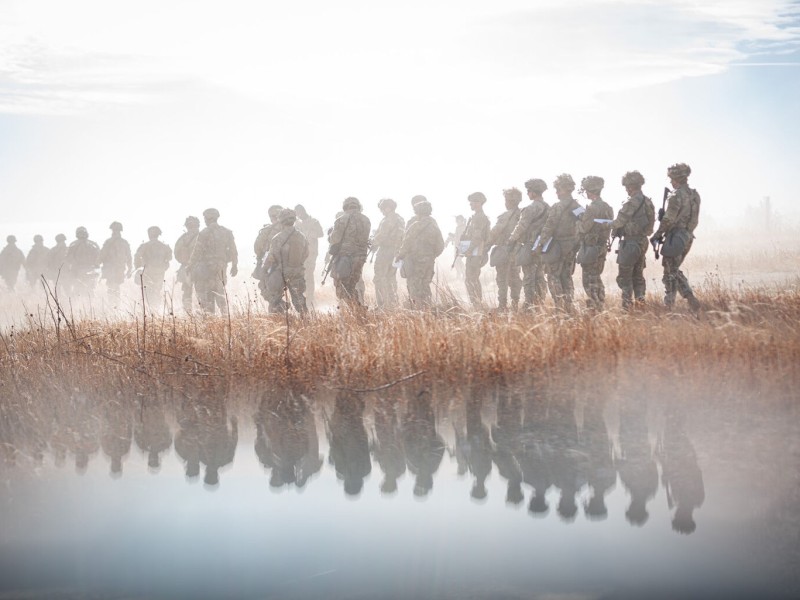
Special Photo: Spc. Jason Klaer/U.S. Army via Georgia Recorder
By Ashley Murray
Georgia Recorder
WASHINGTON — The massive annual defense policy package cleared Congress ahead of the holiday recess, despite protests about attaching a foreign surveillance extension and criticism that the bill did not block a Pentagon abortion policy.
U.S. House lawmakers approved the package 310-118, under a suspension of the chamber’s rules, meaning a two-thirds majority was required.
A bloc of the most far-right representatives voted against the legislation, as did members of the House’s most progressive wing.
If signed into law, which is expected, the roughly $884 billion legislation would authorize a 5.2% pay raise for troops, approve a nuclear submarine program for the Indo-Pacific region and carry the Foreign Intelligence Surveillance Act until mid-April.
The National Defense Authorization Act for Fiscal Year 2024 authorizes the dollar amounts that will be dedicated to continuing military and nuclear operations but does not directly provide the funds. Congress has yet to pass its annual funding bills.
Direct funding for Ukraine’s war effort is also knotted up in congressional infighting over immigration policy. The NDAA would direct $300 million to Ukraine in security assistance as well as support programs for Ukrainian troops suffering post-traumatic stress disorders and brain injuries.
House Speaker Mike Johnson of Louisiana praised the sweeping bill, saying it “will strengthen our national security against adversaries like China and Russia, and support our servicemembers by providing them with the tools necessary to continue to be the most lethal and effective fighting force in the world.”
In a nod to far-right priorities in the bill, including paring down the Pentagon’s diversity and inclusion initiatives, Johnson said, “Importantly, this legislation returns the Department of Defense’s focus back to the business of defending our nation and away from social experiments that hurt our military’s recruitment, morale and readiness.”
The U.S. Senate passed the legislation in a bipartisan 87-13 vote.
Sen. Roger Wicker, the committee’s ranking member, said the bill “should signal to China, Russia, and others that we will not accept a world where America does not have the best fighting force.”
The vote followed a failed attempt by GOP Sen. Rand Paul of Kentucky to block a controversial decision to use the defense package as a vehicle to temporarily extend FISA, which would have expired Dec. 31.
Lawmakers on both sides of the aisle oppose the surveillance law’s ability to scoop up communications by U.S. citizens while spying on foreign targets.
Several senators praised the bill for economic activity that will be brought to their states.
Sen. John Fetterman of Pennsylvania said $300 million was authorized for his state’s defense-related work force and activities.
“Pennsylvania’s military installations and defense industry continue to play a key role in supporting allies like Taiwan, Ukraine, and Israel against attacks on democracy abroad,” Fetterman, a Democrat, said.
Senate Republican Whip John Thune of South Dakota applauded the bill’s funding authorization for the B-21 bomber program, which will be located in his state at Ellsworth Air Force Base.
Senators who opposed the bill included New Jersey Democrat Cory Booker, Indiana Republican Mike Braun, Missouri Republican Josh Hawley, Utah Republican Mike Lee, Wyoming Republican Cynthia Lummis, Massachusetts Democrats Ed Markey and Elizabeth Warren, Oregon Democrats Jeff Merkley and Ron Wyden, Paul, Vermont independent Bernie Sanders, Ohio Republican J.D. Vance and Vermont Democrat Peter Welch.
Hawley vehemently opposed the legislation after his amendment to compensate those exposed to residual radioactive waste from the Manhattan Project was removed from the final bill.
Hawley’s original amendment, which passed the Senate in July to be attached to the NDAA, would have opened the compensation program for St. Louis residents and to those living in Colorado, Idaho, Guam, Montana and New Mexico, as well as expanded coverage areas in Arizona, Nevada and Utah.
While the bill followed a relatively smooth path among senators, the defense policy legislation hit opposition in the GOP-led House, where far-right lawmakers maintain their priorities were stripped from the compromise legislation.
House Freedom Caucus members accused the bill’s negotiators of secretive, non-inclusive negotiations during which their amendments to block a Department of Defense abortion policy, ban certain transgender care for troops and completely eliminate any Pentagon diversity, equity and inclusion programs were nixed.
“The Swamp’s ‘compromise’ NDAA allows the DOD to use your tax dollars to fund abortion travel for servicemembers. As a proud pro-life conservative, I’ll be voting no,” Rep. Andrew Clyde of Georgia posted after the Senate voted to advance the bill.
GOP Rep. Ralph Norman of South Carolina wrote on social media that “The backroom NDAA is a disaster for conservatives in so many ways.”
The Pentagon’s abortion policy gives time off and travel reimbursement for service members who seek abortions in states where it remains legal. The policy, instated after the U.S. Supreme Court struck down Roe v. Wade, fueled Alabama GOP Sen. Tommy Tuberville’s monthslong freeze on military promotions.
The legislation heads to President Biden’s desk. The administration had called on Congress for the bill’s “swift passage.” Congress has passed the NDAA for 63 consecutive years. The annual defense policy package typically draws bipartisan support.
Author

Related Articles
Congress weighs packaging bill with implications for Albany manufacturers
A congressional hearing this week on proposed national packaging-labeling standards could have implications for several of Southwest Georgia’s largest manufacturers, many of which produce or package products shipped across state lines.

Dougherty County Sheriff’s Office, GBI investigate inmate death
“The sheriff’s office will conduct an administrative investigation to determine if the staff response was appropriate. We have requested that the GBI conduct an investigation.”
Residents’ safety concerns defeat request to privatize Plantation Road
The Terrell County Board of Commissioners rejected a request July 7 to remove Plantation Road from the county road system after nearby residents warned that closing the roadway could leave them without emergency access when adjoining roads flood.
