
Congressman swims against environmental tide opposing right whale protection
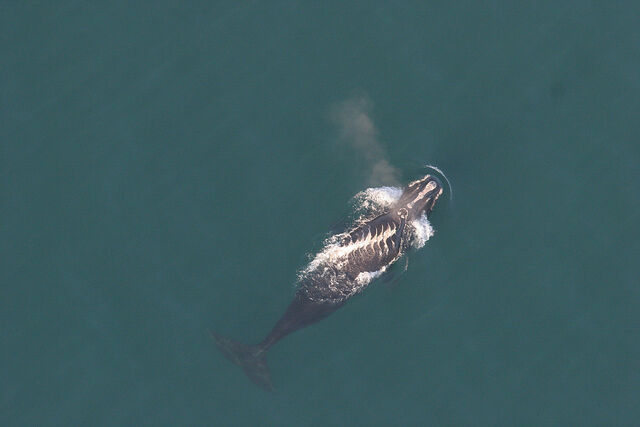
Special Photo: National Oceanic and Atmospheric Administration
By Stanley Dunlap
Georgia Recorder
ATLANTA — Commercial and recreational boating and shipping interests are rallying behind a Georgia congressman’s campaign against a federal agency’s plans to clamp down on how fast thousands of sea vessels can travel along an Atlantic coast that is home to where critically endangered right whales are struggling to survive.
The controversial proposal from the National Oceanic and Atmospheric Administration would limit watercraft between 35 and 65 feet in length to speeds no faster than 11.5 mph around the Eastern Seaboard’s shipping ports and other locations where North Atlantic right whales are at a great risk of becoming entangled in fishing nets or killed by injuries from boat propeller strikes.
Republican U.S. Rep. Buddy Carter of Pooler joined Senate counterparts in taking a pre-emptive legislative strike this month to a rule that the marine associations claim will be financially detrimental and further hinder a vessel’s ability to navigate heavily trafficked shipping ports in Savannah and Brunswick. However, a group of environmentalists says that since the 2008 enforcement of slower speed limits for vessels stretching at least 65 feet, there have been fewer deadly collisions between the larger watercraft and an endangered whale population, which scientists estimate currently sits at about 350.
The agency is accepting public comments through Oct. 31 on a draft rule that also extends speed zone restrictions in some places to up to 100 miles offshore from the coast.
Carter’s H.R. 4323 would delay federal enforcement of lower speed limits until the U.S. Department of Commerce develops technology that better tracks whales so that marine pilots can steer clear of the sea mammals. He says the proposed new speed limit regulations have the good intention of protecting right whales, but they are another example of government overreach that could endanger the safety of boaters, harbor pilots, and business owners.
“We all want to protect the right whale from extinction, but this is the wrong way to do it,” he said. “Before implementing a sweeping rule that will kneecap small businesses up and down the east coast, including 27,000 in Georgia alone, we must use all of the technological advancements at our disposal so that right whales and business owners can thrive together.”
Commercial whale hunting nearly led to the extinction of right whales in the early 1900s, but the biggest threat to right whales today comes from collisions and entanglements with fishing boats, large shipping containers, and other marine craft.
As the seasons of fall and winter arrive, the coasts of Georgia, South Carolina and northeastern Florida often become popular calving grounds for mother whales giving birth after sometimes swimming from as far away as 1,000 miles from the northeast and Canadian waters.
Georgia’s coastal protection nonprofit, One Hundred Miles, is awaiting more details about the legislation expected to come out once the full bill is published online after being reviewed by a research analyst.
Since the implementation of the 2008 rule, five of the 12 right whale boating fatalities in the U.S. involved vessels that are the same size as covered in the proposed regulations.
Since 2008, the number of right whale deaths caused by boats larger than 65 feet has declined, said Catherine Ridley, vice president of education and communications for One Hundred Miles.
Jeff Angers, president of the Center for Sportfishing Policy, questioned federal expansion of seasonal zones rather than better enforcing current regulations on massive cargo ships traveling around the ports in Savannah and Brunswick where there are discrete locations where mother whales give birth.
He said the science doesn’t back up the level of threat to whales that the federal regulatory agency is using to justify its plans.
“Bicycles are made to travel at that speed, but recreational boats are not made to travel in the open Atlantic Ocean at those kinds of speeds,” Angers said. “When you’re going that slow in the ocean, with your family in the boat, it can be dangerous because of the volatility of the waves in the ocean.”
Author

Related Articles

Albany City Commission set to vote on skate park funding
“There have been other sites discussed. Based on information (from) the community, we decided on the current site. That’s the only site we’re looking at right now.”

Following Lee’s lead, Terrell County hits pause on data centers
The Terrell County Board of Commissioners voted unanimously Tuesday to adopt a six-month moratorium on new data centers, giving county officials time to develop zoning regulations governing where such facilities could be located and how they would operate.

Food, mini menagerie provide inspiration for Mitchell County’s Lydia Griffin
“I would like to open, like, a Caribbean/tropical buffet where everybody can eat anything and everything. If I can’t do that, I would start small with a coffee shop (and) deli and keep going.”
