
ConnectHome-Albany aims to provide Internet access to the city’s HUD housing
Program will allow DCSS students to access the Internet
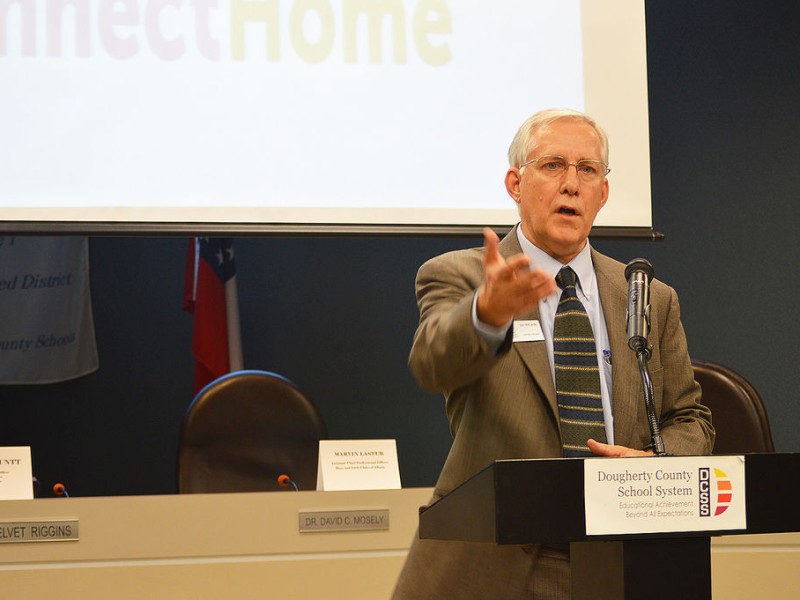
Terry Lewis
ALBANY — Most people are familiar with the “income gap” between America’s wealthy and the poor. There is also a technology gap known as the “digital divide.” Thursday afternoon, the City of Albany, the Dougherty County School System (DCSS) and the Albany Housing Authority (AHA) took a step toward closing that gap.
The trio is launching locally a pilot project designed to bring Internet access to families in HUD-assisted housing that is part of a national effort called ConnectHome-Albany.
The collaborative aims to narrow the digital divide by addressing various barriers to broadband access, including the costs associated with high-speed service and electronic devices, and the need to provide residents with training in digital literacy. Albany is one of 28 cities nationwide and one of three in Georgia to be selected by HUD for the Pilot Project.
“This is truly a public-private sector endeavor HUD Southeast Deputy Regional Administrator Willie C. Taylor,” said. “It shows the collaborative spirit of your great city. If we can connect 1,200 units with broadband access this project has the opportunity to be very impactful on the city.
“Students need access to the Internet at home. Too many students go home unplugged and this is part of President Obama’s effort to provide high-speed Internet access to all Americans.”
At the moment the problem is the project remains unfunded. “There is no federal funding for the project,” AHA Executive Director Dan McCarthy said.
The ConnectHome-Albany Initiative comes at the right time for the DCSS and the city as it dovetails nicely with the DCSS’s 1-to-1 Technology Initiative. The 1-to-1 program will place more than 15,000 computer tables and laptops into the hands of every student in in the school system before the end of the current school year.
The computers will be taken home by the students, but the devices will be less effective if the home does not have Internet connectivity.
DCSS Finance Director Ken Dyer said the district could use E-rate and SPLOST (Special Purpose Local Option Sales Tax) money to help fund the project if the system can strike a deal with the city to keep costs down. The Federally-funded E-rate program, makes telecommunications and information services more affordable in low income areas.
The city is also looking to aggressively expand its fiber optic network.
“We are open for business and want to expand to every street in Albany,” Albany Chief Technology Officer Jason Gauntt said. “The 15,000 computers the school system is rolling out will require a robust infrastructure. We have recently entered into a 25-year intra-governmental agreement with the school system that saves the DCSS money and locks money in for the city. We can expand that agreement.
“We need to find an innovative way to make it happen because we don’t want to leave any of our children behind.”
Related Articles

Dawson police arrest wanted suspect after Flock Safety camera alert
According to police, May drove into the yard of a nearby residence instead of complying with officers’ commands. He then exited the vehicle and ran into the home on foot.
Lee County stands alone without E-SPLOST. Here’s what that means for schools, taxpayers and the county’s future
Following the defeat of its referendum, Lee County became just the second of Georgia’s 159 counties without voter approval for an active ESPLOST, leaving the school system without the state’s primary local funding source for major construction, renovations, school buses and other capital improvements.
Chamber celebrates new businesses, invites community to Coffee and Connections event
The Terrell County Chamber of Commerce is continuing its efforts to strengthen local business relationships through community celebrations and networking opportunities, recently recognizing two new businesses with ribbon-cutting ceremonies and announcing its next “Coffee & Connections” event in Sasser.
