
Darrisaw gives overview of court system
Jennifer Maddox Parks
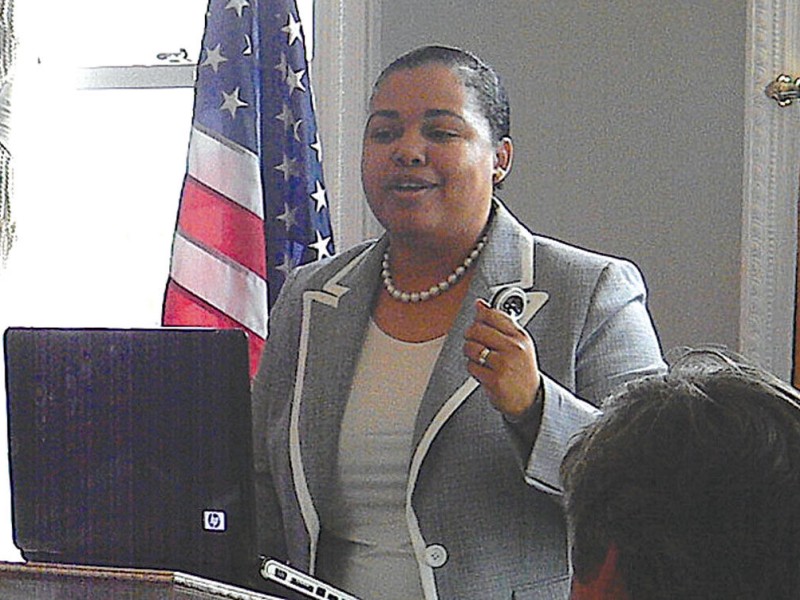
ALBANY, Ga. — Victoria Darrisaw took time off from the campaign trail to educate an Albany civic club on how the court system operates.
Darrisaw, Dougherty County’s Magistrate Judge who is currently running against Albany attorney Christopher Warren for State Court judge to replace outgoing Judge John Salter, said that such a presentation was inspired by the door-to-door visits she has made during her campaign.
“The No. 2 question I get is: ‘What does a magistrate judge or State Court judge do?’ ” she said.
Before the Albany Downtown Sertoma Club, she broke the court system down by the individual courts: Municipal Court, Juvenile Court, Probate Court, Magistrate Court, State Court, Superior Court and discussed the roles of the Georgia Court of Appeals and the Georgia Supreme Court.
A Municipal judge oversees misdemeanor cases, having jurisdiction over city ordinance violations and traffic offenses, she said.
Juvenile Court handles matters involving people under the age of 17, including juveniles who commit traffic offenses. In regards to parental rights and child custody issues, Juvenile Court has the same jurisdiction as Superior Court, Darrisaw explained.
Probate Court often maintains birth and death certificates, deals with matters pertaining to wills and estates, and issues marriage and firearm licenses.
Under Georgia law, the court provides a large scope of services to the public.
“(The Probate Court serves people) from the very beginning of life to the very end of life,” Darrisaw explained.
A Magistrate Court judge oversees misdemeanor criminal offenses and has civil jurisdiction on cases up to $15,000. These cases could potentially include bad check or rental payment disputes, Darrisaw said.
“It is the court of first resort for civil disputes,” she said.
Magistrate judges are appointed by State Court judges. They are also responsible for issuing search and arrest warrants and for overseeing first-appearance hearings.
“We are a small-claims court. We mostly deal with people,” the current magistrate said.
A State Court judge can correct errors of a lower court and has jurisdiction over misdemeanors and civil cases with an unlimited dollar cap, excluding divorce, titles to land and equity, which are matters exclusively handled by the Superior Court.
“It could be a $1 million case (for civil matters),” Darrisaw said. “It doesn’t matter.”
Superior Court is the highest level trial court. It handles felony cases, equity cases and divorce cases, she said.
Darrisaw also included a brief description of the Georgia Court of Appeals, the intermediate appellate court in Georgia, as well as the highest court in the state — the Georgia Supreme Court.
“(The Georgia Court of Appeals) is the court of first review,” Darrisaw said. “There are 12 judges, and cases are assigned to three-judge panels.
“The Georgia Supreme Court is the court of last resort. They deal with divorce cases, death penalty cases, the constitutionality of laws and wills.”
At the end of the meeting, someone asked her the No. 1 question she gets on the campaign trail, to which she replied, “Are you a Jehovah’s Witness?”
Related Articles

Albany Herald – June 27, 2026
Phoebe welcomes family medicine… Dougherty sherrif’s summer camp celebrates… For Community Care Department head Debra Wiley…

Special Sections – June 27, 2026
Interesting facts related to Independence Day,,, Fire up true American flavor on the grill… The nicknames of all 50 states… 9 facts about the Declaration of Independence…

Classifieds – June 27, 2026
Full Time Job: Women’s Recovery & Substance Use Services Director… Real Estate for Sale: 230 Frost St…
