
Daughter of slain civil rights leader brings story to Albany Civil Rights Institute
“So that morning, I felt his presence over my bed and I looked up and said ‘Daddy, daddy, why do all white people hate us?’ He realized he was talking to an 8-year-old. He realized there was to be an impact, and his statement was ‘Sunshine, there’s good and bad in every race. Always look for the good.’”
Staff Photo: Alan Mauldin
ALBANY – Reena Evers-Everett told a crowd at the Albany Civil Rights Institute Wednesday that she remembers her father’s assassination in June 1963 as if it were yesterday.
The daughter of civil rights icon Medgar Evers has not let that experience make her bitter or hateful. Instead she uses her experience to spread a message of unity.
“He embraced life,” Evers-Everett said of her father. “(He asked) ‘How can I help you? How can I help you achieve what you want to achieve? How can I make you feel better?’ We have to get to the point of asking ‘How can I help?’
“I’m trying not to look at that terrible night over and over and look at it as a total negative.”
Evers, then 37, was a field secretary for the NAACP when he was gunned down on June 12, 1963, in the driveway of his home in Jackson, Miss. At the time, he was working to end segregation and register black voters in the state.
Prior to that, the family’s home, which is now the site of the Medgar and Myrlie Evers Home National Monument, had been firebombed during the night when the family patriarch was out of town working.
“So that morning, I felt his presence over my bed and I looked up and said, ‘Daddy, daddy, why do all white people hate us?’” Evers-Everett said. “He realized he was talking to an 8-year-old. He realized there was to be an impact, and his statement was, ‘Sunshine, there’s good and bad in every race. Always look for the good.’”
On Wednesday, Evers-Everett shared her story during a Black History Month appearance at the Civil Rights Institute.
“This is the 100th year of the celebration of black history,” she said. “Black history is all of our history. Over the years, I’ve talked about how important it is not to be racist. We are now again in the fight of (the) erasure of black history.”
Examples of this erasure include the removal of informative panels honoring black soldiers from the Netherlands American Cemetery that detailed the segregation and discrimination that those soldiers faced during World War II.
Evers was part of the Normandy Landings in June 1944 in Europe, and his experience of the treatment of black military personnel reportedly inspired his work in the U.S. Civil Rights Movement upon his return to Mississippi.
Most recently, the Trump administration in January ordered the removal of the slavery exhibit at the Independence Mall in Philadelphia.
“We have to make sure that in this building we collect all of our history, we collect the truth of our history so that that (young) generation I just spoke about will be aware,” Evers-Everett said.
While many people are familiar with the Albany Movement that was launched in the early 1960s to demand rights for African-Americans, the history stretches back much further, she said.
“Our roots are critical,” Evers-Everett said. “In the world, my parents are frozen … documentaries, some sound bites, speeches … but to me it’s the (story) of their love. It’s the knowledge, it’s the security knowing they will always be with me no matter where I go.”
Myrlie Evers is now 92 and worked tirelessly to bring about the prosecution of her husband’s murderer, Evers-Everett said.
Two all-white juries were unable to deliver a verdict during separate trials in Mississippi in 1964, but in 1994 Byron De La Beckwith Jr. was tried again and convicted on a murder count.
“She promised my father, ‘I will never let your name die,’” Evers-Everett said. “She said that your father was not a victim but a mentor. In my family, the women are the ones that often keep the narrative together. (She had) tenacity after 31 years of making sure his assassin came in and was ultimately found guilty.”
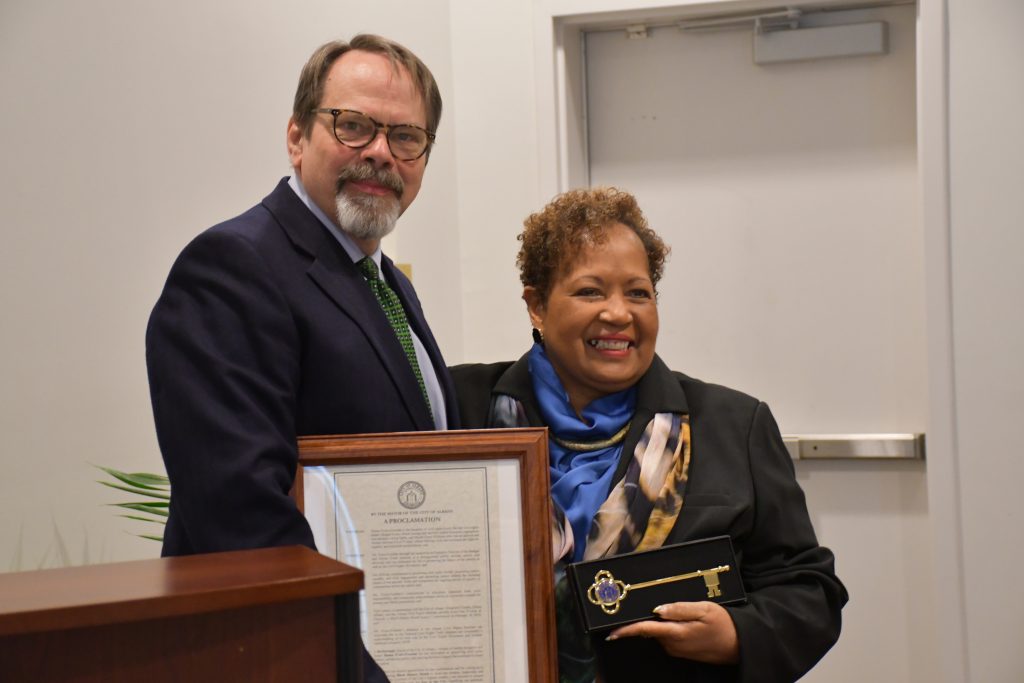
During Wednesday’s program, Albany Mayor Bo Dorough presented a proclamation and key to the city to Evers-Everett.
During an interview with The Albany Herald after her remarks, she said that her father was willing to risk his life because he was called to the work.
“It was put on him from an early age,” she said. “What really changed him was the hanging of one of the family’s best friends, Willie Tingle. He (Tingle) was dragged down the street and they hanged him, and they took his bloody clothes off and hung them up on a fence.
“His father, James, was never one to back down. He told his children to always get respect and give it.”
Speaking to a reporter about the Albany Movement, she said that the impact of that organization should be better known.
“The Albany Movement is something that is amazing and should be brought to the light of the world,” Evers-Everett said.
Author

Related Articles
Albany Herald – July 18, 2026
Georgia Trust for Local News partners with… Adult leadership group spreads concept to… Lee County homeowners have until Aug. 1 to claim…

Classifieds – July 18, 2026
Classifieds; Legals;

Albany police make arrests in murder, robbery cases
Officials with the Albany Police Department have announced a number of arrests in cases that involved a homicide and a pair of thefts.
