
Dawson City Council uninformed as state freezes sewer loans, audits remain incomplete
With three overdue audits, no Mauldin & Jenkins briefing on Thursday’s agenda and funding deadlines approaching, the larger question is increasingly urgent: How will Dawson pay to finish the work, and what will further delay mean for the future reliability of the city’s water and wastewater systems?
The state froze Dawson’s sewer loans, but the city council has not been officially told. State records also reveal a second “Drinking Water” project the city has not publicly discussed in more than seven months.

DAWSON — Neither of the two state loans helping to pay for this city’s $10.2 million sewer overhaul has covered any construction at the wastewater treatment plant, the state lending agency told The Albany Herald last week — an account that does not explain a $109,886 charge city officials told the City Council in August would be paid with loan money.
Both loans have been frozen since at least mid-August because Dawson has not completed its annual audits. The City Council has not been told that in any public meeting record The Albany Herald/Dawson News has reviewed.
The council meets Thursday, preceded by a 5:30 p.m. work session. On the agenda is a consent order update, an ordinance adopting a budget for a fiscal year that began Sept. 1 and a second ordinance authorizing spending past the end of the year that ended Aug. 31. Georgia law requires local governments to adopt a balanced budget before the fiscal year begins.
State records released to The Herald also refer to a second Dawson water project — a “Drinking Water” project separate from the sewer work — that appears in no city record The Herald has obtained and has not been described to the council or the public since at least February.
What the lender says it paid for
The Georgia Environmental Finance Authority, which holds both loans, said in written answers Sept. 3 that the larger of the two, tied to the treatment plant, “has only drawn engineering funds.” It said the second loan pays a different contractor for sewer line work and “is not co-funded with any other funding source.”
Between them, the two statements account for no payment to Southern Champion Construction, the Savannah firm rebuilding the plant under a $7.54 million contract. At an Aug. 13 work session, the council was told a change order adding two floating aerators at the plant “will be funded through GEFA in the amount of $109,886.” The change order is not on Thursday’s agenda.
GEFA has disbursed $765,111.14 on the plant loan since August 2022 across seven requisitions, all of it engineering. On the sewer loan, it has disbursed $1,214,300.79 across four requisitions covering eight pay applications from K-Dug Corp., the Patterson company doing the sewer line work under a contract bid at $1,239,018.51.
A fifth sewer requisition, for $319,930, has been submitted but not paid. Counting it, the city has asked for $1,534,230.79 against a contract of about $1.24 million — roughly $295,000 more than the contract’s bid value. GEFA has not said whether that contract has been increased.
Because the loans have not paid for plant construction, that work has been financed by the $5.82 million federal grant administered by the Governor’s Office of Planning and Budget. All grant money must be spent by Oct. 31. At least $1.96 million of it has not yet been requested.
Two days
Correspondence GEFA released to The Herald places the Aug. 13 council statement inside a two-week exchange about frozen money.
On Aug. 11, GEFA Director of Financial Services Jammie Harden emailed the city’s finance officer, copying City Administrator and Clerk Roxie Powell: “Would you or Roxie please give me a call regarding the city’s pending GEFA draw requests? We wanted to verify some information before attempting to disburse funds.”
The council was told about the aerator funding two days later.
On Aug. 17, Powell wrote to GEFA: “I understand that the city is currently not in compliance with the applicable audit requirements and that GEFA funding has been suspended as a result.” She asked what steps the city could take in the meantime to keep money flowing, writing that the matter was urgent because the treatment plant “is currently operating under a Consent Order.”
On Aug. 20, GEFA Senior Compliance Auditor Charlette Brown Helvy answered that the agency could not release additional funds “until the outstanding audits are finalized and compliance is formally established.” She wrote that “federal regulations strictly prohibit the disbursement of federal funds to borrowers who are not compliant with required financial statement audits.”
Harden’s message asked for a phone call and did not state that funds were suspended. It was addressed to Dawn Williford, recently resigned finance director and to Powell. Two GEFA requisitions totaling $369,338.11 remain submitted and unpaid.
What the council has been told
A consent order update has been a standing item on council agendas, including Thursday’s. The updates describe construction progress. The one delivered Aug. 13 read, in full: “Consent Order — Clarifiers are rebuilt and the plant is back online. Contractors are now reconstructing the influent pump station. Work is about 1/3 complete.”
The November 2024 consent order with the Georgia Environmental Protection Division set two deadlines: sewer line repairs by Dec. 31, 2025, and treatment plant work by March 31, 2026. Both passed with the work unfinished. Neither date appears in the update delivered Aug. 13, or in any other council record The Herald has obtained.
The Herald has recorded every Dawson City Council meeting since March. A review of those recordings, covering every meeting from March through August, found no mention of either deadline, of the loan freeze, or any official documentation of the audit noncompliance that caused it.
Those recordings are, in large part, the only publicly accessible record of the council’s proceedings. The city does not routinely publish council agendas, minutes or meeting packets online before meetings, although it provided The Herald with agendas for its August and September work sessions and regular council meetings in advance.
Georgia’s Open Meetings Act requires a local government to make its agenda available on request, to write a summary of the subjects acted on and the members present within two business days of a meeting, and to open its minutes to public inspection no later than immediately after the next regular meeting.
A resident who wanted to know what the council has been told about the sewer project, the consent order or the frozen loans would have no practical way to find out without the city’s cooperation.
The city’s own Financial Status Update, presented to the mayor and council at the same Aug. 13 meeting, runs six pages and covers cash flow, revenue collections, a tax anticipation note, the budget approach and an “Audit Status Update.” It does not mention that the state had suspended the city’s loan disbursements over the audits.
That report told council the city had drawn $350,000 against a $400,000 tax anticipation note “to address immediate accounts payable obligations and improve vendor payment timelines,” leaving $50,000 available. It also said a representative of Mauldin & Jenkins, the CPA firm engaged on the outstanding audits, “is scheduled to attend the next regularly scheduled council meeting” to brief the mayor, council and citizens on audit progress.
That meeting is Thursday. However Mauldin & Jenkins are not on the agenda.
A second water project
On Aug. 19, Powell asked GEFA what steps were available “to allow the city to maintain funding for its current Drinking Water and Clean Water projects while the audits are being finalized.”
GEFA’s compliance auditor used the same phrase in reply, writing that the agency was “unable to release additional funds for the Drinking Water and Clean Water projects until the outstanding audits are finalized.”
Clean Water refers to the two loans financing the sewer project. Drinking Water is a separate state program, the Drinking Water State Revolving Fund, which lends to cities for water supply and treatment. GEFA named that fund in its written answers to The Herald when describing federal requirements that apply to its lending.
The Herald has found no reference to a Dawson drinking water project in any city budget document, council agenda, council packet or set of minutes it has obtained, and no such agreement appears in the records GEFA has produced. The Herald has asked the city to identify any such project and to list every agreement it holds with Dawson.
If a drinking water loan exists, the city’s obligations to the state are larger than the $10.2 million committed to the sewer project, and the money is subject to the same freeze.
What is checked, and by whom
Asked whether it compares the invoices behind a loan requisition against the payment requests the city files with the governor’s budget office for the same project, GEFA said its review “is limited to determining whether costs submitted for reimbursement are eligible under the applicable GEFA funding program and are supported by the required documentation.”
Asked what prevents the same contractor invoice from being reimbursed twice, once from a loan and once from the grant, the authority said: “Loan recipients are responsible for maintaining appropriate financial management systems and internal controls to ensure that project costs are properly allocated.”
Both funders pay the city, not the contractors. Dawson has not completed an outside audit since Fiscal 2022, and it declined The Herald’s request for the vendor payment records that would show which fund each check was drawn on.
Nothing in the records obtained by The Herald shows that the same expense was paid twice. The amounts in GEFA’s disbursement logs do not match the invoices in the grant file, and the available records do not provide enough detail to trace every payment across both funding sources.
The audits
Dawson’s outside audits for Fiscal Years 2023, 2024 and 2025 remain outstanding. The city is listed as noncompliant by the Georgia Department of Audits and Accounts, a delay City Manager Roxie Powell attributed to “significant turnover within the Finance Department, as well as a financial system conversion during Fiscal Year 2023.”
It is not the first time the city has committed to correcting the problems.
In a 2024 compliance report prepared for the state’s grant office, Dawson said its Fiscal 2023 and 2024 audits would be submitted by October 2025 and its Fiscal 2025 audit would be completed by November 2025. The city also said it would adopt comprehensive financial-management policies by May 8, 2025, and have a chief financial officer in place by May 5, 2025. The city manager was identified as the official responsible for ensuring those steps were completed.
Ten months after the last of those deadlines passed, the audits are still being scoped, and Powell has again offered to “develop and implement formal financial policies and procedures.”
When The Herald asked whether Dawson had submitted a corrective-action plan, GEFA produced the August correspondence in which the city asked the agency for guidance on what such a plan should include.
Thursday’s agenda still includes a Finance Department report. The space identifying the finance director, however, is blank.
What is left
The grant deadline is seven weeks away. Both loans remain frozen. The plant loan’s draw period expired in June 2023, and its proposed extension hinges on audits the city has not completed. The sewer loan expires in January. Meanwhile, the city’s latest quarterly report to the U.S. Treasury lists the project as less than halfway complete.
The council will take up the city budget Thursday.
The central questions remain unanswered: which loan was supposed to fund the $109,886 aerator change order; what city officials knew about the frozen draw requests when they presented it to council Aug. 13; whether Dawson has an undisclosed drinking water agreement with GEFA, and why missed consent-order deadlines were not reported publicly.
With three overdue audits, no Mauldin & Jenkins briefing on Thursday’s agenda and funding deadlines approaching, the larger question is increasingly urgent: How will Dawson pay to finish the work, and what will further delay mean for the future reliability of the city’s water and wastewater systems?
Related Articles

Beyond the bushel: Value-added products give southwest Georgia growers a second paycheck
Across the exhibit halls at Spence Field, farmers and small manufacturers showed how they turn raw crops into finished products. They bottle sauces, box gifts, print shirts, and they find new income and new customers along the way.
Small fish make big business for Southern farmers
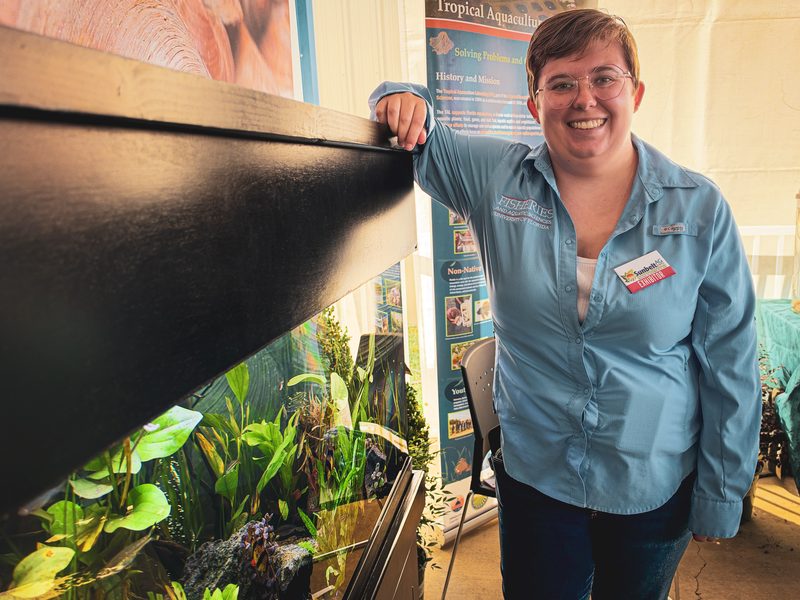
The fish in a University of Florida display at the annual Sunbelt Ag Expo this week were more than technicolor aquarium pets. They are farm products, representing a multimillion-dollar industry that depends on breeding, feeding and keeping some very small livestock alive.

Pelham farmers turn hardship into a regenerative mission
When serious health problems disrupted April Workman’s career, she and her husband, James, began reconsidering how they earned a living, raised their family and cared for their farm.
