
Dublin 4-H Center recognized on National Register of Historic Places
Special Photo: UGA/CAES
By Josie Smith
University of Georgia
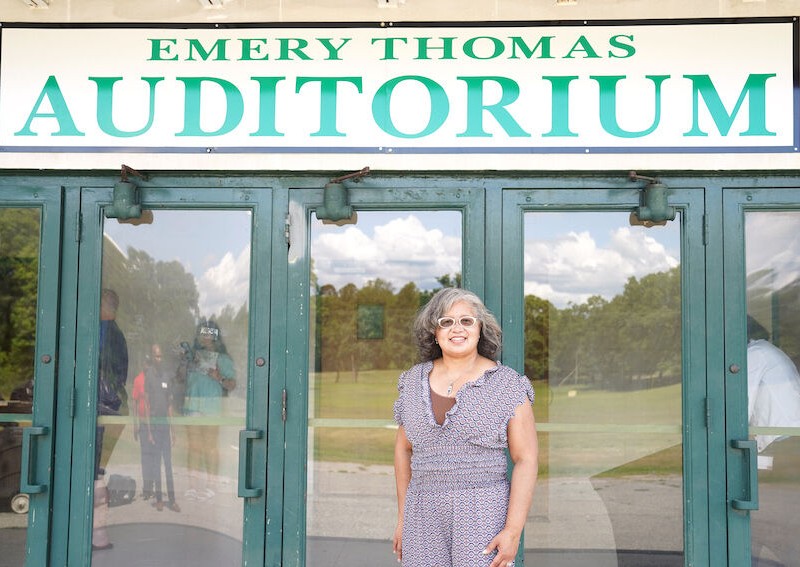
DUBLIN — Georgia 4-H recognized the historical significance of the Dublin 4-H Center on May 14 with a program at the Emery Thomas Auditorium, which was recently named to the National Register of Historic Places by the National Park Service.
The Dublin 4-H Center opened in 1957 and became the first state center for black 4-H Club members in the United States. Thanks to the dedication of Percy Hunter Stone and other black Cooperative Extension agents, the center served black 4-Hers and their families until it closed in 1968.
The event honored the contributions of Stone and other leaders who worked toward representation and equality for black 4-Hers during segregation. Stone was born in Franklin County, Va., in 1893 and later received his college degree at Hampton Institute in Virginia. He began his career as a county extension agent in Clarke County in 1919 and then moved to Savannah in 1923 to become Georgia’s first Negro State 4-H Club leader.
In 1939, Stone assisted with the acquisition of property in Laurens County to begin construction of the Dublin 4-H Center. World War II slowed the construction of the new facility for black 4-H members, but Stone continued his efforts, and by 1954 there were 50,000 black 4-H members in Georgia.
Stone retired from extension in 1956 and moved to Washington, D.C., to serve in the Federal Extension Service of the U.S. Department of Agriculture. He returned to Georgia in 1957 for the dedication of the Dublin 4-H Center. In April, Stone was announced as an inductee to the National 4-H Hall of Fame.
The Emery Thomas Auditorium is the only building that remains at the Dublin 4-H Center. Emery Thomas served as the Laurens County Extension agent and was the first black alderman to serve on Dublin’s city council. His granddaughter, Tonya Thomas Berry, attended the May 14 event.
“I was so thrilled to be a part of this special recognition,” Berry said following the program.
“As a young 4-Her growing up in Georgia, coming here to camp was truly the highlight of my summer,” UGA Extension Agent Dorothy Graves said during her remarks. “Not only did the 4-H motto instill in me the (idea) ‘to make the best better,’ it also extended the rights to help me live out that motto.”
Graves commented that 4-H helps young people become citizens who contribute to their communities, just as Stone did during his tenure as a 4-H leader.
Fred Harrison, retired director of extension and dean emeritus for Fort Valley State University, discussed the importance of including the history of Dublin 4-H Center in the story of Georgia 4-H.
“It was only 65 years ago that this camp was dedicated,” Harrison recalled. “The 4-H program in Georgia was segregated, we had two separate camps. … The reason we can confidently say today that the extension programs in Georgia are combined is because people like Percy Hunter Stone worked hard and did not quit.”
Harrison also acknowledged the progress that has been made since.
“There is much work to be done, but Georgia has led the way, and Georgia has a story to tell,” he said in his closing comments.
The history of Dublin 4-H Center will be commemorated with permanent signage installed at the entrance to the Emery Thomas Auditorium. Replicas of the displays have been installed in Sutton Hall at Rock Eagle 4-H Center in Eatonton.
“We are committed to making sure this history is remembered,” Arch Smith, Georgia’s 4-H state leader and director, said. “The 4-Hers of tomorrow will have the opportunity to learn about the work that was done by those who came before them.”
The National Register of Historic Places is the official list of the nation’s historic places deemed worthy of preservation. Authorized by the National Historic Preservation Act of 1966, the National Park Service’s National Register of Historic Places is part of a national program to coordinate and support public and private efforts to identify, evaluate and protect America’s historic and archeological resources.
For more information about Georgia 4-H, contact a UGA Extension office or visit www.georgia4h.org.
Author

Related Articles

Terrell County invites community to celebrate Independence Day with July Fest
Families from across Southwest Georgia are invited to gather in Dawson on July 4 for an afternoon of food, fellowship and fireworks as the Terrell County Recreation Department hosts its annual July Fest celebration.
DOT says delay in Oglethorpe Bridge opening should be brief
“We know it’s not going to be July 22. We don’t think it’s going to be much later than that.”

City of Albany has big July 4 celebration planned for Saturday
“It’s going to be a lot of moving and shooting them off in a short time. It’s going to be a big show.”
