
Education, loss of population among biggest drags on Albany area economy
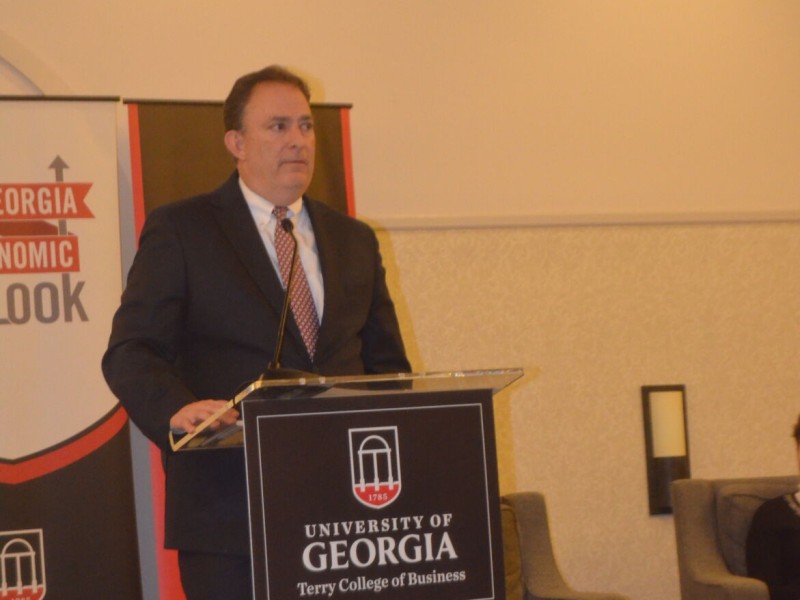
Staff Photo: Alan Mauldin
By Alan Mauldin
[email protected]
ALBANY — The state of the economy is looking up, but the Albany area likely will lag the rest of the state and nation as a whole in recovering jobs lost during the “COVID recession.”
That was the assessment by two experts from the University of Georgia’s Terry College of Business. The state’s premier economic forecasting series, canceled in 2021 due to COVID, made a stop in Albany on Wednesday for a luncheon at the Hilton Garden Inn.
Albany’s economy, which is more heavily dependent on the government and health care sectors, did not take as much of a dive as some other Georgia cities, but it lacks the wider industrial base to mount a quick recovery.
The Albany Metropolitan Statistical Area, which includes Baker, Dougherty, Lee, Terrell and Worth counties, is expected to recover more than 600 jobs in 2022.
“It will take Albany about a year or two to fully recover, (by) 2023, 2024,” Alexandra Hill, an analyst with the Selig Center for Economic Growth at the University of Georgia, said at the summit.
The region faces some negatives, including declining population and education levels lower than the state average.
Since 2010 the MSA as a whole has experienced a 5.6 percent population drop, with the largest decrease coming in Baker County, which lost 14 percent of its population. The bright spot was Lee County, where the population grew by 6.9 percent during that period, Hill said.
While the Dougherty County School System has done a good job in boosting high school graduation rates, which has exceeded the state average, the number of residents with bachelor’s degrees is one in five, compared to one in three for the rest of the country.
That reality creates a “job mismatch” in that for every job opening that doesn’t require a high school diploma there are two applicants, while there is only one person with a bachelor’s degree available for every two jobs for which that degree is a requirement.
The improved graduation rate also hasn’t caught up as there are still less high school graduates in Albany when compared to the rest of the state and nation.
It was not all doom and gloom for the region, however. The area has a low cost of living and cost of doing business, has a strong health care center that is the largest employer, and is a transportation hub. The housing sector also has finally recovered from the Great Recession of 2009.
The state and nation are looking at expansion for the year driven by the unleashing of pent up consumer spending, business investment, along with housing, Ben Ayers, dean of the Terry College of Business, said. The state’s gross domestic product is expected to grow at a 4.3 percent rate for the year, compared to a historical level of 2.3 percent.
Again, Albany may lag, but it also is expected to experience growth.
Some of the headwinds will include a shortage of workers and supply chain issues, Ayers said. While economic growth in 2022 is not anticipated to match the 5.8 percent rate last year, it will be broader.
“The good news is there will be job growth across all sectors, again more steady growth than in 2021,” Ayers said. “Despite the shortage of workers and supply, we have made great strides in returning to normal.
“In mid-’20, we were at about 60 percent of what we consider normal. We expect Georgia’s economy will be back to fully normal this year.”
Author

Related Articles

Albany/Dougherty County among local governments looking at data centers
“Our understanding is that data center developments look like an easy fix for the problems that face rural America, but this is a Faustian deal at best. You can see the effects in communities across the state and country.
Albany Herald – July 14, 2026
In Lee County, they saw it… Bigger budget will mean improvements at… Small actions can help save…

Classifieds – July 14, 2026
Albany Classifieds and Legals…
