
‘Final nail in the coffin’: New invasive cotton jassid bug spreads across Georgia
The cotton jassid, first reported in Georgia in July, poses a new threat to an already rocky cotton industry.

ALBANY – Jordan Cary bends to a cotton plant in a Dougherty County field, turning over its leaf and pointing out the curled edges.
“That cupping means they’re here somewhere,” he said.
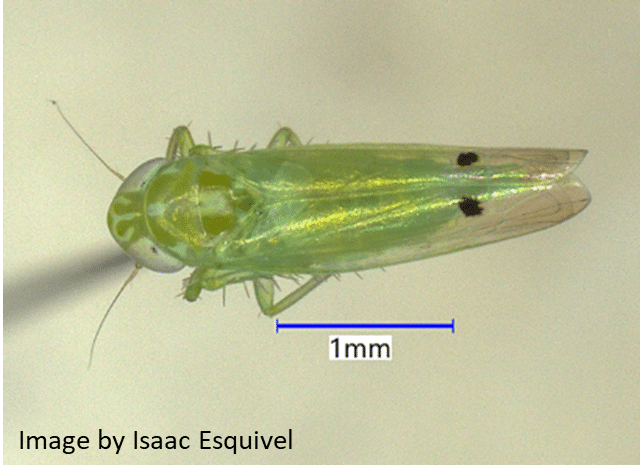
About five flipped leaves later he finds what he’s looking for – or what he hoped he wouldn’t see. On the underside of the cotton leaf is a bright green bug, smaller than a pinky fingernail. It’s a two-spotted cotton leaf hopper (Amrasca biguttula), more widely known as the cotton jassid, an insect pest that just recently made its way into Georgia fields.
Cary, who works as a crop scout, routinely inspecting fields across south Georgia, said the counties closer to the Florida border are seeing the worst of the bug. He’s helped a number of farmers spray their fields against the pest.
“You knock them back, and then they’re right back about a week later,” he said.
The cotton jassid is native to the Indian subcontinent. It was first reported in the western hemisphere in Puerto Rico in 2023. Florida began reporting the bug early in 2025, and in early July, it was first reported in Georgia in Seminole County. It’s about 3 mm long and identifiable by two black dots on each wing. The jassid enjoys vegetable patches of okra, eggplant and sunflower, but the most concerning for many growers is Georgia’s leading row crop, cotton.
Georgia ranks third nationally in cotton production, according to the University of Georgia. Cotton-related professions provide more than 50,000 jobs in the state, and the crop’s overall impact exceeds $3 billion.
Vivek Bist, the UGA extension agent for Dougherty County, began looking for the cotton jassid in the county just a few weeks ago. He said he found it in several fields; although, Dougherty County doesn’t have a very high cotton production rate.
“We anticipate that this pest is going to be in most of our fields by next year,” Bist said. “If growers are taking care … scouting … spraying for other bugs pests, they’re not seeing a lot of this, but for fields that were not properly managed, those fields are more likely to have higher numbers. It (the cotton jassid) does not have its natural predator here, so once it establishes itself, it’s going to grow faster.”
One of the fields Bist reported the cotton jassid in belongs to farmer Mark Gwines. Gwines grows row crops in both Dougherty and Worth counties. He said cotton is looking good this year, but he, like many farmers, have scaled back their acreage due to low commodity prices that have been plaguing the U.S. cotton industry for about two years now.
Gwines said U.S. cotton farmers can’t compete with the quantity, quality and prices of the commodity in China or Brazil.
“That’s what’s making this pest so concerning,” he said. “The chemicals you have to kill it with are pricey, and you just don’t need that extra expense in a year when, even with a really good crop, it’s still not going to be good.”
Gwines sprayed his cotton fields Monday with Bidrin, an insecticide commonly used for stink bugs. However, it also kills off the beneficial critters like ladybugs, spiders, wasps and fire ants that get rid of other pests like worms and aphids.
Even after spraying on Monday, Cary, Gwines’ scout, found a mature jassid, Wednesday.

Gwines said the pest is not a big enough concern yet for him to cut back even more on his cotton acreage. He said Georgia farmers got lucky that the pest wasn’t found until later in the season.
“The impact remains to be seen,” he said. “It’s going to take a little while to get the hang of it. Extensions are just doing a lot of testing on what kills it best.”
Seth McAllister, the UGA extension agent for Terrell County, began raising the cotton jassid alarm to county leaders in early August when the pest had been reported in about 13 Georgia counties. Fast forward to the first week of September, that number has grown to more than 40 counties.
McAllister first spotted the cotton jassid in an okra patch at Mark’s Melon Patch in late July. He said there were low numbers, but just a few weeks later the bug made its way to Terrell cotton fields. By the second week of August, he said, most Terrell cotton fields were being treated with insecticide against them.
“The insect is not eye-catching by any means, but it has a very high reproduction rate,” McAllister said. “They’re moving really quick.”
The pest has a needle-type mouth that pierces the bottom of a leaf and sucks the plant sap out. Much like a mosquito, the enzymes in the cotton jassid’s saliva have a detrimental effect on the plant.
It takes about three weeks for the effect to set in on a cotton plant. First, the leaves cup and turn yellow, then brown and then finally red. By this point, the leaves are no longer photosynthesizing and feeding the plant.
“Historically, when cotton’s done blooming and getting ready to be picked at the end of the year, the leaves will naturally get a reddish hue anyway,” McAllister said. “But this is an early premature reddening that’s not supposed to happen in July or August. We think our yield potential could be drastically reduced. We just don’t know how much yet.”
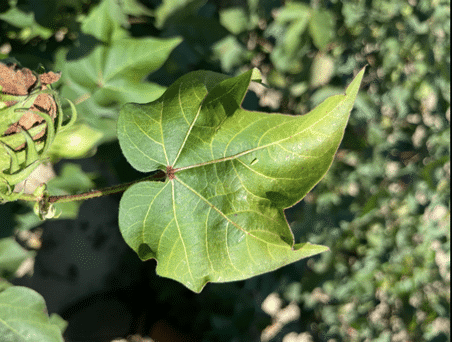
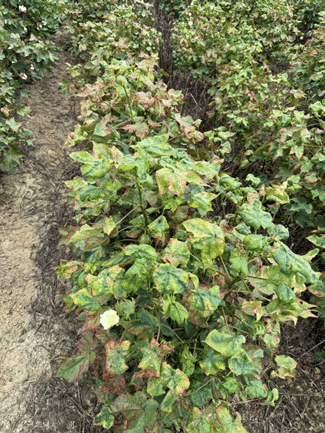
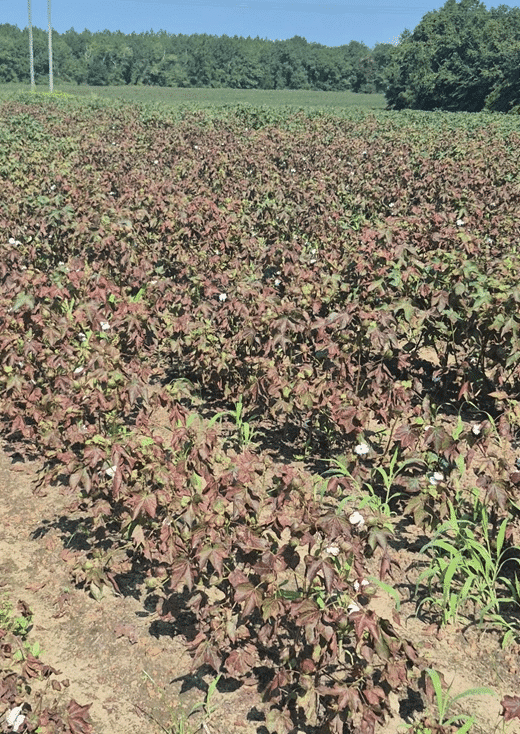
McAllister said UGA extension agents are working hard, teaching farmers how to identify the cotton jassid, researching the bug’s reproduction rate and identifying just how many it takes for them to become detrimental to a plant.
He said a singular insect doesn’t create much damage, but UGA extension agents are currently recommending insecticide treatment with two to four immature cotton jassids per leaf, especially when paired with visible damage.
“But, that could change tomorrow,” McAllister said. “Exclusion would’ve been the No. 1 way we prevent them, but that’s out the window. We’ve still got a lot to learn.”
He said Georgia cotton farmers are already fighting tough battles. Normally, the dominant crop in Terrell County, cotton acreage is down about 50% this year compared to 2024. McAllister said irrigated cotton production is going to be around 1,100 to 1,500 pounds per acre.
“With those numbers, with high input prices, producers are still projected to lose about $181 an acre,” he said.
McAllister said it’s vital for Terrell County farmers’ future to stay sustainable in the cotton industry, but it’s becoming increasingly more challenging for them to do so.
“This insect could be the final nail in the coffin of our cotton industry if something doesn’t change,” he said.
Author

Related Articles

Voters will decide on Dougherty County Commision District 4 in Nov. 3 election
Only one competitive Dougherty County Commission race remains to be decided on Nov. 3. Democratic challenger Anthony Patterson is the challenger for incumbent Republican Russell Gray in District 4.

Lee commissioners adopt 29.71-mill tax levy, including school bond payments
Lee County commissioners adopted a combined county and school property tax rate of 29.71 mills Monday, formalizing a levy that includes 17.96 mills for school operations and a separate 0.58-mill charge to repay school bonds.

PHOTOS: Albany State and Phoebe Ceremony
Click the arrow to scroll through the images.
