
Final piece of the puzzle: Dougherty County courthouse repairs held up by supply issues
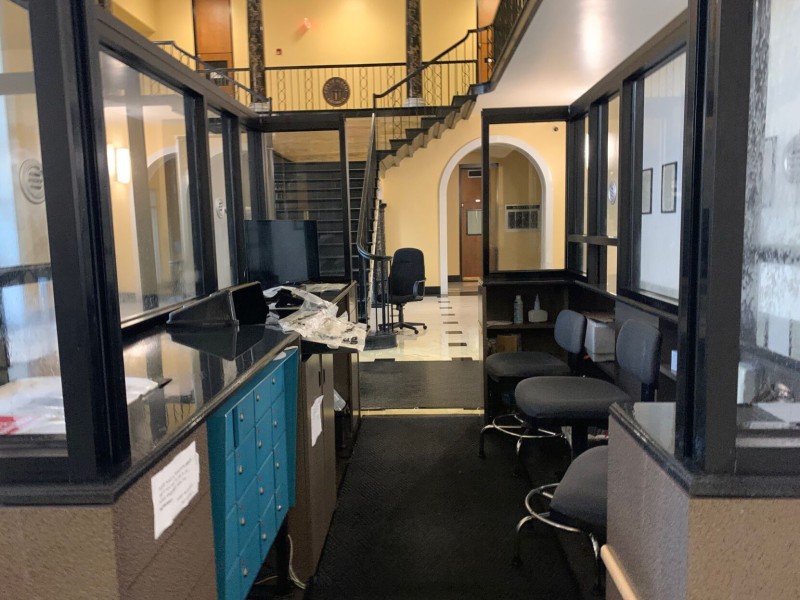
The front lobby of the Dougherty County Judicial Building was inundated with water, destroying the counter and security equipment, by flooding caused by a malfunctioning coffee pot water supply unit over the Easter weekend in 2021.
Special PhotoBy Alan Mauldin
[email protected]
ALBANY — There’s never a good time for a flooded courthouse, but a leak that caused water to pour from a third-floor jury room down to the basement on Easter weekend 2021 couldn’t have occurred at a worse one.
Occurring during a spike in the COVID-19 pandemic, the flooding, caused by a malfunctioning water hose feeding a coffee maker, officials say repair work has been hampered by supply issues and shortage of workers.
Now, approaching the one-year anniversary of the front entrance of the Dougherty County Judicial Building being closed, one piece of equipment on order is holding up completion of getting the security screening system up and running.
We’re waiting on “an inset that goes into the (lobby) countertop that works with the x-ray machine that the Sheriff’s Office requested,” Dougherty County Director of Facilities Management Heidi Minnick said during a Thursday telephone interview. “Once the countertop is installed with the final piece the sheriff’s office requested, we will be able to turn the building over to them.
“Then my part will be completed. We can’t turn it over to the sheriff’s office until the countertop is installed.”
The job of restoring the building began immediately after it was discovered by an employee who noticed water while taking a walk during a break on Easter Sunday. Water had been flowing from the hose for a day or two before that time.
Before the arrival of Servpro to remove water and prevent the formation of mold, county workers began using wet vacuums and taking other steps to prevent additional damage, Minnick said.
Ironically, perhaps, iWaves ionizers installed in the air systems provided ionic filtration of the air as a protective measure for the novel coronavirus may also have helped prevent mold from taking hold.
Two independent tests from separate companies have given the building a clean bill of health for mold, the director said.
The security scanning equipment itself was on back order for months.
Workers, including contractors and county employees, had to replace ceiling tiles and other damage, repair the electrical and HVAC systems and replace cabinets.
“All the security equipment had to be replaced,” Minnick said. “The marble floor had to be cleaned and repaired by experts. We had to wait for suppliers. There were problems with the supply chain.
“It’s been quite a few vendors. We make sure we deal with vendors who are experts.”
While final numbers aren’t in, the director estimated the cost for repairs will be in the $500,000 range. She had no estimate on the building being returned to fully normal operations, but is hoping it will be within the next month and before the anniversary.
After being burned once by a coffee maker, or at least the water feed to the commercial unit, the county is not taking the chance of being scorched twice.
“Right after that happened, we went to all of the buildings and checked the coffee pot installations that were done by outside vendors,” she said. “We removed the plumbing that was done by those vendors.”
The water supply systems for the few remaining coffee makers fed by outside lines have been upgraded, Minnick said.
Author

Related Articles

Bringing (positive) changes to The Herald’s Squawkbox
The Herald, as part of The Georgia Trust for Local News, is altering the way the Squawkbox is presented.

U.S. 19 speed limit reduced for traffic approaching Nelms Road intersection
The speed limit for U.S. 19 traffic approaching the Nelms Road intersection has been reduced from 65 mph to 55 mph.
PHOTOS: Albany State New Student Orientation
Photos by Reginald Christian, Albany State University
