
Final stage of Albany-Dougherty Resiliency Plan completed; next step is review from city, county officials
Staff Photo: Lucille Lannigan
By Lucille Lannigan
[email protected]
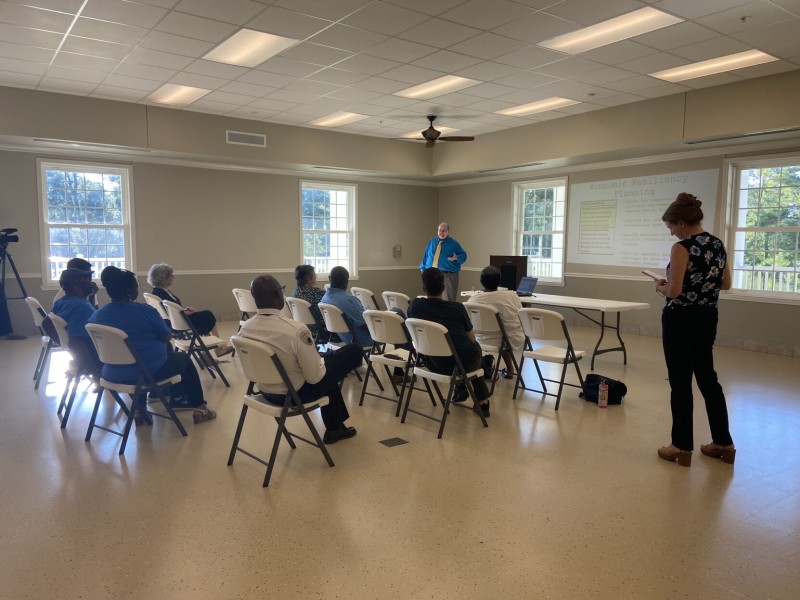
ALBANY – The final public meeting for the Albany Resiliency Plan was held Monday, and attendees got a look at the solutions and resources that could help Albany during a disaster.
The Resiliency Plan outlines a path for Albany’s development that is sustainable and resilient, according to city and county officials. It’s a path to make the city well-prepared for “short-term disruptions and long-term challenges,” whether environmental, economic or social. The plan is being funded by a Community Development Block Grant Disaster Recovery Planning Grant from the Georgia Department of Community Affairs.
A team from Metro Analytics, the consulting agency in charge of the plan, developed it in several steps, including data collection, analysis and stakeholder engagement. The group met with area hospitals and emergency services. It analyzed the condition of each city parcel to see potential threats or long-lasting damage. It walked through neighborhoods with community members to assess needs.
Albany is a city that is still recovering from natural disasters. The city took numerous hits over the years with the Flood of 1994, tornadoes in 2017, Hurricane Michael in 2018 and the COVID-19 pandemic in 2020.
Recommendations from the plan include a resiliency summit to form a coalition of community-based hubs and champions, a community-based process for declaring disruptions, educational events like a “resiliency awareness week,” and a one-stop resiliency portal to connect people with resources and more.
The plan had five focus areas for Metro Analytics to tackle: building a resiliency coalition; transparency and communication; infrastructure — building and zoning; resiliency-focused initiatives, and economic resiliency.
In the plan, the team named five areas as resiliency clusters, including the Dawson Road, Phoebe Putney Memorial Hospital, Broad Avenue/downtown, Albany Technical College and the East Flint River areas. These were decided by the prevalence of “hard asset jobs,” or jobs that provide services that can’t be provided elsewhere.
Hearing community stories was a key part of the Metro Analytics team’s plan development. The team plans to create “Resiliency Awareness Challenge” videos to showcase stories from the community and the voice of agencies that can help in the future.
A Lived Experiences Survey has been accessible online since March for Albany and Dougherty residents to share their disaster experiences. However, Mary Huffstetter, an agent with Metro Analytics, said it never gained much traction.
Instead, Hufstetter said the team reached people through leaders like Harriet Hollis, the Dougherty County grants program manager, and Albany Ward I Commissioner Jon Howard.
The group walked through neighborhoods in Albany like the area near the old Roses building on East Oglethorpe Boulevard. Hollis connected the team with the owner of Helen’s Barber Shop-Art Salon along Highland Avenue and to Frank Wilson, the former director of the Albany Civil Rights Institute.
Hollis said these people are trusted leaders among communities that had been most impacted by some of the extreme weather events.
“I thought it was important that they hear from folks who had been in the trenches and who have been around Albany a while and know the history,” she said.
She said the Metro Analytics team was able to learn more about Albany’s makeup and history, like how things transpired during the storms and what resources were available to which parts of the community.
Hollis, whose own south Albany home was flooded, said many homes throughout south and east Albany as well as the Radium Springs area, faced extensive damage to their homes and property.
She said south Albany already faces issues like food deserts and a lack of resources, which made the storms even more devastating.
Hollis said lasting effects from the flood and wind events are still visible in many of these neighborhoods. Houses are dilapidated, boarded up or have tarped roofs. In the Radium Springs area, many houses were torn down or abandoned.
“Because they were damaged in the storm, and people couldn’t afford to fix their homes up, people moved away and left those properties,” she said. “They moved somewhere else … they may have left the community altogether.”
Hollis said she’d like to see a database where people can easily learn about resources they’d need during a disaster. She said historically during the aftermath of a disaster, vulnerable community members were taken advantage of by groups posing as relief resources.
“If everybody can access the information, and everybody has the same information, it would be phenomenal,” she said.
Once the plan is reviewed, Duncan said, a part of rolling it out is hosting a resiliency summit at which government officials, agencies and the public can come and identify key players or “champions” in the resiliency plan.
Howard called for increased involvement of Dougherty County’s schools and students in the resiliency plan and summit.
Clinton Vicks, a board member of the city’s Community and Economic Development CD Council, emphasized the need for Metro Analytics to involve more people from the nonprofit sector in the summit.
“Those are the trusted people in the community,” Vicks said. “We have not had the best experiences with just elected officials.”
Hollis said she agreed with Vicks.
“We’ve got to have the community folks, the nonprofit folks, the governmental folks … everybody needs to have a voice,” she said. “Now it’s up to us as a community, as Albany, to make the plan work.”
Hollis said getting involved in this plan helps the community to be proactive and prepared for the next disaster.
“And we know that another disaster is coming because with global warming … and everything going on nationwide, we know it’s going to happen,” she said. “The more prepared we are … the quicker we can be in our response.”
She encouraged people to get involved.
“There’s still time, and even if you didn’t get involved in the input portion, once that summit is planned, we need everybody to come to the table,” Hollis said.
Author

Related Articles
Tropical Storm Isaias changes Albany-area high school football schedule
Tropical Storm Isaias is still hundreds of miles from Southwest Georgia, but it has already changed this week’s high school football schedule.

PHOTOS: Albany State Homecoming Fair and Carnival
Click the arrow to scroll through the photos.

PHOTOS: Albany State Homecoming 2026 – Business After Hours
Click the arrow to scroll through the photos.
