
Following the path to revitalization
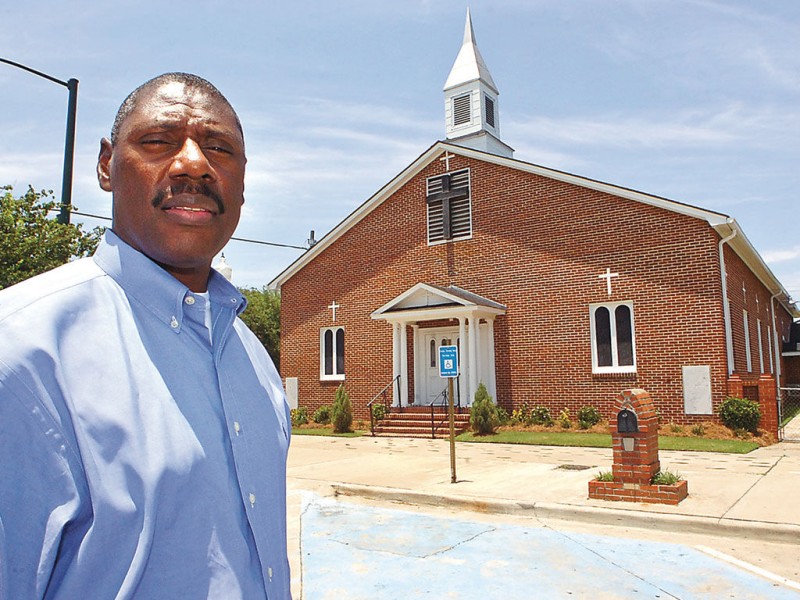
Carlton Fletcher
ALBANY — Take a stroll along the 200 and 300 blocks of South Jackson Street here, in what longtime tailor Connie Ford calls the “heart of Harlem,” and you retrace the footprints of history.
Literally.
Embedded in the concrete of the sidewalks along Jackson are tan and gray-colored footprints that mark the path of marchers who were a part of the historic Albany Civl Rights Movement. Like most of the businesses that survived the ravages that time and urban renewal have brought to the city’s Harlem district, those footsteps have faded, losing much of their luster.
Dougherty County Commissioner John Hayes, whose office at Capitol City Bank & Trust at 301 W. Oglethorpe Blvd., looks out on the heart of Harlem, is spearheading an effort to revitalize the district that was long the epicenter of social activity in Albany’s African-American community. Hayes insists the district can become part of the kind of tourist destination that draws millions of visitors to Bay Street in Savannah and Bourbon Street in New Orleans.
“I believe our community is missing out on something large here,” Hayes said during one of several conversations about the Harlem District. “This district is steeped in something that’s a very important part not just of our city’s history, but our nation’s history.
“To not mark that, to not preserve that history, is shameful. We as a community have got to move beyond the minutiae that holds us back and expand our vision.”
Hayes is one of the more introspective and soft-spoken members of the Dougherty Commission. But there’s no mistaking the passion in his voice as he talks of the possibilities of the Harlem District, which encompasses a roughly eight-square-block area just off Oglethorpe, one of Albany’s main thoroughfares.
“People come here from all over to get Jimmie’s Hot Dogs, and when I talk about Jimmie’s I can’t help but compare it to the Varsity (in Atlanta),” Hayes said. “I’ve heard from a number of people that Jimmie’s hot dogs are as good or better than the Varsity’s; it’s just a matter of image.
“And we’ve got Shiloh Baptist Church, where Dr. (Martin Luther) King spoke during the height of the Civil Rights movement, and Sherrod Park where the movement gained momentum. There’s so much history there. There’s no reason we can’t do what other cities have done and provide a first-person look at that history while creating commerce.”
Hayes and other community leaders say they believe that drawing attention to the historic elements of the Harlem District could lead to a revitalization that would transform aging businesses there to their former grandeur.
“The Harlem District was an important part of African-American history in Albany, but it’s also an important part of Albany’s history,” former Agriculture Department director Shirley Sherrod said. “I don’t think you can look at any one part of a city without seeing it as a whole. To revitalize the Harlem District would, I think, be a positive for all of us.
“Mississippi, Alabama and other states have embraced the Civil Rights elements of their history, but around here we seem to want to get rid of everything that’s old. We’ve already lost the opportunity to see and revisit ‘Jailhouse Alley;’ everything’s been torn down. All of us — not just African-Americans — are in danger of losing our history.”
Much of Albany’s Civil Rights history is tied to the Greyhound bus terminal at 300 W. Oglethorpe. It was there that historic sit-ins and boycotts helped shape legislation that brought civic change to an area of the Deep South that vehemently rejected such change.
City of Albany officials will decide soon whether to build a new multimodal transit hub at the corner of Washington Street and Roosevelt Avenue, essentially cutting Destiny Transportation Group — which oversees city and regional transit and leases space to Greyhound — out of the local transportation loop. Destiny Vice President/CFO Orlando Rambo said any such move would effectively end talk of revitalizing the Harlem District.
“(Relocating the transportation hub) would essentially kill revitalization in this district,” Rambo said. “And while we initially fought the plan out of self-preservation, this is bigger than Destiny. Our facility is the anchor of this district, and any hope of rebuilding this neighborhood has to involve us.
“Locations of transit facilities are, we know, inherently political, but sometimes what’s good for a community and politics can work together. Taking us out of the transportation equation would cause a demise of this entire district. The city would, in essence, be disinvesting in the district.”
Jimmie’s owner Tommy Mathes makes no bones that his historic restaurant’s success is tied to the Greyhound terminal that brings him a large number of his customers.
“If you want to revitalize the Harlem District, you can’t move the bus station from here,” Mathes said. “Our sign says it all; we’re a landmark, true. But we also go hand-in-hand with the bus station.”
Mathes owns all the storefronts along the eastern side of the 200 block of Jackson, and he notes the poorly maintained condition of the city-owned right-of-way in front of the storefronts.
“Just look right down there (at the Micro Business Enterprise Center a block south) at how well-maintained the right-of-way is,” the restaurateur said. “And I spend a great deal of my time trying to keep the homeless people from running off customers by asking them for money before they even get out of their vehicles.
“We need a police presence here. We’re right across the street from the Law Enforcement Center, but we never see an officer walking through here. We need to do something to get rid of the perception that this area is dangerous.”
Ford, who’s worked as a tailor at his Connie’s Corner for 44 years, and Eugene Bailey, who’s cut hair and shined shoes in the Harlem District for a half-century, the last nine at Harlem Barber & Beauty, remember vividly the days of black shoppers crowding the sidewalks in the district.
“You couldn’t hardly walk for all the people,” Bailey said. “We had everything anybody could want: restaurants, a taxi line, nightclubs, stores. Now there’s just a few of us left. There’s nowhere to go, nothing to do.”
Ford says there’s a simple reason the Harlem District was the center of social activity for African-Americans in the region.
“The businesses were thriving because this was the only place black people congregated,” he said. “Now all the black-owned businesses are gone. They come in here and build places like the Micro Business Center, but those people are like foreigners to us. You think they do business here?
“You mention Harlem to young black people now, and they say ‘Where’s that?’ There’s no sense of history. I ain’t gonna get rid of this joint because I still have a great time coming in here every day. I’m 74 now, but I still love meeting and talking to the people. And I still have plenty of work.”
Hayes says business owners like Ford, Bailey, Mathes and others in the Harlem District who’ve held firm despite a declining customer base and the passage of time deserve to be rewarded for their willingness to persevere.
“If we frame this the right way, I can see this district attracting good private investors,” he said. “With the right public/private mix, I believe we can create a business atmosphere where the return on investment becomes perpetual. There are so many resources right here in our midst; we just have to get them together like we’ve done during critical times in our history.
“I can see an Albany whose future is in the hands of its people. But it can’t be one person’s or a few people’s vision. It has to be shared. And it can start in the Harlem District. I believe that, and I’m determined to do everything I can to improve what I can while I can. For it to happen, though, we have to see the greater take interest in the least.”
Time will determine if Hayes’ vision for the Harlem District is one the community is willing to share. The footprints, at least, are already in place.
Related Articles
Albany Herald – June 20, 2026
City Albany faces shortfall for police… Women’s Anchorage tentatively set to… Commissioner, school leaders clash over…

Classifieds – June 20, 2026
ALBANY HERALD CLASSIFIEDS JUNE 20, 2026
Public safety drives Leesburg’s $4.2 million Fiscal Year ’27 budget
The adopted spending plan reflects modest growth in city revenues and continued emphasis on maintaining core municipal services, particularly public safety and sanitation, which together account for a significant share of general fund expenditures.
