
Georgia electric vehicle rollout rides heavily on state, federal backing
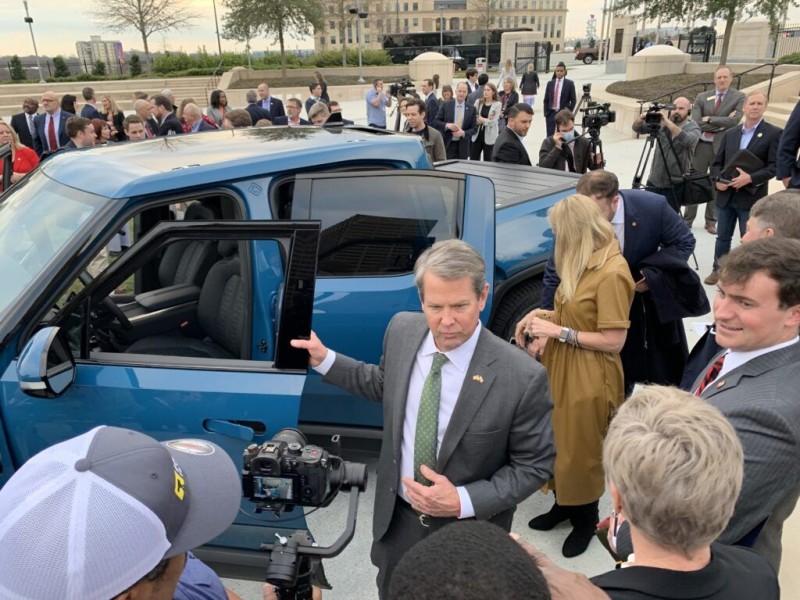
Jill Nolin/Georgia Recorder
By Stanley Dunlap
Georgia Recorder
ATLANTA — Gov. Brian Kemp is on a mission to make Georgia the undisputed electric vehicle capital of the nation.
The governor’s ambitious plan doesn’t seem too far-fetched after the significant strides made by the state on the economic development front in the last two years, which includes four multibillion-dollar investments into building electric vehicles and the batteries that keep them running.
A growing industry also has presented a number of challenges to state legislators and agency leaders this year, including the steep costs involved in building up charging stations for electric vehicles, the high annual fee Georgia now charges EV owners, and the continuing costs to repair and build roads with shrinking fuel tax revenue.
The state Department of Economic Development cites figures estimating that the global projection of 56 million in annual passenger electric vehicle sales in 2040 while advocacy group Environment Georgia predicts that electric vehicles could represent 10% of the market in the state by 2030.
In all, the electric mobility industry will be responsible for 35 projects across Georgia to the tune of $23 billion dollars of investment and 28,000 new jobs.
“I believe this is a unique moment of opportunity for our state and for the thousands upon thousands of hard-working Georgians who will benefit from great jobs and incredible innovative companies for generations to come,” Kemp said during his inaugural address. “That’s why by the end of my second term as your governor, I intend for Georgia to be recognized as the electric mobility capital of America.
“To accomplish this goal, we are keeping our foot on the gas, and I look forward to the announcements we’ll make in the near future.”
As Georgia’s first big venture into the electric mobility market, SK Innovation opened a $1.67 billion lithium-ion battery manufacturing facility in Commerce in 2019, followed by an expansion more than doubling its size.
Now, Hyundai and EV truck manufacturer Rivian are building the two largest economic development projects in Georgia’s history at mega sites. Rivian is in the development stage an hour east of Atlanta, and Hyundai’s plant is in the works at a site near Savannah’s port.
In addition, SK Innovation and Hyundai are partnering to build a battery plant in Bartow County, and another $2.5 billion is being pledged by California-based startup Archer Aviation Inc. to manufacture an electric vertical takeoff and landing aircraft.
The electric automobile industry reaches well beyond passenger cars, as Sysco plans to convert its fleet of 150 tractor trailers that deliver food to restaurants, schools and other commercial kitchens to electric power. And federal funding will enable BlueBird to produce electric-powered school buses in Fort Valley.
Yet these developments are not without their detractors who criticize the state’s generous incentive packages. For its proposed plant, Rivian Automotive received $1.5 billion in state and local incentives. Local residents have concerns about how the plant will contribute to urban sprawl, the traffic it would create and the environmental damage it could cause.
And a capacity problem could hamper the long-term viability of the electric vehicle industry: a shortage of lithium-ion batteries.
Although challenges lie ahead, Public Service Commissioner Tim Echols said he believes that the governor’s prediction can come true with public and private investment into clean energy to increase electric vehicle suppliers that continue to deliver on the technology’s promise. Georgia is currently behind California in the EV industry, he said.
The electric automotive industry is expected to secure a front seat this Legislative session after a joint House and Senate study committee spent the off-season taking field trips to manufacturing sites and hearing from representatives from utility companies, state convenience store association, food service companies, automobile manufacturers and electric vehicle owners.
Committee members have compiled a 73-page report that can act as a guide for some of the proposed changes this year and in the near future.
The study committee recommends permitting businesses to sell electricity by the kilowatt hour instead by the amount of time an EV takes to charge.
The study committee also called for a more detailed analysis to determine how to offset some of the $2 billion in state fuel taxes now collected annually that the state Department of Transportation uses for road construction.
A $211 fee is currently charged to owners of small battery-powered cars, while $317 is charged to owners of commercial electric vehicles. As a comparison, the DOT brings in 30 cents per gallon from fuel taxes.
A pilot project the DOT is considering would allow drivers to track their electric car mileage and be charged based on how many miles they travel.
As part of President Joe Biden’s Bipartisan Infrastructure Law, Georgia has received $135 million for charging stations and infrastructure.
A number of convenience store chains say that utility companies are unfairly encroaching into their territory, and that they are placed at a disadvantage.
In response, state regulators added a first right of refusal provision to the latest Georgia Power rate case that allows businesses to build their own charging stations within 18 months and within a certain number of miles of where Georgia Power is proposing to build them.
Author

Related Articles

Regional catering business finds new home at Warrior Creek Mercantile
For months, Marchbanks said she had been asking God for an opportunity to serve others. “I just kept praying, ‘God, use me as a servant,'” she recalled. “I didn’t care what it was. I just wanted to be used to help people.”

Leesburg business reflects growing trend toward multi-use downtown spaces
Beyond the pristinely curated lunch spot, owner Sheri Smith has created a small hub of health and wellness services, retail and local partnerships — an example of the type of multi-use business model many small communities are increasingly embracing as they reinvest in historic downtown properties.

Busy businesswoman Erica Henderson is work ethic personified
Businesswoman/mom Erica Henderson manages three jobs simultaneously … and does so remarkably well, thank you.
