
Georgia lawmakers pass anti-Semitism bill
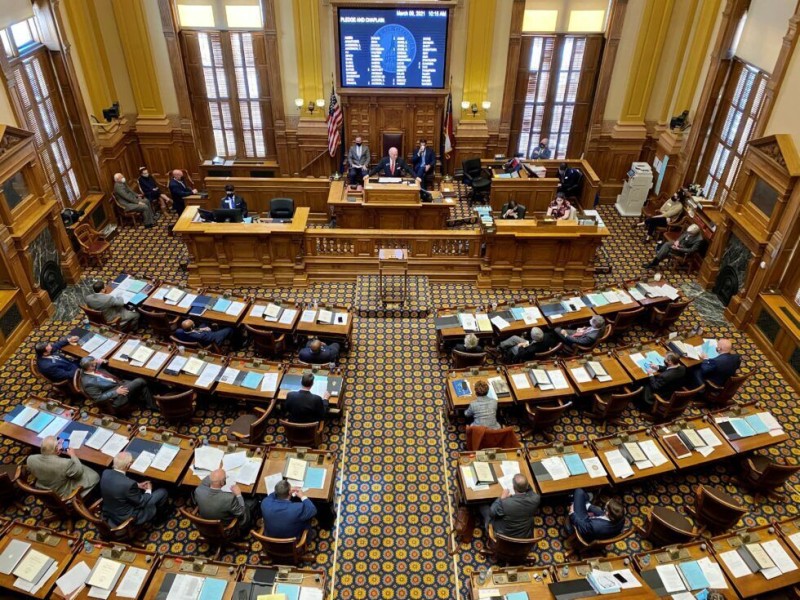
Under the Religious Freedom Restoration Act, which passed the state Senate 33-19 along party lines, state and local governments would not be permitted to “substantially burden” an individual’s free exercise of religion unless the government could demonstrate it had a “compelling governmental interest” in doing so.
File Photo: Beau EvansBy Dave Williams, Capitol Beat News Service
ATLANTA — The state General Assembly has overwhelmingly passed legislation defining anti-Semitism and incorporating it into Georgia’s hate crimes law.
The state Senate approved the bill 44-6 after a nearly two-hour debate. The Georgia House of Representatives followed in a 129-5 vote.
The House had passed a similar version of the legislation last year, only to have it die in the Senate. Since then, however, incidents of anti-Semitism have been on the rise across Georgia, sparked by the Oct. 7 massacre of Israeli civilians by Hamas militants and its aftermath, Senate President Pro Tempore John Kennedy, R-Macon, told his colleagues.
Kennedy cited the spreading of anti-Semitic flyers in Jewish neighborhoods by what he described as “outside agitators” and the hanging in effigy of a Jew outside a synagogue in Macon.
“The Oct. 7 attack on the Jewish state and our ally … highlighted the nearly nonstop threat our Jewish brothers and sisters face,” Kennedy said. “This is the antithesis of what our great state and our great nation are all about.”
“Certain things rise above politics,” added Rep. John Carson, R-Marietta, who sponsored the bill in the House. “It’s time to get this done.”
The legislation, now headed to Gov. Brian Kemp’s desk, would establish as part of state law the definition of anti-Semitism used by the International Holocaust Remembrance Alliance, an intergovernmental organization founded by Sweden’s prime minister in 1998.
The bill allows prosecutors to seek enhanced penalties when crimes have been committed because the victim is Jewish.
While only one Republican — Sen. Colton Moore of Trenton — voted against the legislation in the Senate, it split the Senate Democratic Caucus.
Senate Minority Leader Gloria Butler, D-Stone Mountain, supported the measure, citing a long history of anti-Semitism in Georgia including the 1915 lynching of factory superintendent Leo Frank after he was convicted of murdering a 13-year-old employee — which a consensus of historians now believe was a miscarriage of justice — and the bombing of an Atlanta temple in 1958.
But some Democrats argued the bill violates the First Amendment right to free speech because it would allow Georgians to be charged with a hate crime for simply criticizing the Israeli government’s war on Hamas that has killed thousands of Palestinian civilians.
Sen. Nikki Merritt, D-Grayson, tried unsuccessfully to amend the bill to clarify that criticism of Israel may not be deemed anti-Semitic.
“This is not an anti-hate bill,” Merritt said. “This is an anti-speech bill.”
But Sen. Brian Strickland, R-McDonough, chairman of the Senate Judiciary Committee, which unanimously approved the bill on Monday, said it is not aimed at speech. He cited a portion of the legislation that specifically states it is not to be construed as infringing on free speech rights.
“You can continue to say anything you want in this state. This bill protects that,” Strickland said. “(But) you can’t go and hit somebody in the face because you don’t like what the country they identify with is doing.”
Sen. Harold Jones, D-Augusta, said the bill is guilty of “picking and choosing” because it singles out Jews for protection but does not address violence motivated by Islamophobia or hatred of other immigrant groups.
But Kennedy said Jews in Georgia have been particularly vulnerable to hate-motivated violence.
“The Jewish community in our state is crying out for this,” he said. “This bill is needed.”
Author

Related Articles

Congress weighs packaging bill with implications for Albany manufacturers
A congressional hearing this week on proposed national packaging-labeling standards could have implications for several of Southwest Georgia’s largest manufacturers, many of which produce or package products shipped across state lines.

Dougherty County Sheriff’s Office, GBI investigate inmate death
“The sheriff’s office will conduct an administrative investigation to determine if the staff response was appropriate. We have requested that the GBI conduct an investigation.”
Residents’ safety concerns defeat request to privatize Plantation Road
The Terrell County Board of Commissioners rejected a request July 7 to remove Plantation Road from the county road system after nearby residents warned that closing the roadway could leave them without emergency access when adjoining roads flood.
