
Georgia State receives $10 million artificial intelligence research grant
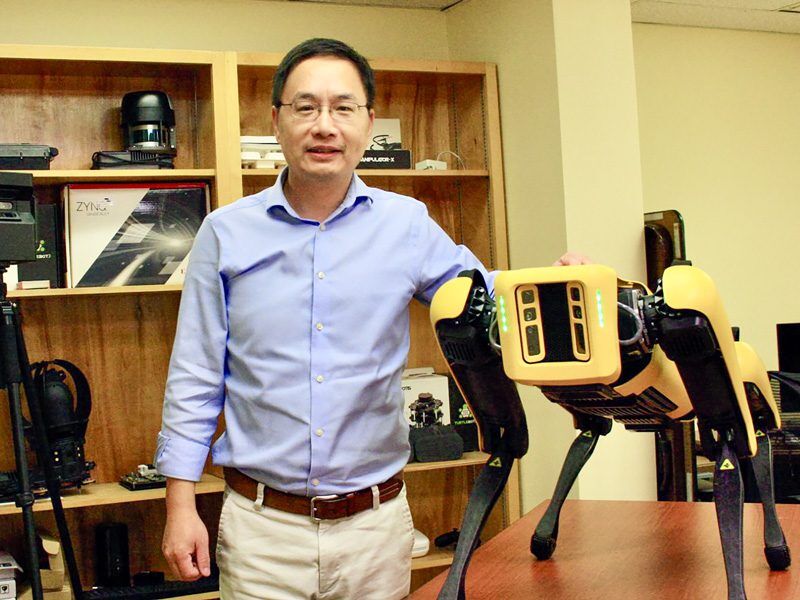
Special Photo: Qing Su
From staff reports
ATLANTA — Jonathan Shihao Ji, a computer science professor at Georgia State University, has received a $10 million grant from the Department of Defense to address critical problems in artificial intelligence and robotics with a focus on human-robot interaction, 3D virtual environment reconstruction, edge computing and trustworthy AI.
In recent years, AI has become more and more prevalent in our world, powering search engines, voice assistants and self-driving cars. But Ji said he thinks it can do more.
“It has been claimed recently that AI is the new electricity,” Ji said. “It can empower and will transform almost every industry in the next several years.”
The research team at Georgia State includes co-principal investigators Professor Anu Bourgeois and Assistant Professor Yi Ding in the Department of Computer Science in the College of Arts & Sciences, and Professor Balasubramaniam Ramesh, chair of the Department of Computer Information Systems in the J. Mack Robinson College of Business.
“AI research is a rapidly-developing field, but the advancements we are seeing are typically years in the making,” Sara Rosen, dean of the College of Arts & Sciences, said. “The award of the CoE-ACS represents the culmination of years of boundary-pushing research, which has spanned Dr. Ji’s time at Georgia State and in industry.”
One major area of research for the center will involve Boston Dynamics’ Spot — a four-legged, dog-like robot — which was acquired by Ji with another DoD grant last year.
Using Spot, Ji says he hopes he and his fellow researchers will be able to advance AI technology by developing a natural language interface for the robot, which could increase the number of useful tasks that it can perform.
“We’ll be able to tell Spot, ‘Please go to the kitchen and see if the fridge door is closed properly. If not, please close it,’ and Spot should be able to understand it and go do that on its own,” he said.
Ji said he also hopes to teach Spot how to navigate a variety of environments on its own.
“We can build a 3D virtual environment and train Spot in that environment, then transfer the knowledge learned from the simulator into the real world,” he said.
That could be helpful in situations such as search and rescue, facility maintenance and emergency response that may be dangerous for humans.
Research also will focus on developing machine learning algorithms to increase the ease of human-computer interaction. To do this, researchers at the center will try to teach AI to understand humans in new ways, for example by human voices or through virtual reality goggles.
“If you want to teach the robot how to pick up a water bottle, you can show the robot how to do it naturally by demonstration,” Ji said.
The center also will focus on increasing the security of AI devices and systems. In many cases, data that could be housed and processed on a device is instead uploaded to remote servers collectively referred to as the cloud, creating a risk that private information could be leaked, he said.
Edge computing could be a solution. This technology involves storing and processing data locally, rather than in the cloud.
The grant will enable Ji and his fellow researchers at Georgia State to fund 12 Ph.D. students, 100 undergraduate students and multiple post-doctoral researchers at the university over the initial five years. The team also plans to partner with local high schools, hoping to spark interest in AI and robotics in younger generations.
“This very significant grant presents an incredible opportunity to establish a national presence for the university in cutting-edge research areas such as Human-AI Collaboration and the development of Responsible AI systems that are also well-aligned with the strategic priorities of the university,” Ramesh said. “We are also excited by the opportunity provided by the grant to prepare a diverse group of students to pursue research and careers in artificial intelligence.”
Professor Yiran Chen, director of Athena NSF AI Institute and the Duke PI of the project, noted the long-standing collaboration between his team and colleagues at Georgia State.
“We eagerly anticipate a more productive partnership within this new center of excellence,” Chen said.
Author

Related Articles
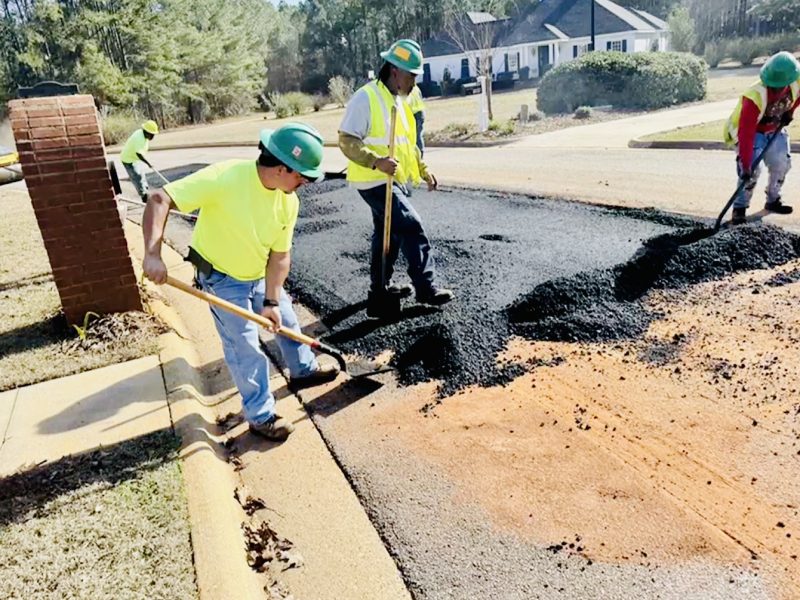
From Ledo to Coston, Lee County’s summer road projects are underway
Updates provided during recent meetings of the Lee County Board of Commissioners show projects are underway or scheduled to begin on several county roads, while additional transportation improvements funded through the Local Maintenance and Improvement Grant (LMIG) program and Transportation Special Purpose Local Option Sales Tax (T-SPLOST) are expected to begin shortly after the July Fourth holiday.

PSC candidate Peter Hubbard makes case for election to full term
The reason why voters should pick me is I’m a rare breed in that I read everything that comes across my desk. I’m asking hard questions at the meetings. I want to get to the bottom of are data centers paying their fair share, are residential customers getting their fair share.
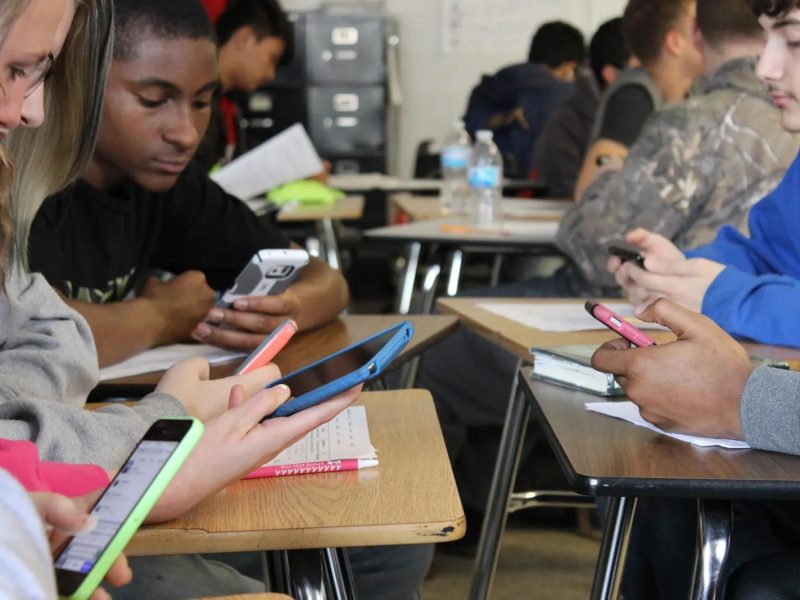
Dougherty Schools prepare for bell-to-bell student cell phone ban
As Georgia prepares to expand its statewide ban on personal electronic devices in public schools, Dougherty County School System leaders say they are working to balance compliance with the new law while giving individual schools flexibility in how they implement the policy.
