
High court upholds Dougherty life prison sentence

Jennifer Maddox Parks
ALBANY, Ga. — The Georgia Supreme Court has upheld the convictions and life prison sentence given to Kasaem Toomer in Dougherty County for the Oct. 3, 2007 murder of 19-year-old Justin Cox, officials from the high court announced Monday.
Toomer appealed on several grounds, including his claim that the prosecutor had used three of his peremptory strikes to exclude prospective jurors solely based on their race, in violation of Toomer’s constitutional right to equal protection.
“We disagree,” says Monday’s opinion, written by Justice David Nahmias.
Under its 1986 decision in Batson v. Kentucky, the U.S. Supreme Court established a three-step process for ferreting out racial discrimination in jury selection: the opponent of a peremptory strike must make a minimum showing of evidence that racial discrimination may exist, the party proposing the strike must then provide a race-neutral explanation for the strike and the court must then decide whether the opponent of the strike has proven the proponent’s discriminatory intent.
In this case, Toomer’s Batson claim focused on the second step, officials said.
In a nine-page special concurrence, Justice Robert Benham wrote that, “[t]he legal journey to a destination in the law where race and gender are impermissible factors in determining whether a person is allowed to serve on a jury, and a litigant’s right to have a jury untainted by race and gender consideration, has been long and arduous.
“As president of my local bar association, I would watch the prospective jurors, with subpoena in hand beaming with pride and anticipation that they too would be allowed to become a part of government as jurors. As they entered the jury box they made sure that they were well-groomed, polite and well-mannered. They would look up at the judge and out at the lawyers with pride and respect. But, as the process began, their joy turned to gloom as white citizens were retained and black citizens were stricken even though they gave almost identical answers. Looking disappointed and dejected, they would leave the jury box crestfallen, sad and feeling less than a full citizen. It is with this background in mind that I consider the action of the majority in disapproving the efforts in a line of cases that sought to flesh out, in a more meaningful and practical way, the right to jury service.”
The special concurrence did not take issue with the U.S. Supreme Court’s decisions cited by the majority. “I acknowledge that as a state we must accept the U.S. Supreme Court’s determinations as to the United States Constitution as well as federal statutes and regulations. However, as the Supreme Court of Georgia, we are free to interpret the Georgia Constitution in a manner that acknowledges the federal floor, but nevertheless raises that floor to provide our citizens with greater rights.” Benham further argued that, for years, “our courts continued for many years to require that justifications for peremptory strikes be ‘specific,’ ‘case-related,’ and ‘concrete.’
“Trial judges need flexibility in using legal tools so that they may shape and mold the law to fit the particular situation,” the special concurrence further states. “The majority opinion has given them an inflexible formalistic approach that elevates form over substance. There are times during the jury selection process that the trial court needs to be able to compress the process to get to the heart of the matter so that justice can be done not only to the parties, but also to the prospective jurors.”
In May 2009, Toomer was convicted on charges connected to Cox’s death. At the time, prosecutors were maintaining that there was clear, irrefutable evidence that Toomer punched the 19-year-old and then dumped his body into the Flint River.
The victim’s car was found abandoned behind the Albany Civic Center. A second defendant alleged to be connected to the incident, Robert Williams, was sentenced in 2009 to serve four years in prison followed by 11 years on probation after pleading guilty to motor vehicle theft and making false statements.
Related Articles
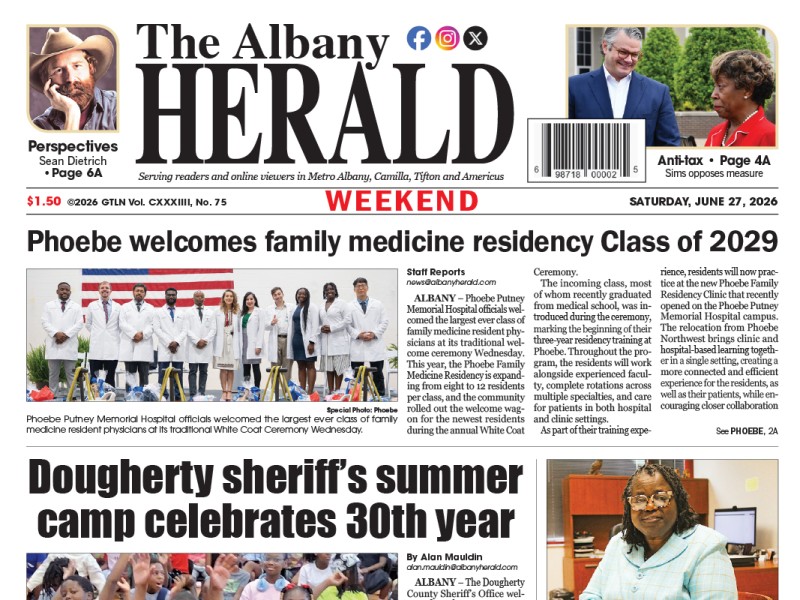
Albany Herald – June 27, 2026
Phoebe welcomes family medicine… Dougherty sherrif’s summer camp celebrates… For Community Care Department head Debra Wiley…

Special Sections – June 27, 2026
Interesting facts related to Independence Day,,, Fire up true American flavor on the grill… The nicknames of all 50 states… 9 facts about the Declaration of Independence…

Classifieds – June 27, 2026
Full Time Job: Women’s Recovery & Substance Use Services Director… Real Estate for Sale: 230 Frost St…
