
Jim Auchmutey’s book is about race relations and redemption in Americus
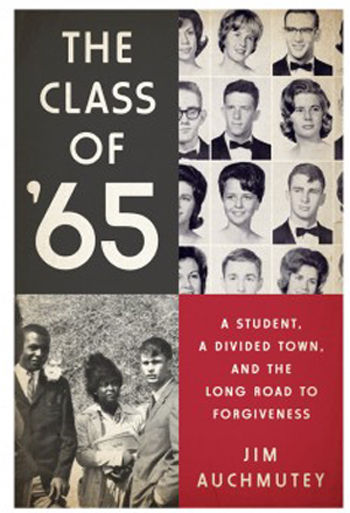
The cover of Jim Auchmutey’s “The Class of ’65: A Student, A Divided Town and the Long Road to Redemption.”
Terry Lewis
ALBANY — As a long-time reporter for the Atlanta Journal-Constitution, Jim Auchmutey traveled all across Georgia, but seemed inexorably drawn to Americus and the nearby farming commune of Koinonia, the community which spawned Habitat for Humanity.
“I have always been a student of history and I probably spent more time in Americus than any other small town in Georgia, Auchmutey said. “It has a fascinating civil rights history.”
That history and a man named Greg Wittkamper prompted Auchmutey to write “The Class of ‘65: A student, A Divided Town and the Long Road to Forgiveness.”
The book, which is being published soon by PublicAffairs, is an untold story of race, religion and reconciliation — a true tale that illustrates human capacity for change and redemption. It revolves around a youngster who grew up at Koinonia, and the way he was bullied and persecuted when he went to school at Americus High School during the height of civil rights tensions.
Decades later, some of his classmates tracked him down in West Virginia and apologized for the way they had acted toward him.
To understand the story, one must also understand Koinonia and the era.
Koinonia, just eight miles to the southwest of Americus, was founded in 1942 as a Christian commune where blacks and whites could live and work together as equal partners — much to the dismay of many citizens of Sumter County.
Wittkamper was a junior at Americus High when it was integrated in 1964. Following the teachings of Koinonia, he saw no difference in color, but his classmates did. He was bullied, beaten, and people urinated on his locker. He called it the worst time of his life.
When he graduated in 1965 he moved to West Virgina, and put the past behind him.
Then a remarkable thing happened — he was invited to his 40th class reunion. Then the letters began, former classmates apologizing for his treatment and asking forgiveness.
“He was still mindful of the ugly things that had happened to him, but he was getting letters asking for forgiveness and all for different reasons,” Auchmutey said.
In an excerpt from the book, Auchmutey wrote:
The last time Greg had seen any of his classmates was graduation day, in the early summer of 1965, when his name was booed and hooted during the diploma ceremony. Now they were inviting him back to their 40th reunion. He hadn’t lived in Georgia in decades. He wondered how they even knew where to find him.
Greg leafed through the rest of his mail and noticed a familiar name on a return address: David Morgan. He tore open the letter.
“I expect you will be quite surprised to hear from me,” it began. “If you remember me at all, it will likely be for unpleasant reasons.”
Greg remembered him all right. While David hadn’t hurled insults or thrown a fist, he was part of the crowd of students that jeered as others harassed him during his three years at Americus High. They spat on him, ripped his books, tripped him on the stairs, urinated in his locker. A couple of guys even hit him in the face. Greg had heard about scapegoats in the Old Testament; he didn’t know he was going to become one.
“Throughout the last 40-plus years,” the letter continued, “I have occasionally thought of you and those dark days you endured at our hands. As I matured, I became more and more ashamed, and wished that I had taken a different stand back then.”
Greg stared at the paper and felt his throat tighten. He was nearing 60 now, his waist thicker, his beard showing patches of gray, and he was content with his life in West Virginia, where his real estate business was going well and he had recently remarried and had a young daughter to dote on. But some hurts never go away. In everyone’s memory, there’s something hidden, something dark, something no one wants to think about when the lights go out and sleep won’t come. For Greg, it was Americus High School.”
For Auchmutey the story is all about forgiveness.
“People can change, there is always a chance for reconciliation and redemption,” he said. “We also have to recognize that things have changed for the better.”
Wittkamper attended the reunion and he forgave.
Auchmutey will have a book signing Thursday from 5 p.m. to 8 p.m. at the Lake Blackshear Library at 307 E. Lamar St. in Americus. Call 229-924-8091 for more information.
Related Articles
Brie’s Gift offers a helping hand for families affected by leukemia
“I think that would be beautiful. Brie loved her school, she loved her city. I think that would be wonderful.”

Classifieds – June 30, 2026
JOBS: Full-Time – Fire Fighting Pilot for Thrush Aircraft, LLC… SERVICE … DIRECTORY: Health – Private Caregiver… Home Repair/Remodeling: Enhanced Remodeling & Drywall…
Albany Herald – June 30, 2026
Albany Commission approves $358.2
million budget… State Bar of Georgia honors Willie Lockette with… Red light violations will bring citations at…
