
LATAI GRANT BROWN: What you should know about strokes
LaTai Grant Brown
Since 1989, the month of May has been designated as Stroke Awareness Month. During this month, great lengths are taken to educate the public about the warning signs of stroke. Please take the time to become familiar with these signs. The life you save just might be your own!
A stroke is when an area of the brain does not get the blood flow that it needs. This lack of blood flow can lead to cell damage and/or death. Blood flow is how brain cells get nutrients as well as oxygen. Brain cells can only survive about 4-6 minutes without oxygen. This is why one must ACT F.A.S.T when presented with the signs of a stroke.
What should I do if I think me or my loved one might be having a stroke?
ACT F.A.S.T.
F — Facial drooping. Ask the person to smile. Is their smile uneven?
A — Arm weakness. Have them raise their arms. Are they able to raise both equally?
S — Speech. Is their speech slurred? Are they having difficulty understanding?
T — Time to call 911. If they show any or all of the warnings signs call 911. It is extremely important to record the time that the warning signs occur and get to the hospital. There are a couple of different treatment options available to help reverse the effects of stroke, but you must present to the hospital quickly and meet the criteria for treatment.
Who is affected?
About 795,000 people in the United States have strokes every year. More than 140,000 of these people will die. Overall women have a higher risk of stroke than men because women live longer. Strokes tend to be more common as we age. At younger ages men have more strokes than women. African Americans seem to have a higher risk than Caucasians for strokes. Latinos and Asian/Pacific Islanders have a greater risk than Caucasians.
What factors increase the risk of stroke?
Uncontrollable factors:
- Age — After age 55 the risk of stroke doubles every decade.
- Gender — Women are at increased risk of stroke. More women die of stroke than breast cancer each year.
- Race — African Americans have the highest risk of stroke.
- Previous history of TIA or stroke.
- History of narrow blood vessels (fibromuscular dysplasia).
- History of a small hole in the heart (patent foramen ovale or PFO).
Controllable factors:
- High blood pressure;
- Diabetes;
- High cholesterol;
- Tobacco use;
- Heavy alcohol use;
- Obesity;
- Hardening of the arteries (atherosclerosis);
- Irregular heartbeat (atrial fibrillation).
LaTai Grant Brown, MD is a board certified general neurologist with Phoebe Neurology Associates. Her sub-specialty interests include epilepsy, sleep and headache. Her spare time is usually spent cooking, making minor home improvements and gardening. She has two children — Khiari, 11 and Kameryn, 5.
Related Articles
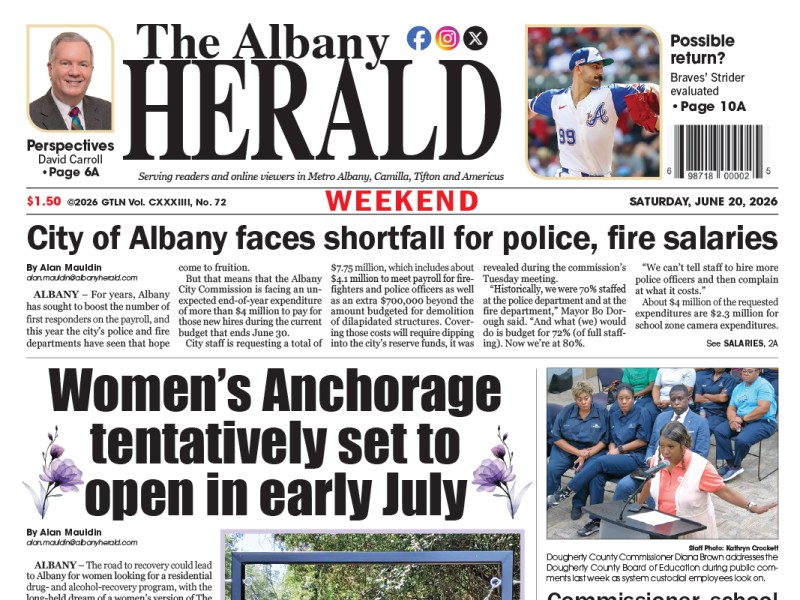
Albany Herald – June 20, 2026
City Albany faces shortfall for police… Women’s Anchorage tentatively set to… Commissioner, school leaders clash over…

Classifieds – June 20, 2026
ALBANY HERALD CLASSIFIEDS JUNE 20, 2026

Public safety drives Leesburg’s $4.2 million Fiscal Year ’27 budget
The adopted spending plan reflects modest growth in city revenues and continued emphasis on maintaining core municipal services, particularly public safety and sanitation, which together account for a significant share of general fund expenditures.
