
‘It’s time to listen to us’: Lee County school tax proposal draws fire
A longtime Lee County resident urged the school board to reject a proposed property tax increase during its first public hearing Oct. 8, questioning spending priorities and warning about the burden on families and older residents.
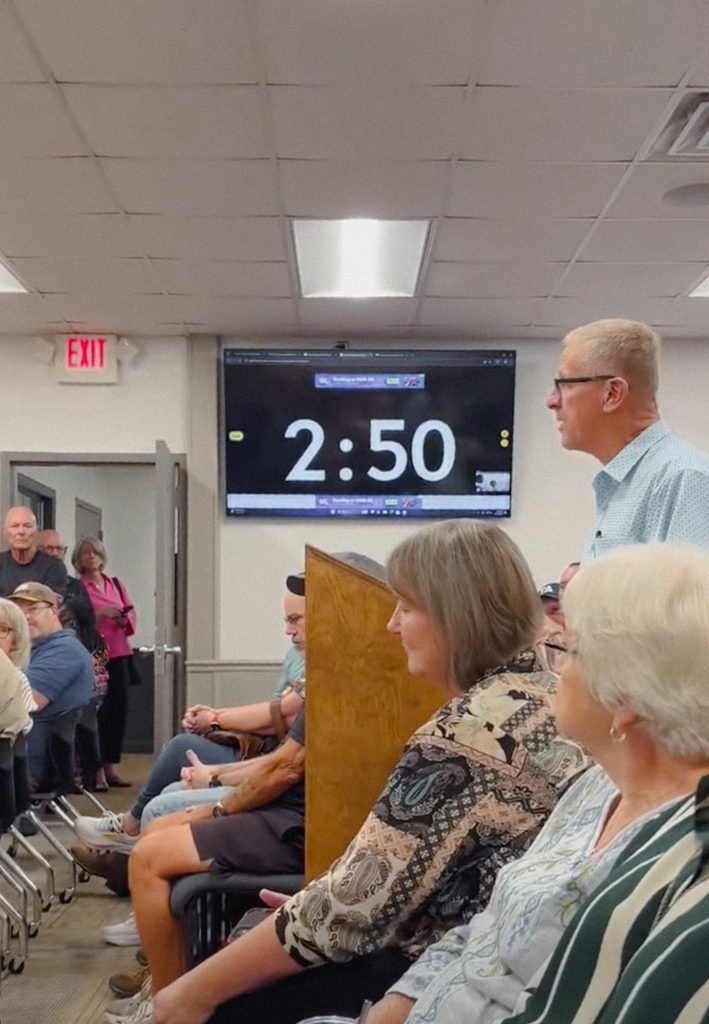
LEESBURG — A longtime Lee County resident was among many who spoke against a proposed school property tax increase at a packed public hearing Oct. 8, questioning spending priorities and warning about the burden on families and older residents.
John Clay, whose two children graduated from Lee County High School, told board members that maintenance needs should have taken priority over recreational facilities and that taxpayers could not afford every project the district wanted.
“You don’t spend money you don’t have funds to spend,” Clay said during a public comment period.
The proposal would raise the school operating tax rate from 15.96 to 18.96 mills, an increase of 3 mills, or about 18.8%. For a property with $100,000 in taxable assessed value, that would add $300 to the annual school operating tax if its taxable value remains unchanged.
The advertised 28.7% increase compares the proposed rate with the 14.732-mill rollback rate, which accounts for reassessment increases in existing property. Individual tax bills also depend on property values and exemptions.
The district’s published tax table projects an operating levy of about $30.69 million, compared with $23.56 million for 2025. That is approximately $7.13 million more, or 30.25%, reflecting both the proposed rate and a larger taxable digest.
District officials say the additional revenue would restore reserves after tax refunds, help address an expected interruption in education sales tax collections and cover rising costs.
Clay questioned whether the district had adequately separated necessities from projects that could wait. During the hearing, he pointed to the high school’s heating and air-conditioning needs, arguing those should have been addressed before spending on courts and other facilities.
He also warned that higher taxes could make it harder for long-time residents living on Social Security or stretching each paycheck to remain in the county.
“Now’s the time to act. It’s time to listen to us,” he told the board.
In an Oct. 9 interview with The Albany Herald, Clay said his criticism grew out of his attachment to the school system. He has lived in Lee County for nearly 30 years and serves on the county Planning and Zoning Commission, he said. His family moved from Albany when his children were small specifically so they could attend Lee County schools.
His son graduated in 2015 and is now a nuclear engineer in the Navy, while his daughter graduated in 2017 and works as a labor and delivery nurse at Phoebe Putney Memorial Hospital, he said. Clay credited the school system’s teachers and staff with helping prepare them for those careers.
Now, he wants the district to take a closer look at its finances before asking property owners for more money.
“I’m hoping what will happen is that the tax increase will be voted down,” Clay said.
He called for an independent audit and said the district should make spending decisions within the resources available, much as households must.
“Everybody deserves to get what they can, but you make sure you can afford what you buy,” he said.
The district identifies approximately $3.28 million in refunds tied to a 2025 tax calculation error as a major reason for the proposal. Its explanation assigns about 2.02 mills to recovering that amount, saying the money had already been budgeted and spent on salary and benefit increases.
Clay argued that the refunds and the district’s handling of them damaged public confidence. He said he believes that frustration contributed to voters’ rejection of an education sales tax renewal in May.
“I’m glad that they made the tax mistake last year because I think it made people more aware of what’s happening in that school system,” he said.
The existing education special-purpose local-option sales tax, known as E-SPLOST, remains in place until it reaches its authorized collection limit. District officials expect that to happen in May or June 2027 and project about $4 million in lost revenue during the gap, even if voters approve a renewal in November 2027.
Superintendent Kathleen Truitt previously told The Herald that the proposed property tax increase would partly replace that expected loss and help cover higher fuel costs.
“We are very cognizant of families and taxpayers,” Truitt said in an earlier interview.
E-SPLOST supports authorized capital projects and eligible debt rather than ordinary operating expenses such as teacher salaries. Its anticipated expiration raises questions about how the district will fund construction, equipment and existing obligations.
One major project is replacing much of the high school’s heating and air-conditioning equipment. A project worksheet reviewed in earlier reporting estimated the cost at about $7.98 million, including approximately $5.91 million in local funding.
Truitt previously said the current HVAC equipment remained functional but was approaching the end of its expected life. She argued that delaying the work could push back other maintenance projects.
“If you spread out the funds that you need for air conditioning at the high school over five years, then I’ve kicked that roof project five years too late,” she said.
Clay said he wants taxpayers to continue questioning those spending priorities. He said he plans to return for the final hearing on Oct. 15.
“I’m going to speak what I feel is right,” he said.
The second hearing is scheduled for 11:30 a.m. Oct. 9, and the final hearing is scheduled for 6 p.m. Oct. 15. The board is scheduled to set the rate at 6:30 p.m. Oct. 15. All meetings are at the Board of Education office, 126 Starksville Ave. N. in Leesburg.
Related Articles

Incumbent Bill Yearta, newcomer Mitchell Rosa vie for state House District 152 seat
The Georgia House District 152 race features Republican incumbent Bill Yearta and Democrat Mitchell Rosa, who is making his first run at political office. The two candidates will be on the ballot for voters in Lee and Worth counties and southeastern Dougherty County on Nov. 3.

Despite tax-exempt status, Phoebe is third-highest taxpayer in Dougherty County
In tax year 2025, Phoebe paid a total of $960,370 in property taxes, trailing only Georgia Power Co. ($2,782,559.87) and Sabal Trail Transmission LLC ($2,335,948.31).
Value of Dougherty’s tax-exempt worship property more than doubles
The assessed value of property in Dougherty County’s religious-worship exemption category more than doubled over a decade, reaching $38.2 million in 2025 while the county’s net taxable value grew about 2%.
