
Albany, Dougherty County officials get trail master plan overview
City, county, state officials focus on benefits of unified trail system

By Carlton Fletcher
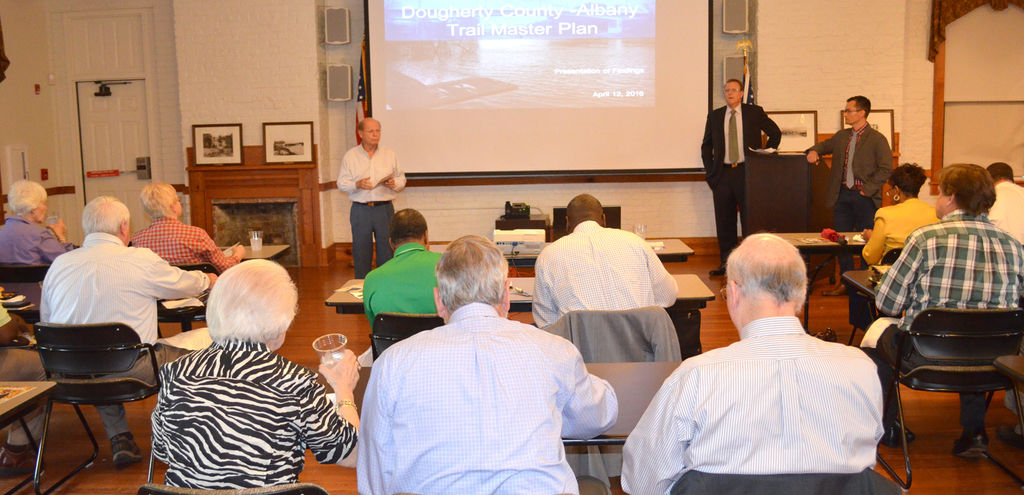
ALBANY — Six members of both the Dougherty County and Albany city commissions, three members of the region’s state legislative delegation, and both the Albany City and Dougherty County managers came to the city’s Bridge House Welcome Center Tuesday for a presentation of findings concerning the Dougherty County-Albany Trail Master Plan.
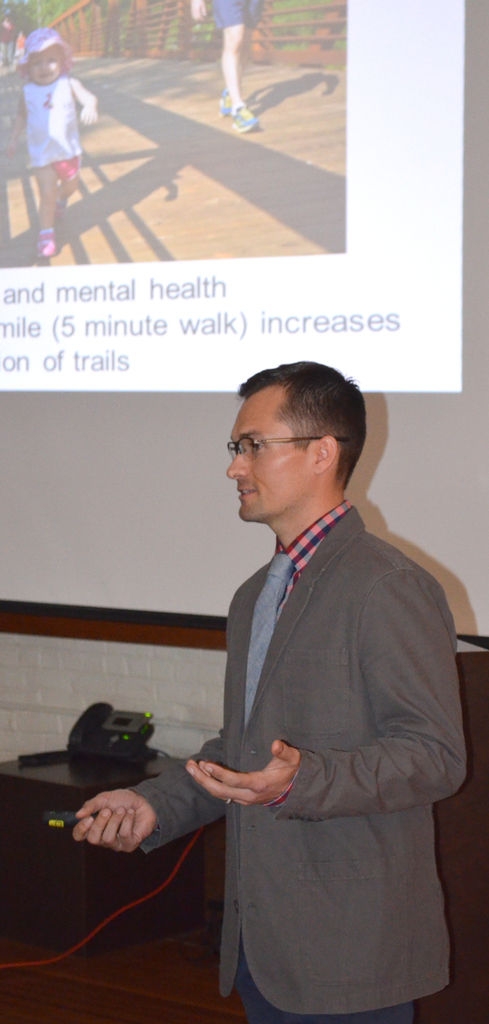
Presented by Kaizen Collaborative Urban Designer John Simmons, the noon gathering gave local officials — many for the first time — a detailed summary of Kaizen’s efforts to develop a trail master plan that will unite the city and county’s various planned and existing trails into a single system.
“Every event that we’ve had that involved the public and local stakeholders has had a tremendous turnout,” Simmons told the officials. “I think that clearly speaks of the interest in this project within this community.”
Simmons said Atlanta-based Kaizen, whose name is taken from a Japanese phrase meaning “continuing improvement and learning,” has developed more than 680 miles of trails throughout Georgia and the Southeast, including the 66-mile Silver Comet Trail that stretches from Atlanta to the Alabama state line.
The designer said figures released by Atlanta economic developers show that the Silver Comet Trail had resulted in $24 million in additional recreational spending and $5 million in additional tourism spending. He said property values along the trail increased by $130 million with property taxes going up $1.7 million.
“That trail has resulted in a $50 million economic impact and 400 jobs in Atlanta and a $61 million impact and an additional 670 jobs statewide,” Simmons said.
During his presentation, Simmons pointed out connectivity opportunities along the proposed route of the trail, including trailheads at the Ledo Road Walmart and Phoebe North along the 13.6-mile city-owned rail trail that stretches from downtown Albany to Sasser in Terrell County. He also said such opportunities also exist in downtown Albany neighborhoods near Tift Park, the main campus of Phoebe Putney Memorial Hospital and along 11th Avenue.
In Albany’s downtown district, Simmons noted connectivity possibilities along Flint, West Roosevelt and West Broad avenues, as well as Albany State University with the downtown district west of the Flint River and south to Radium Springs.
“Research for our (state-required) Comprehensive Plan shows that we’re losing population in the city and county and our median income is decreasing,” city/county Planning Services Director Paul Forgey told officials. “How can we reverse that trend? One way is to bring our young people back into the community after they graduate college. When that group, which is the one that has the opportunity to make money, leaves, it drives our income figures down.
“We have to find a way to make our community more attractive to the young millennials and to our senior citizens. A trail system is one way to attract both groups.”
Simmons said his company’s research indicates 20 percent of local people surveyed said they did not use the Riverfront Trail along the Flint. Additionally, he said, 59 percent of those surveyed said improved security was a major concern and 57 percent said more connections were needed along the trail.

Author

Related Articles

James Rubino installed in new role at Marine Corps Logistics Command in Albany
James L. Rubino recently assumed the role as executive deputy of Marine Corps Logistics Command in Albany. In his new role he will oversee integrated logistics support.

Rain depresses voter turnout in Dougherty County
“A lot of people don’t vote when it’s raining. People don’t do a lot of things when it’s raining.”
City of Albany faces shortfall for police, fire salaries
“We can’t tell staff to hire more police officers and then complain at what it costs.”
