
Albany Utility Board lengthens customers’ billing cycles
Additional time for utility bill payment expected to cut late fees
By Carlton Fletcher
ALBANY — It’s not a price reduction that many customers would like, but the Albany Utility Board voted Thursday morning to give ratepayers 10 additional days to pay their utility bills.
With the start of the new fiscal year July 1, Utility Board customers’ billing cycles will be extended from 20 days to 30, action that officials say will help alleviate late payment fees many customers are forced to pay.
“We can’t reduce fees at this time — and I know that’s what everyone would love — but we can extend billing cycles,” Assistant City Manager Stephen Collier said. “Hopefully, that will reduce the late payment fees for many of our customers.”
The city’s Utility Board currently charges a $15 late fee on the final day of customers’ billing cycles and adds a $30 disconnect/reconnect fee after five days. Collier said his research shows that the city of Marietta charges a $100 disconnect/connect fee, while Mitchell EMC charges $35 if the disconnect is made electronically from its offices and a $50 fee if a technician has to go to the customer’s home.
“This is a good gesture, a good start,” board member the Rev. Gary Sanders said. “I think we need to evaluate the program in a year or so to see if it’s having an impact.”
Also at the meeting, the board voted to recommend that the city fund a $2.61 million elevated water tank maintenance agreement with American Tank Maintenance. The contract would, staff said, cover engineering, wash-outs and clean-outs every other year, and interior renovations over a 15-year period.
“This action is consistent with what we’ve been talking about with asset management,” City Manager Sharon Subadan said.
The board also voted to recommend that the Albany City Commission approve a $45,976.34 contract with Waco Electric to rebuild a 47 hp pump at the city’s Lift Station 17. Asked by board member the Rev. Sam Sneed if repairing the pump was more cost effective than buying a new one, Subadan said timing was an issue.
“The lead time to get a new pump is three-four months,” she said. “Time is definitely a factor. Of course, if this amount didn’t surpass my ($40,000 spending) cap, that pump would be repaired by now. Essentially, bureaucracy allows this process to be held up over $5,976.34.
“I hope that’s something we’ll be able to discuss with the commission soon.”
Assistant city Engineering Director Robert Griffin gave the board a report on credit availability under the city’s stormwater utility. Griffin pointed out that stormwater fees are determined by Equivalent Residential Units, which are based on an average 2,700-square feet of impervious surface. Currently, fees are $3 per ERU, but they will increase to $4.75 on July 1.
“We want customers, especially businesses, to know what they need to do to get stormwater credits,” Griffin said. “They can get up to 50 percent of the stormwater fee reduced from their bill by incorporating such measures as a retention pond into their stormwater plan.”
Subadan said the credit measures are as important as the stormwater fees.
“As much water as we can keep out of our system, it’s better for everyone,” she said.
Also at the meeting, Subadan praised Utility Board employees Jeff Hughes and Mike Capps for their efforts in helping the local Procter & Gamble plant operate at maximum capacity during December floods. Subadan said P&G officials sent awards of recognition Capps, Hughes and Assistant City Manager Phil Roberson for “literally working around the clock” to keep the plant operating.
Author

Related Articles

Albany recycling center enacts material separation rule
Mixed items will no longer be accepted at the Albany recycling center at its 2521 Meredyth Drive facility. Individuals will now be required to separate items befor they will be accepted.
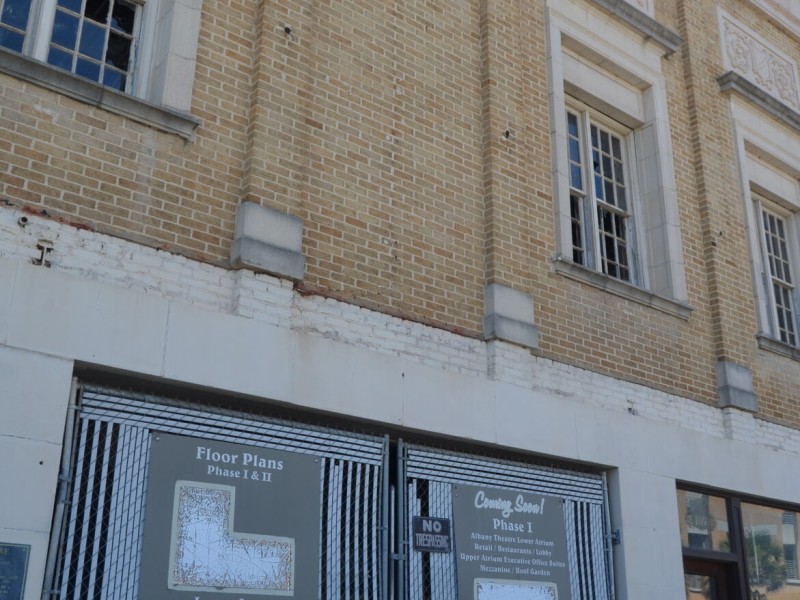
Albany City Commission takes action on proposed downtown hotel, two theater renovation projects
“We’re taking the original building back to, hopefully, it’s glory days. One of the cool things about the project is we are going to restore the balcony. It’s going to have a balcony, so it’s going to be super cool.”
Dawson’s $10.2 million sewer project leaves major financial questions unresolved
As Dawson’s finance director resigns and operating pressures mount, records show $10.2 million in sewer funding, frozen loans, missing audits and gaps in the public accounting of project money.
