
Beer 101: Morgan provides historical perspective
Albany physician planning downtown microbrewery
By David Shivers
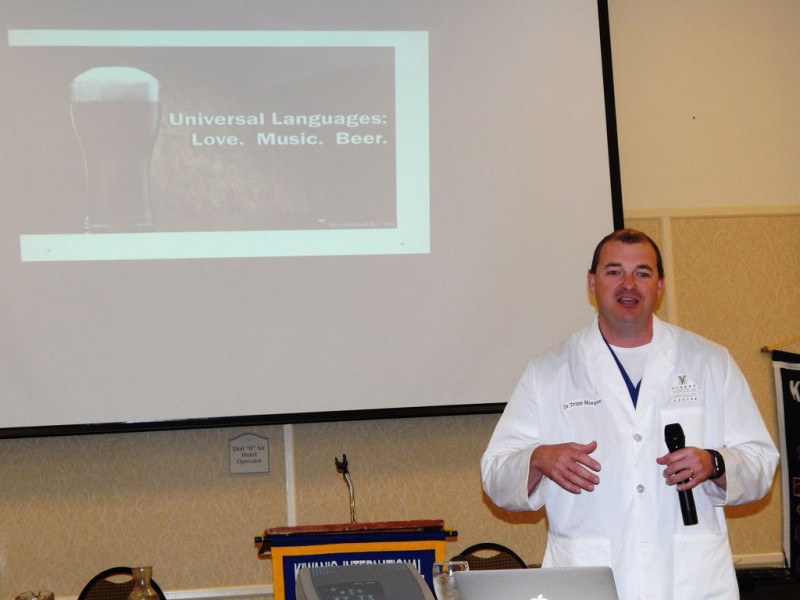
ALBANY — The human race has a long history of affinity for beer, and with the new microbrewery on the horizon for downtown Albany, it seemed to developer Dr. Tripp Morgan III a good time to deliver a brief history of beer along with some details about his project.
Dr. Morgan, a vascular surgeon, brought his presentation to the Kiwanis Club of Dougherty County recently. The study of beer, he noted, is called zythology.
Beer was known to ancient civilizations, including the Babylonian, Assyrian, Egyptian, Hebrew, Chinese, and Inca cultures. From 25 B.C.E. to 300 B.C.E. it was drank extensively throughout the Roman Empire, according to Morgan’s presentation, and from 500 A.D. to 1500 A.D. the largest brewers were religious monasteries. In medieval Europe, the alcohol present in beer (three to four percent content) often made it a cleaner beverage than water and prevented millions of people from contracting giardia (a microscopic intestinal parasite).
It’s believed, according to Morgan, the Romans discovered beer when they conquered northwestern Europe. Because of the climate in southern Europe, wine was their preferred beverage.
“Beer is very finicky; it likes to be cold,” said Morgan. “It’s only good for a couple of days when it’s not cold; it loses a lot of its flavor. Once you made wine, you could put it in a bag, carry it all around the Roman Empire.” In fact, it’s believed wine became known as the drink of the elite after the Romans discovered the “barbarians” of the north drinking beer.
By 1200, beer-making was firmly established as a commercial enterprise in Germany, Austria, and England. In an unconfirmed “statistic”, Morgan quipped that the Pilgrims landed at Plymouth Rock in 1620 because their beer supplies were running low. In 1820, Oktoberfest was established as an official celebration in Munich, Germany.
Beer sales did well in the U.S. until the Prohibition Act banned them in 1920, and breweries in small towns that had developed their own special brands were shut down. When Prohibition was repealed in the early 1930s, large brewers began to commandeer the beer market
Then, said Morgan, “Around 1976 to the early 1980s, there was really a change in the U.S. beer market with the establishment of the New Albion Brew Company in Sonoma, Calif.” The 1980s became the decade of the microbrewery pioneers.
The year 2004 saw an acceleration of craft brewery sales with annual growth percentages of between 6 and 12 percent each year through 2008. Last year craft beer owned 13 percent of the total beer market in the U.S. and is expected to reach 20 percent by 2020 with projections of continued growth.
Georgia law currently divides beer licensing into three tiers: manufacturing, wholesaling, and retailing. Morgan’s Albany microbrewery will be classified as a beer manufacturer and will sell its products to a distributor, although it will offer tours with tastings. Downtown, said Morgan, “We’re not relying on traffic. Hopefully we’ll bring traffic, but we’re not relying on traffic being there already.”
The microbrewery will use wheat instead of barley, said Morgan, because wheat does much better here than barley. On his family’s own Dougherty County farm property, fruits can also be grown for use in flavoring craft beers. Hops, though, will have to be purchased from outside.
“We’ll have a specific set of beers,” he said. “We’ll have two or three core products that we’ll make all the time, and then during the year we’ll have seasonals” or for special events. “We can also make some nonalcoholic products like root beer or carbonated water.”
Morgan and his partners have leased the former Art Park property on Pine Avenue from the city and purchased the two buildings to the east of it to locate the microbrewery. One of buildings will be mainly green space. “The old Albany Herald building will be the main entrance and tasting room, and then the art park is where our brewhouse will be.” There will also be an open area for special events, and they want to get into small-run barrel-aged beer, which Morgan described as “sort of an added value thing.”
While no one has been hired as yet, several persons have been interviewed for the brewmaster position, said Morgan. He expects the project to bring 8-12 permanent jobs downtown.
Morgan has had the idea of a microbrewery “in the back of my mind” for 10 years and home-brewed some beer in college. He initially proposed the brewery on the farm property, but county zoning ordinances proved an obstacle ‘’which stopped us for a while, and then the city came and made us an offer and said ‘Why not downtown?’”
Morgan believes the microbrewery now will represent the best of both worlds – city and country.
PHOTO CAPTION
Dr. Tripp Morgan III describes for Kiwanis of Dougherty members a brief history of beer and its popularity. (Photo by David Shivers)
Related Articles

James Rubino installed in new role at Marine Corps Logistics Command in Albany
James L. Rubino recently assumed the role as executive deputy of Marine Corps Logistics Command in Albany. In his new role he will oversee integrated logistics support.

Rain depresses voter turnout in Dougherty County
“A lot of people don’t vote when it’s raining. People don’t do a lot of things when it’s raining.”

City of Albany faces shortfall for police, fire salaries
“We can’t tell staff to hire more police officers and then complain at what it costs.”
