Research center will apply artificial intelligence and computer technology to farming
Staff Photo: Alan Mauldin
By Alan Mauldin
[email protected]
ALBANY — A robotic arm to pick fruit and vegetables? A machine that can learn and steer heavy machinery such as a tractor?
Those scenarios aren’t from Silicon Valley or the next installment of “The Terminator” series of movies, they’re projects that could be furthered with a new technology center coming to Albany.
The Georgia Board of Regents recently gave the OK for the project,
“We had the nexus program approved by the Board of Regents,” Robert Owor, chairman of the Department of Mathematics and Computer Sciences at Albany State University, said.
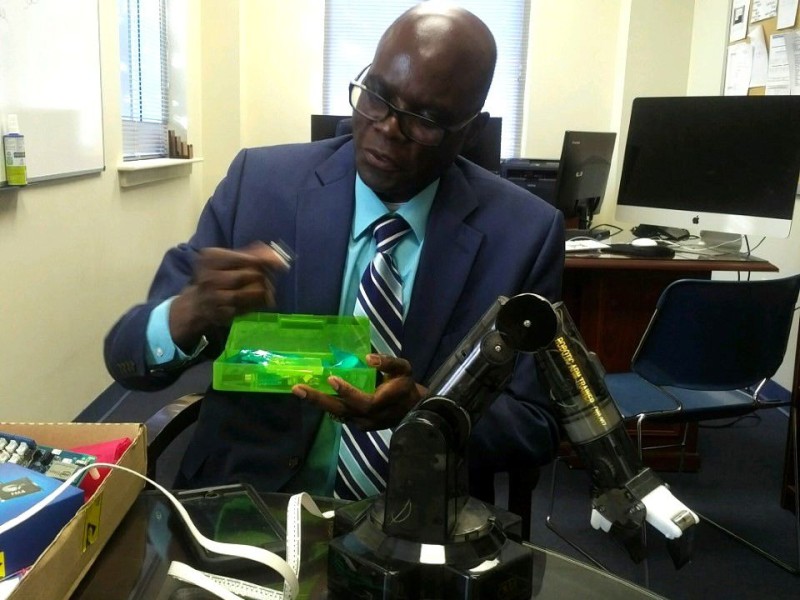
While talking with a reporter, Owor sat at a table on which sat a robotic arm and a donated computer chip that provides the brain for self-driving cars.
Albany State is planning nexus degrees in both blockchain with machine learning and blockchain with data analytics. It was the first university in the state approved to offer the degrees, along with Columbus State University, which plans to offer a nexus degree in film production beginning in January.
“This is really cutting-edge technology,” Owor said. “We have just entered the fourth industrial revolution.”
The first industrial revolution was mechanical, the second mechanical/electrical, the third was electronic.
“The fourth one was artificial intelligence,” said Owor, who along with Albany physician Dr. Tripp Morgan made the pitch to the Board of Regents.
Artificial intelligence, or AI, is associated with designing computers or computer-controlled robots to perform the tasks of intelligent beings or machines that can go beyond initial programming to learn and reason on their own.
The technology center, envisioned for downtown Albany, will be dedicated to projects designed to assist with agriculture. The initial project will deal with irrigation and ways to help farmers use less water, cutting their costs, while maintaining production.
“We want to create a center for innovation and technology, and we want to help farmers to use the technologies to increase their production, increase yield and cut down costs,” Owor said.
Machines could measure temperature, evaporation rate and other factors to optimize water application, even providing varied rates in different parts of a field based on the need in specific locations, for example.
“If I use sensors and artificial intelligence and assess all the costs, I could cut my expenses by 60 percent,” Owor said. “We are very interested in reducing the amount of water used from the Flint River.”
Technology also could be used to help reduce the use of pesticides.
“Our health is getting affected by the use of pesticides,” Owor said. “That’s because we have to spray all over. With AI, we could use cameras or drones that tell us exactly where the pests are. With targeted spraying we could save (money) and also have less pesticides in our food.”
Owor said he envisions having other institutions such as the Commodore Conyers College & Career (4C) Academy in the Dougherty County School System and Albany Technical College participate.
The 4C Academy has launched a program that fosters hands-on learning that includes agriculture and robotics.
“I think there’s a tremendous opportunity to engage our students and engage our farmers and to build productive solutions,” Owor said. “We’re working with the city of Albany to give us a location downtown. We’re partnering with the U.S. Department of Agriculture, the Georgia Department of Agriculture and the University System of Georgia, so we can bring in different experts to assist us.”
The effort has money for setting up the center and support from technology companies, and Owor said he plans to seek grant funding.
“We want to create opportunities right here,” Owor said. “That’s why we’re asking for this to be here. I’m really excited about all this technology.”
Morgan, owner of Pretoria Fields Collective, said that the brewery’s farmland will be used for research purposes. He said he became interested in the project after meeting Owor and having him on his “No Dams Given” podcast.
“Then, after having a really great conversation with him, he and I were discussing how people in our area need access to some highly skilled (areas) — website developers, app developers,” Morgan said. “In southwest Georgia, those things are really hard to find.”
The center also will be an opportunity to re-purpose some space in downtown, he said.
A main question is “how do we bring AI and robotics together to help promote farming, decrease use of pesticides and chemicals and protect natural resources and be more efficient?” Morgan said.
Author

Related Articles
Regional catering business finds new home at Warrior Creek Mercantile
For months, Marchbanks said she had been asking God for an opportunity to serve others. “I just kept praying, ‘God, use me as a servant,'” she recalled. “I didn’t care what it was. I just wanted to be used to help people.”