
Dougherty officials call for federal help
Chris Cohilas: Residents have no food, no home, no warmth, no hope
By Carlton Fletcher
ALBANY — Dougherty County Commission Chairman Chris Cohilas called on President Trump and Federal Emergency Management Agency officials Monday to “cut through the red tape” and get federal help to the community in the wake of the weekend of storms that left four confirmed dead and “mass destruction” in the county.
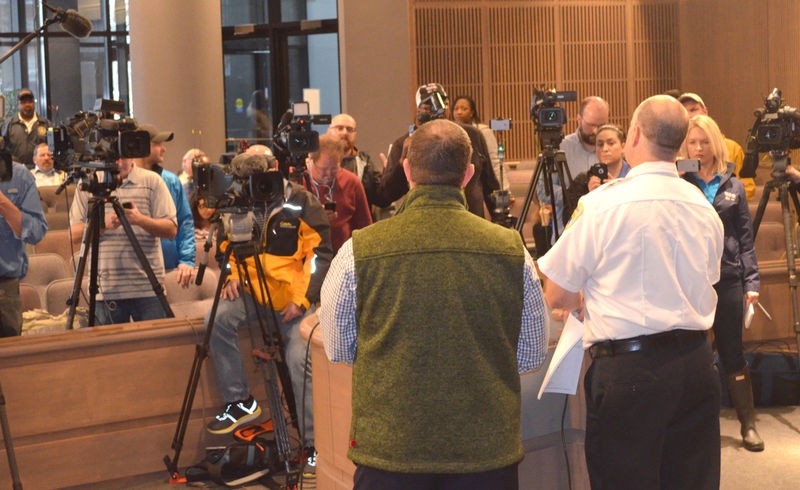
At a news conference at the Albany-Dougherty Government Center, Cohilas pleaded for “boots on the ground” in a community that’s “exhausted every asset we have.”
“We’ve been begging FEMA for boots on the ground,” Cohilas said. “And for that to get caught up in bureaucratic red tape at a time like this is deplorable. I’m asking President Trump to cut through the red tape and get people on the damned ground here.”
Cohilas and Dougherty County Emergency Management Director Ron Rowe conducted the news conference, but unlike the several that city and county officials held after the Jan. 2 storm system that devastated the community, this one drew national, regional, state and local media outlets.
Rowe confirmed that four southeast Dougherty County residents were killed in a tornado that touched down Sunday afternoon at the Paradise Village Mobile Home Park at 600 Holly Drive, but he said the identities of the victims were being withheld pending notification of next of kin. Coroner Michael Fowler held a news conference later in the afternoon during which he gave the names of some of the storm victims.
“The damage that we’ve suffered in our community is immeasurable,” Cohilas said. “Four deaths have been confirmed, and that’s going to rise. Our people are suffering. They have no food, no home, no warmth, no hope.”
Rowe described recovery efforts in the affected area as “primitive.”
“It’s been difficult to get an estimate of the number of structures damaged, even from an aerial view,” he said. “The damage is so severe, it’s hard to tell where one structure stops and another begins. Because of the debris and the lack of access, we’re conducting very primitive search and rescue efforts right now, going from door to door.”
Rowe said that the Paradise Village and Pine Bluff mobile home parks in the region are scenes of “total devastation and destruction.”
“Whole neighborhoods have been removed, if I can use that term,” Rowe said. “With our ongoing recovery efforts from the Jan. 2 storm (that left thousands without power and an estimated 1 million cubic yards in downed trees and debris), this latest series of storms has compounded our issues. There are only a couple of areas in our county that have not been impacted by these two events.”
Georgia Gov. Nathan Deal, who said on his Twitter account Sunday that he had contacted President Trump concerning the devastation in the state, announced Monday that he was expanding his initial emergency declaration to include nine additional counties in south Georgia. That executive order, which Deal extended Monday to run through midnight on Jan. 30, now includes Atkinson, Baker, Berrien, Brooks, Calhoun, Clay, Colquitt, Cook, Crisp, Dougherty, Lowndes, Mitchell, Thomas, Turner, Wilcox and Worth counties.
Dougherty and Mitchell counties were already under an emergency declaration from the Jan. 2 storm.
Deal also announced that he plans to make another visit to the affected areas on Wednesday.
Cohilas thanked members of the media on hand for Monday’s news conference, calling the Jan. 2 storm the “most underreported disaster in the history of this country.”
“Our community was already crippled from the Jan. 2 storm,” he said. “Our folks here are hurting, they’ve been needing (federal) help for a while now. And it’s not for lack of local effort. There are a lot of heroes in our community today.
“This latest storm is, in many ways, going to be worse. People’s homes were destroyed; the Marine Base sustained serious damage; businesses and industries — where our people earn their living — have been impacted. Procter & Gamble had a warehouse destroyed.; Coats & Clark was hit. … And we have search and rescue units out now in several neighborhoods, sifting through the rubble trying to find bodies.”
Asked if the county had adequate resources, given GEMA’s involvement, to manage recovery efforts, Cohilas quickly said no.
“Even using state assets, it’s not enough,” he said. “When GEMA officials came down here after Jan. 2 and saw the damage, within 20 minutes they were dictating letters to FEMA saying there was a great need for assistance. Now, with this storm coming three weeks later, we just don’t have the resources. We need everything the federal government can throw at us.
“We’re not asking for money today; we’re asking for help.”
Rowe said that individuals not directly involved in recovery efforts or who do not live in the area should stay away from the county for the immediate future.
“If you don’t need to be in Dougherty County right now, don’t be,” he said. “This sightseeing event (that some engage in) is not good for our ongoing rescue efforts.”
Cohilas said that a projection of $26 million in noninsured losses and $30 million in insured losses from the Jan. 2 event did not scratch the surface of the damage the county had undergone before the series of weekend storms that brought the deadly tornado to the community.
“There’s no way to meaningfully aggregate the numbers,” the commission chairman said. “Just from the Jan. 2 storm, I feel there was in excess of $100 million in damages. And that doesn’t even take into account the business losses.”
Rowe said EMA officials had tried to warn citizens of the potential danger of the series of storm cells that spawned several as-yet unconfirmed tornadoes, 80-mph straight-line winds, hail and up to 11 inches of rain in some locations.
“This was an unprecedented weather event,” the EMA chief said. “We had back-to-back-to-back storm systems Friday, Saturday and Sunday. We knew there was the potential for danger as soon as the National Weather Service told us that this event was possible, so we started warning citizens five days out. We put fliers up in restaurants and other gathering places, and in some areas we went door-to-door.
“Still, I don’t think there’s any way you can prepare adequately for something like this. People use this term, but there are areas in our county that look like bombs went off.”
Author

Related Articles

James Rubino installed in new role at Marine Corps Logistics Command in Albany
James L. Rubino recently assumed the role as executive deputy of Marine Corps Logistics Command in Albany. In his new role he will oversee integrated logistics support.

Rain depresses voter turnout in Dougherty County
“A lot of people don’t vote when it’s raining. People don’t do a lot of things when it’s raining.”
City of Albany faces shortfall for police, fire salaries
“We can’t tell staff to hire more police officers and then complain at what it costs.”
