
Dougherty tax-exempt property list grows
Tax officials say county’s tax digest shrinks as exemption list grows
By Carlton Fletcher
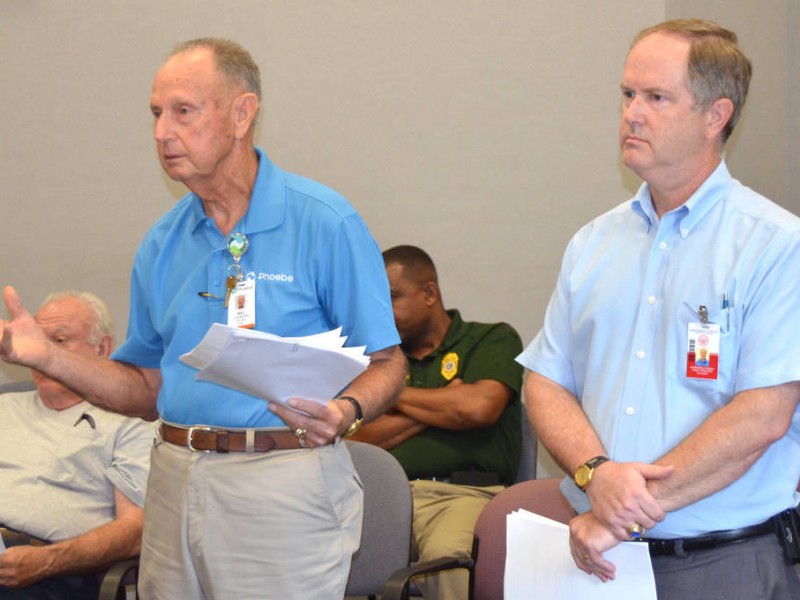
ALBANY — As long-time Dougherty Tax Assessors Board Chairman William Ashberry gave county commissioners a history lesson Monday based on his 38 years with the board, the focus turned to tax-exempt properties in the county.
As pointed out in recent Albany Herald articles concerning the county’s state-highest percentage of properties whose owners pay no taxes, the growing list of state- and federally-mandated tax exemptions is taking an ever-growing bite out of the county’s rapidly shrinking digest.
When Ashberry noted that the tax burden in the county is shifted in greater amounts to the shrinking number of individuals and businesses that do not have tax-exempt status, District 6 Commissioner Anthony Jones jumped into the fray with the admonition: “We need to point out to our citizens that the only free cheese is in the mouse trap.”
The county’s financial staff and tax officials might be excused if they feel that perhaps Jones’ trap has clamped down on them as they keep adding — more appropriately, subtracting — to the havoc that government-mandated exemptions are having on the county’s tax numbers. Information provided by Ashberry and county Chief Tax Appraiser George Anderson Monday shows that 4,179 properties, with a tax value of $369,196,519, are on the county’s tax-exempt roll.
“I don’t think citizens get the reality of this,” Ashberry said. “Many of them just seem to think than when some group gets tax-exempt status, it’s just giving a usually deserving group a break. What they’re not getting is that the more properties that are moved to the exempt status, the more taxpayers who are not exempt have to pay.”
Anderson said the county tax office has one employee whose sole duty is to review tax-exempt properties yearly to assure that those properties are being used properly in one of eight categories for which exemptions are permitted. Those categories are nonprofit homes for the aged, public property, places of religious worship, charitable properties, places of religious burial, charity hospitals, educational institutions and a catch-all “other exempt” category.
“Once a property is reviewed, our staff member will make a recommendation as to whether the property is being used properly,” Anderson said. “The Tax Assessors Board will make the final decision.”
In 2017, 27 properties in Dougherty County were removed from tax-exempt status and placed on the taxable roll. The properties are valued at $5,024,166, according to information provided by Ashberry and Anderson. The previous year, 13 such properties, valued at $4,217,590, had their status changed.
Conversely, 11 county properties valued at $9,394,460 were moved from taxable to tax-exempt status this year, and 48 previously taxable properties, valued at $15,260,370, were granted tax-exempt status last year.
“The thing that a lot of people in the public don’t consider is that all of these tax-exempt properties — like churches building basketball gyms — get the same services as taxable properties, but they don’t have to pay for the services,” County Attorney Spencer Lee said. “And we can’t leave the government properties — city, county, state and federal — and schools out of this discussion.”
Ashberry offered a list of tax exemptions that were not in effect when he started with the Tax Assessors Board, including all farm crops, farm equipment, pecan trees, pine trees, construction equipment used to build highways, community hospitals, veterans organizations (“And they surely deserve it,” he noted), churches, public charitable organizations, homeowners (homestead exemptions) and business inventory.
“I want to make sure y’all understand that I’m not saying that any exemption is right or wrong, but you take a charity hospital like Phoebe (Putney Memorial Hospital) that comes in and buys property and leases at least 50 percent of that property to doctors, the property is tax exempt,” Ashberry said. “Now, none of those doctors who were, in the past, paying taxes on the properties where they had their offices are paying taxes.
“Those kinds of things take a tremendous bite out of the tax digest.”
Anderson, meanwhile, said the tax office has not begun to evaluate what impact January floods that devastated properties in the community will have on the county’s tax digest next year.
“We won’t do that evaluation until closer to the end of the year because tax values are based each year on a property’s value on Jan. 1,” the chief tax appraiser said. “We would not get a true value at this time, so it doesn’t make sense to try and make an evaluation now.”
Commission Chairman Chris Cohilas said, “Suffice it to say that there are a lot of positive things that can impact your tax digest, but two tornadoes are not among them.”
Added Lee: “We do know this: If a house is worth $75,000 and it’s located on a lot worth $15,000, if the house no longer exists at the end of the tax year, that property will be worth $15,000.”

Author

Related Articles

James Rubino installed in new role at Marine Corps Logistics Command in Albany
James L. Rubino recently assumed the role as executive deputy of Marine Corps Logistics Command in Albany. In his new role he will oversee integrated logistics support.

Rain depresses voter turnout in Dougherty County
“A lot of people don’t vote when it’s raining. People don’t do a lot of things when it’s raining.”
City of Albany faces shortfall for police, fire salaries
“We can’t tell staff to hire more police officers and then complain at what it costs.”
