
Food security focus of ag abroad gathering
Annual gathering emphasizes international cooperation
By Merritt Melancon
University of Georgia, CAES
ATHENS — University of Georgia College of Agricultural and Environmental Sciences (CAES) students and faculty gathered recently to celebrate their commitment to international cooperation and scholarship and to discuss current issues in food security.
The gathering was the college’s eighth annual International Agriculture Day Lecture and Reception. The event has become a time to reflect on the international nature of agriculture and the importance of agricultural development in building a safer, healthier world.
“Perhaps the single greatest challenge that these students will face is feeding a global population that is expected to exceed 9 billion people in a relatively short period of time,” said CAES Dean and Director Sam Pardue. “We need to do this while maintaining and conserving our natural resources. We aim to provide them with the very best education and opportunities to prepare them to meet that challenge and conquer it.
“Today we focus our attention on one of the major hurdles: understanding other cultures and how we need to work together to build a more food-secure world.”
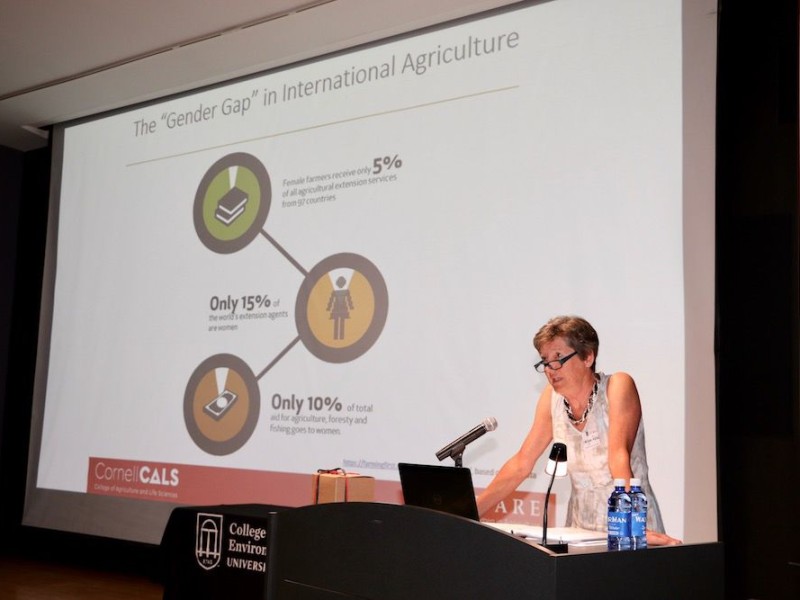
The gender gap is a culturally based agricultural challenge that must be overcome, said keynote speaker Helga Recke, a Visiting Fellow in Cornell University’s College of Agriculture and Life Sciences’ Advancing Women in Agriculture through Research and Education program.
Feeding the world’s growing population will only be possible if all farmers, including the nearly 50 percent of farmers who are women, are empowered to produce their best crops.
Lack of credit, lack of education and cultural subordination keep female farmers around the world producing about 20 to 30 percent less than their male counterparts, Recke told the gathering. This disparity must be overcome to provide worldwide food security.
Recke has spent her career on the forefront of global agricultural development, studying the ways that gender impacts agricultural development and supporting education and professional development for female agricultural scientists across the developing world.
In her lecture “Efforts to Narrow the Gender Gap in Agriculture: One Woman’s Journey,” Recke discussed how traditional and transitional gender roles affect agricultural development and scientific progress in the developing world.
“Gender in agriculture is not just a hobby horse,” she said. “It has real consequences if you pay attention.”
Agricultural development efforts that ignore the way women use agricultural technologies or the division of labor between women and men on farms are bound to fail.
As part of the effort to create agricultural technologies responsive to the needs of both female and male farmers, Recke has spent two decades supporting leadership roles for female scientists and extension specialists in developing countries and around the world.
Having a more diverse group of scientists that is developing technologies will lead to a more diverse set of solutions for farmers, she said. These are the types of solutions that students and faculty members gathered at the event will develop in the coming century.
The CAES Office of Global Programs, which hosts the International Agriculture Day Lecture and Reception each spring, honored some of the college’s most globally minded students with travel grants, scholarships and awards at the event. Students who will graduate this year with the college’s International Agriculture Certificate were also recognized.
Kirsten Allen, a senior pursuing a bachelor’s degree in pharmaceutical sciences and a minor in plant biology and a certificate recipient, told the crowd how her internship in Piacenza, Italy, broadened her worldview and inspired her to work internationally.
CAES Professor Terence Centner has studied the intersection of environmental policies and outcomes in agricultural and natural resource conservation settings for 30 years. This year, as part of his commitment to international scholarship and education, he established the Terence J. Centner International Scholarship.
The scholarship will support a CAES undergraduate student who participates in a semesterlong exchange program at a UGA partner university in Africa, Asia, Australia, Europe or South America.
Over the three decades he spent in Conner Hall, Wen Williams, retired CAES professor of agricultural and applied economics and associate dean and director for academic affairs, impacted the lives of thousands of students.
This year, in support of his mission to broaden the horizons of CAES students, he established the Wen Williams International Travel Endowment Fund, which supports a CAES undergraduate student participating in one of the college’s study abroad, international internship or exchange programs.
For more information about the Office of Global Programs, visit www.global.uga.edu.
Merritt Melancon is a news editor with the University of Georgia College of Agricultural and Environmental Sciences.
Related Articles
From Ledo to Coston, Lee County’s summer road projects are underway
Updates provided during recent meetings of the Lee County Board of Commissioners show projects are underway or scheduled to begin on several county roads, while additional transportation improvements funded through the Local Maintenance and Improvement Grant (LMIG) program and Transportation Special Purpose Local Option Sales Tax (T-SPLOST) are expected to begin shortly after the July Fourth holiday.
PSC candidate Peter Hubbard makes case for election to full term
The reason why voters should pick me is I’m a rare breed in that I read everything that comes across my desk. I’m asking hard questions at the meetings. I want to get to the bottom of are data centers paying their fair share, are residential customers getting their fair share.
Dougherty Schools prepare for bell-to-bell student cell phone ban
As Georgia prepares to expand its statewide ban on personal electronic devices in public schools, Dougherty County School System leaders say they are working to balance compliance with the new law while giving individual schools flexibility in how they implement the policy.
