
Ivey Hines anxious to finish what he started
Commission candidate says he has vision to serve citizens
By Carlton Fletcher
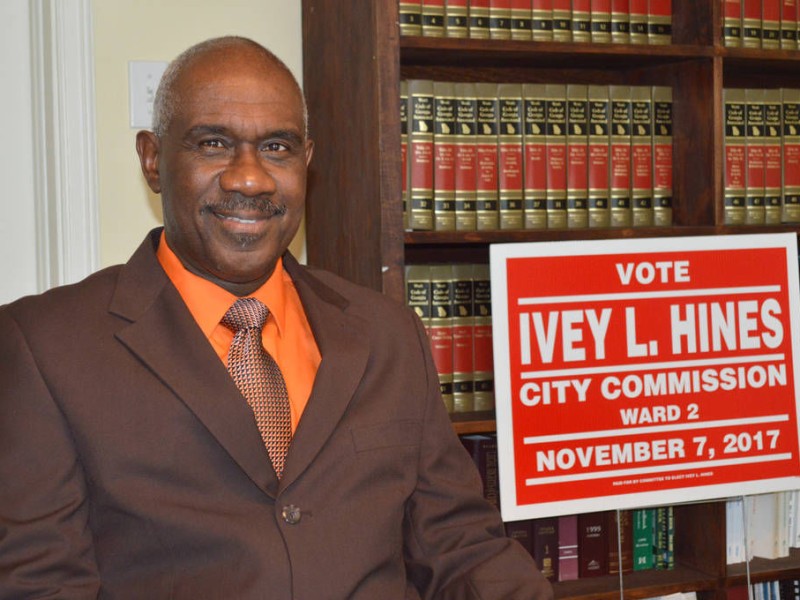
ALBANY — Ivey Hines may have lost his eyesight to a debilitating disease, but the retired IT specialist says the one quality that puts him ahead of the pack in the crowded Ward II Albany City Commission race is vision.
“A leader must have vision,” Hines said. “Some people, though, confuse sight and vision. Sight is the ability to see what’s wonderful and chaotic. Vision is the ability to see what’s chaotic and create a concept of order out of it. Anything that is good can be made better. Vision is the ability to make things better.”
Hines is no newcomer to the city government or to the Ward II seat. He won a special election to replace current Albany Mayor Dorothy Hubbard in the Ward II seat in 2013 when Hubbard stepped down for her successful mayoral run. The fact that Hines lost to Bobby Coleman in his quest to retain the Ward II seat four years ago has eaten away at the former commissioner over the ensuing years.
“I was a proponent of putting together a well-thought-out strategic plan when I was in office before, and we had begun to incorporate some of the elements of that plan when I left office,” Hines, a former pastor who still preaches, said. “The leaders of a city, with input from its citizens, must determine what kind of city they want. But the only way to make that happen is to have a road map.”
Given Albany’s high poverty rate, Hines adds his name to the chorus of individuals clamoring for economic development in the city and region. But his is a somewhat outside-the-mainstream approach.
“We have this tendency to just put it out there that we’re interested in bringing business here,” he said. “And, to a degree, that’s true because we do need jobs. But I believe we have to take a more sustainable approach when we’re recruiting businesses. What we have to do is look at the businesses that we have here and the assets that our community can offer, and then recruit businesses that complement what’s already here or that will be best served by our assets.
“Again, we have to put together a plan that focuses on our strengths and then recruit businesses that are considering expansion or looking to build by letting them know what we have to offer. By recruiting businesses that complement the ones already here, we’ll also give those existing businesses a greater opportunity for expansion.”
Hines says that, despite common criticism, Albany does have plenty to offer potential businesses or individuals looking to relocate here.
“Contrary to what some people think, we have some selling points in Albany,” he said. “We’ve grown accustomed to complaining about education here, but we have a strong educational foundation. We have a newly united (Albany State) university, Albany Technical College is training students for specific jobs in the community, the new Commodore Conyers College and Career Academy is one of the best educational ideas we’ve seen in a long time, and people tend to forget that Turner Job Corps is an asset that we can leverage.
“And when you look at the issues that confront our community — poverty, economic development, crime — everything is impacted by education. I’m all in in support of education, and that stuff about ‘but we can’t do anything about education, it’s up to the school board’ just doesn’t work. Every warm body in Dougherty County, every citizen needs to be involved in promoting how important education is.”
Hines said one of the concerns Ward II citizens have directed at him in the four years he’s been out of office is lack of access to their commissioner.
“I’ve talked to people in the ward who are displeased about what’s on the table,” he said. “They feel neglected, that they’re not being heard. That seems to have become a problem over the last four years. I’ve heard the whispers of concern about my sight, but I want to assure our citizens that I’m fully aware of what’s going on. I’m engaged, and when people call I respond.”
Hines said he also brings the ability to work with others to the table.
“No one person can bring about change without a consensus,” he said. “You have to be able to get three other votes to have an impact. I can do that. I work with others well. I believe that any seven people working together is going to be stronger than any one person at the table. There’s a synergy to a collective group. And, at the end of the day, you’ll get a better product.”
Author

Related Articles

James Rubino installed in new role at Marine Corps Logistics Command in Albany
James L. Rubino recently assumed the role as executive deputy of Marine Corps Logistics Command in Albany. In his new role he will oversee integrated logistics support.

Rain depresses voter turnout in Dougherty County
“A lot of people don’t vote when it’s raining. People don’t do a lot of things when it’s raining.”
City of Albany faces shortfall for police, fire salaries
“We can’t tell staff to hire more police officers and then complain at what it costs.”
