
Labor numbers show mixed bag for Albany area
Albany ranked 12th among Georgia’s 14 metropolitan areas in March with a 4.7 percent unemployment rate
From Staff Reports
ATLANTA — Georgia Labor Commissioner Mark Butler said Thursday that the Albany area posted a mixed March as several critical job measures trended in the right direction again, but others slipped.
Albany ranked 12th among Georgia’s 14 metropolitan statistical areas, or MSAs, with a 4.7 percent unemployment rate, down .4 percent from last month. The rate was 5.5 percent a year ago.
Butler noted the monthly numbers for jobs, employed residents and the labor force all decreased in March. At the same time, the unemployment rate dropped.
“So many of our local communities are trending in the right direction in terms of job creation and hiring,” Butler said. “And, we are even seeing records in many places.”
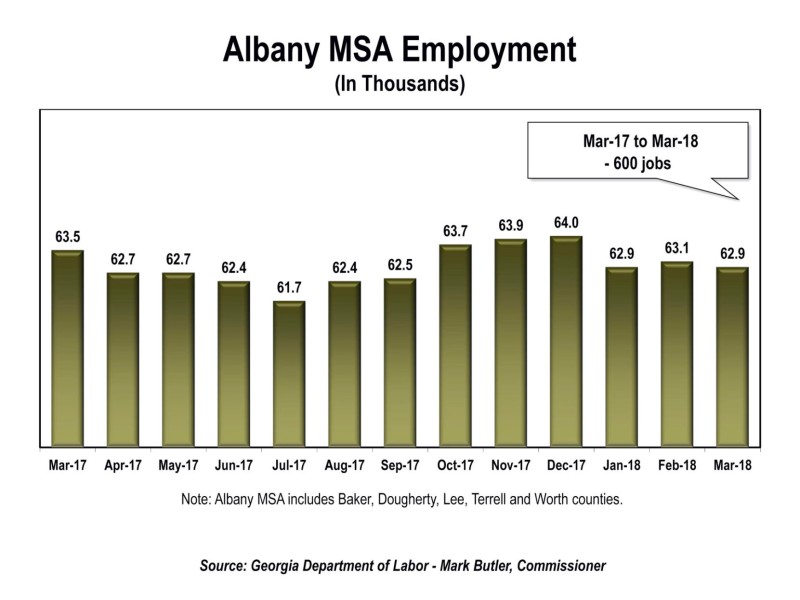
Albany ended March with 65,765 employed residents. The area’s employed residents fell in March by 158 but was still up by 540 over the year. Jobs dropped by 200 in March to 62,900. The change over the past 12 months was a decline of 600, officials with the Georgia Department of Labor said.
The area reported a decline in private services, the Department of Labor said.
The Albany labor force ended March at 69,021. Labor officials said this number is down 457 over the month and down 18 over the past 12 months.
Georgia’s 14 metropolitan statistical areas had unemployment rates that varied from a low of 3.3 percent in Gainesville to Dalton ’s 5.3 percent. Labor officials said all 14 trended lower in March.
Initial claims for unemployment, a measurement of new layoffs, were up about 52 percent for the month and by about 2 percent for the year. The five-county MSA for the Albany area includes Baker, Dougherty, Lee, Terrell and Worth counties.
Employ Georgia, the GDOL’s online job listing service at www.employgeorgia.com showed 650 new active job postings in metro Albany for March.
Visit dol.georgia.gov to learn more about career opportunities, Employ Georgia and other GDOL services for job seekers and employers. The website also includes additional labor data for the state.
Related Articles

James Rubino installed in new role at Marine Corps Logistics Command in Albany
James L. Rubino recently assumed the role as executive deputy of Marine Corps Logistics Command in Albany. In his new role he will oversee integrated logistics support.

Rain depresses voter turnout in Dougherty County
“A lot of people don’t vote when it’s raining. People don’t do a lot of things when it’s raining.”

City of Albany faces shortfall for police, fire salaries
“We can’t tell staff to hire more police officers and then complain at what it costs.”
