
Michigan-type water issues unlikely in Albany
Plumbing, water chemistry, close monitoring guard against water disaster
By Carlton Fletcher
ALBANY — As the furor surrounding the tainted water supply in Flint, Mich., continues to grow, with some even demanding that criminal charges be brought against what they contend were complicit government officials all the way up to Gov. Rick Snyder’s office, Southwest Georgians hundreds of miles south have started if their own water is safe.
In today’s world of rampant litigation, no one’s going out on any limbs and proclaiming a local water system to be fail-safe. The men and women who keep Albany’s water flowing clean and virtually contaminant free, however, say something occurring akin to the Michigan tragedy is not at all likely.
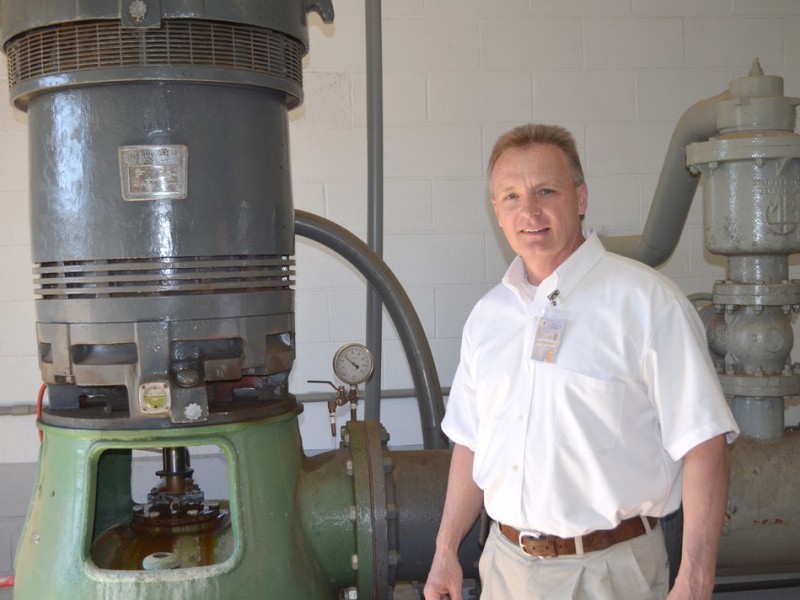
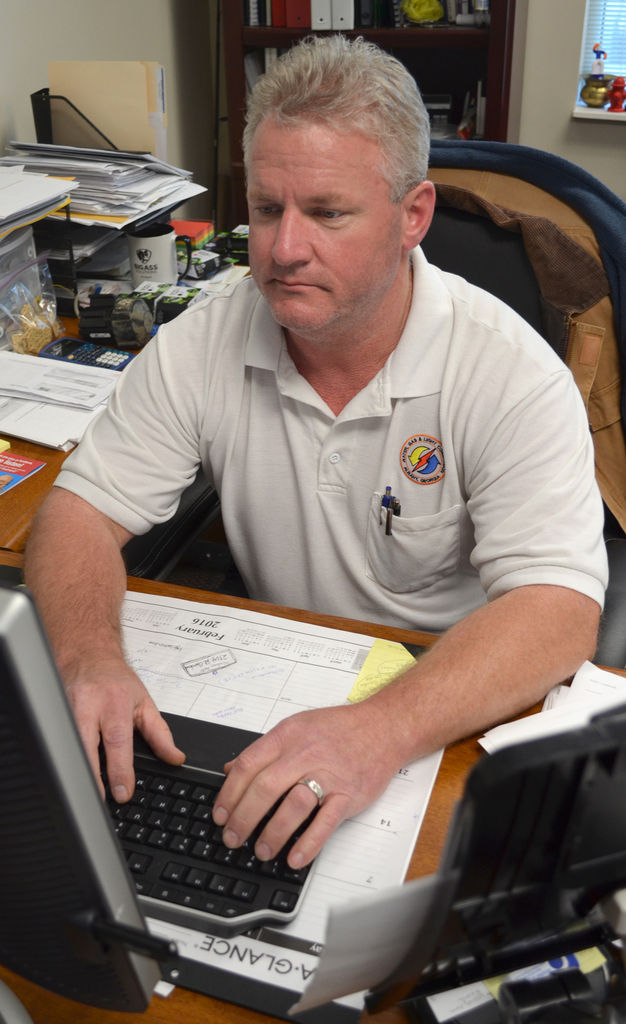
“This is a different situation altogether,” Albany Utility Board Water Quality Supervisor Kurt Anthony said while showing a visitor around one of the city’s 38 secured well sites. “First of all, they transferred to a total surface water system in Flint, while we have a mostly groundwater system. That’s a night-and-day difference. Plus, we monitor our water system 24 hours a day, 365 days a year. And we pull 100 samples a month from 300 different sample stations around the city.
“Our water system is, actually, very complex. That’s one of the reasons I can say the people of Albany don’t realize how lucky they are to have operators in the water department who care about the product we put out.”
Anthony’s supervisor, Perry Mathis, puts it even more succinctly.
“To most of the people here, this is not a job, it’s a passion,” said Mathis, the Utility Board’s systems control manager with 29 years on the job. “These are not people who worry about clocking in, clocking out and collecting a paycheck.
“These are people who feel that thay’re responsible for every person in the city once they turn that water tap on.”
The Flint tragedy grows more complex every day, but as increasingly distressing details surface, a few things have become clear. Leaders of the once-booming industrial city that has been ravaged by a declining economy decided Flint could not continue to pay the inflated costs for water being supplied by the city of Detroit after that major city’s bankruptcy forced its leaders to increase costs.
Flint officials chose instead to get their water supply from the Flint River (a separate river that shares the name of the one that passes through Albany), a move that appeared to help the city’s bottom line. But the cost, it turns out, may eventually be measured in the hundreds of millions of dollars, especially once expected lawsuits become part of the mix.
Flint’s austerity measures with its water system, according to reports, included a failure to properly treat the water in the Flint River, which had for decades been a dump site for industrial waste from dozens of manufacturing plants. Over the course of the next two years, Flint citizens — particularly young children and the elderly — started getting sick.
When a growing number of citizens’ cries of panic over incidences of illness that appeared to be water-related were largely ignored by Flint officials, many had their water independently tested. The results were alarming: dangerous levels of lead and copper in the water, elements that can be fatal. Even presented independent test results and visual evidence of water the color of urine, local and state officials, as well as the federal Environmental Protection Agency, denied that Flint’s water was unsafe.
The furor over those denials led to a closer examination that revealed what many say is ineptitude of the highest order, including attempts by some Flint and Michigan officials to cover up the obvious dangers posed by the contaminated water.
The Michigan situation prompted bipartisan reaction in Washington. On Wednesday, the House passed 416-2 the Safe Drinking Water Act Improved Compliance Awareness Act, sponsored by Rep. Daniel T. Kildee, D-Mich., that if signed into law would require the EPA to develop a plan for communicating with local governments, utilities, and the general public when there are dangerously high levels of lead in municipal drinking water supplies.
“What happened in Flint is in their plumbing, and in the chemistry of their water,” Mathis said. “Water with a low pH causes leaching, corrosion. The people up there have to know that. And they have to know that the water would be safe if treated properly with the right chemicals.”
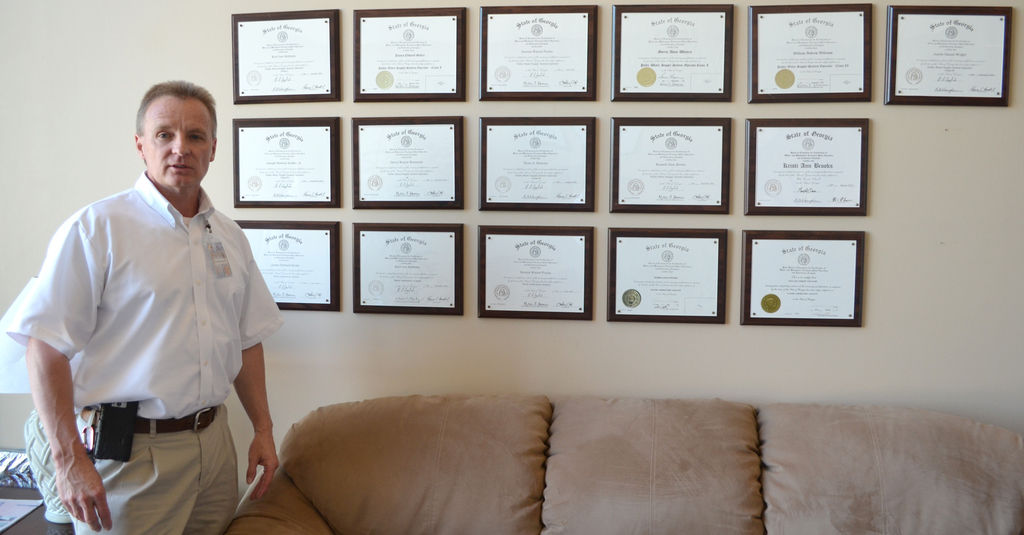
Anthony, a 10-year water department veteran who is one of fewer than 1,000 water operators in Georgia who have Class 1 (the state’s highest) certification, said water chemistry is another reason Southwest Georgians can consider themselves fortunate.
“What the Flint folks have is ‘corrosive water,’” he said. “The pH scale goes from 1 to 14, with 7 being neutral. That’s what you want. Albany’s water, even with no treatment, stays between 7 and 7.8.”
Anthony, Mathis and Utility Board Water Production/Water Quality Supervisor Jim Stolze offered a recent visitor an insider’s look at the city’s water system, a system that has won numerous awards for its quality. Among the structures that are their responsibility:
— More than 600 miles of water transmission lines;
— 38 wells, eight at the city’s Lily Pond Road well field and 30 scattered throughout the city “from County Line Road to Hidden Lakes”;
— 10 elevated water storage tanks;
— 300 sample taps for monitoring;
— Some 8,500 fire hydrants that must be routinely flushed and repaired;
— Between 11 million and 13 million gallons of water pumped daily (with certification to pump up to 36 million);
— Around 37,000 water meters that must be monitored and read to determine monthly billing.
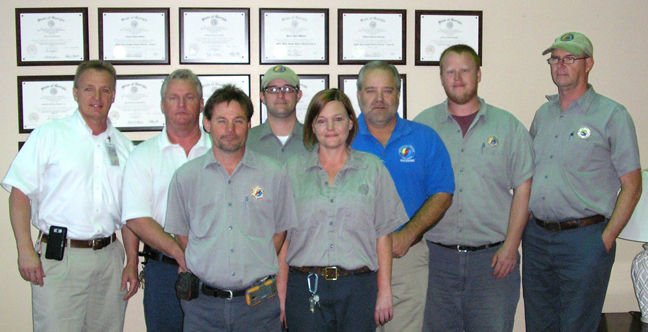
These responsibilities and others are managed by Mathis and his staff of seven — Anthony, Stolze and licensed operators Adam Winters, Dennis Fuchs, Kristi Harris, Justin Wright and David Apperson.
“I want to make one thing clear: Regardless of the city’s budget, we are going to treat our water and make sure it is high quality,” Mathis said. “But, yes, we have needs. We could use equipment upgrades, and we definitely could use more personnel. We’ve been put in a position, mostly through staff cuts, where our people are being stretched to the limit. I was in a situation today where if one person called in sick, I don’t know what we would have done. That’s not a good situation to be in.
“I understand that, as a part of the city government rather than an independent department, politics are more likely to enter into this equation now. Our commissioners are not getting calls about water, because there are no problems with our water. People take their water for granted, which, in a way, is a compliment, I guess. But because people can look up and see that streetlights are out, commissioners are getting 10 or 12 calls about streetlights.”
Mathis pauses, a long-suffering look on his face.
“I’ll let you guess what becomes the priority,” he says. “And while I agree that streetlights are important, I can live without them. I can’t live without water.”
Utility Board Energy Control/SCADA (Supervisory Control And Data Acquisition) Manager Jack Nutt, who also has 29 years on the job, oversees the monitoring staff that is the E-911 equivalent for the city’s utilities. Thursday afternoon, Energy Control Operators David Remstedt, Ryan Ramsey and Margarette Hawkins manned computer stations at the control center, monitoring the city’s water, gas and light systems. They answered calls and dispatched personnel to trouble spots associated with all utilities.
“If there’s a broken water main, discolored water, a power outage, a gas leak, the calls come in here,” Nutt said. “Our operators take the calls and notify the proper personnel. We also crank the wells up and shut them down to maintain proper tank levels.
“This is one of the safeguards for maintaining our utilities.”
The Utility Board’s Lily Pond Road water treatment plant building also houses a laboratory where water samples are monitored on a daily basis.
“This is a complicated process of making rounds for personal inspections at our well sites, collecting and monitoring water samples to check for bacteria and other impurities, maintaining the proper levels of fluoride and chlorine in the water,” Stolze, also a 29-year Utility Board veteran, said. “It’s not something our people take lightly. We have personnel who look on this not as a job, but as a career.”
It’s a career the water personnel are unquestionably doing well. On the department’s last mandatory EPD sanitary survey, Albany earned a 96.9 (out of 100) score, the best the utility has ever recorded.
“We did have a problem when (pecan farmer) Bubba Pippen brought nitrates into the water system (through the spread of chicken waste as fertilizer) several years ago,” Mathis said. “I’ve been here 29 years, and that’s the only time I’m aware that there has been any kind of major problem.”
That’s the kind of record that suits Anthony just fine.
“What we have here is a pride thing in the quality of our water and our water system,” he said. “The people who work here think of this as ‘their system.’ What I think every day when I’m at work is, ‘My kids are drinking this water.’ That’s my motivation to make sure we provide the best water possible.”


Author

Related Articles

Dougherty County Sheriff’s Office, GBI investigate inmate death
“The sheriff’s office will conduct an administrative investigation to determine if the staff response was appropriate. We have requested that the GBI conduct an investigation.”

Dougherty Jail graduates first class of female GED recipients
“It was an escape. I can say this has been challenging. I want to express my gratitude for being able to attend this program.”

From cotton to cloud: In the data center debate, is rural Georgia once again being asked to carry the cost?
Across much of rural Georgia, the abandoned cotton warehouses and shrinking tax bases remain — enduring reminders that industries built to serve distant markets do not necessarily stay rooted in the communities that first sustained them.
