
Nonprofit proposes plan to provide local jobs, fight recidivism
Atlanta-based Charitable Connections plans to establish footprint in Albany
By Carlton Fletcher
ALBANY — Michelle Uchiyama’s pitch to the Albany City Commission Tuesday morning caught commissioners, always leery of groups asking for funding, off guard.
Uchiyama, the founder and president of Atlanta-based nonprofit Charitable Connections Inc., assured commissioners she not only did not come before them to ask for money, she came with a plan that would address a number of the community’s most dire problems: lack of jobs, a dwindling tax base and recidivism.
“We’re not a typical foundation,” Uchiyama said in what proved to be the understatement of the day. “We take a holistic approach in preparing your citizens’ return to the community to be a productive one. We want to work with you to bring a public/private re-entry training program to your community. And by re-entry, I mean individuals returning to society from the prison system, the homeless, people with mental health issues and military personnel.
“We’re not here to ask you for money, we’re bringing economic capacity with us.”
Ward III City Commissioner B.J. Fletcher said she’d talked with Uchiyama and others in the community who work with re-entry candidates and came away excited about the group’s proposal.
“I had some of the same questions my colleagues have when I talked with Ms. Uchiyama, with Leslie Lamb, with Dr. (Charles) Ochie,” Fletcher said. “Not only is Charitable Connections not asking us for money, they’re looking to buy property in the community and eventually create up to 500 jobs that will pay from $12 to $17 and hour. I want to thank you for considering Albany.”
After the meeting, Uchiyama and other Charitable Connections staff spent time in Albany scouting locations where they can “establish our footprint” in the community.
“Today’s meeting was a wonderful meeting,” Uchiyama said. “I think the council is open to our program and ready to move forward. I think it became a very favorable meeting when I told them we did not intend to ask them for money.”
The nonprofit president said she left the meeting convinced that Charitable Connections would soon have a presence in Albany.
“Much as we did in Atlanta when we started our program (19 years ago), we’re definitely going to establish a presence in Albany,” she said. “We opened a small store in Atlanta and sold used building materials by appointment. As we establish our footprint here, we expect to continue to grow as we did there.
“It’s hard to explain what our program looks like because it is always evolving. But if we find the right site, we hope to establish a facility that will allow us to conduct two-component training: constructing housing and the installation of modular units. That’s part of the design we utilize on multifamily or student housing units in this country and internationally.”
Fletcher said Uchiyama’s efforts to collaborate with local organizations already working to combat recidivism is proof that Charitable Connections is looking to help an element of the local population with some of the greatest needs.
“For most of the ex-offenders in our region, people with no formal training and many without even a GED, the thing they need most is a job opportunity,” Fletcher said. “Ms. Uchiyama’s program is not something where they come into an area and insist on doing their own thing. They work with others in the area — with Leslie Lamb, with Dr. Ochie — to create a collaborative program that benefits those in need.
“Frankly, I hate organizations that do nothing but enable people by giving them things. That only keeps them down. The best thing you can give people who truly want to make their lives better is a job opportunity. Then they can take control of changing their own lives. I believe things are not going to get better unless we work to bring about changes. In 2016, I plan to aggressively work with organizations like Charitable Connections, the SOWEGA Council on Aging, and the Boys and Girls Clubs to help make our community better.”
Also at Tuesday’s commission meeting, the first of the new year for the city government, City Manager Sharon Subadan introduced the “Fight Albany Blight” concept to commissioners. Subadan said the program, which has already organized a steering committee, would work to find ways that other communities used the court system to better manage blighted properties and to create minimum housing standards that property owners would be held to.
Albany Police Department Chief Michael Persley gave a detailed report on crime in the city, which he said is at a historic 26-year low.
“While we celebrate an overall decrease in crime, we’re mindful that the numbers reflect a reduction in property crimes such as burglary, larceny and auto theft,” Persley said. “But we must focus on what is actually an uptick in violent, Part 1 crimes that plague our city. Incidents of murder, rape and especially aggravated assault are difficult to predict and therefore present one of the department’s most difficult challenges.”
Persley’s crime statistics for the fourth quarter of 2015 show 34,809 calls for service with an average response time of 7 minutes, 12 seconds. Reports included 1,317 traffic accidents that established a citywide Top 5 intersections for traffic accidents: Nottingham Way at North Westover Boulevard, Nottingham Way at the Liberty Expressway, Westover Boulevard at Dawson Road, Slappey Boulevard at Gillionville Road and Slappey Boulevard at Palmyra Road.
The APD chief said 1,110 Part 1 crimes (including homicide, rape, robbery, aggravated assault, burglary, larceny, auto theft and arson) had been reported from Oct. 1 to Dec. 31, while 1,583 Part 2 crimes were reported. He noted that the Albany-Dougherty Drug Unit had made 25 arrests, seized more than $124,000 in drugs and in excess of $9,000 in property.
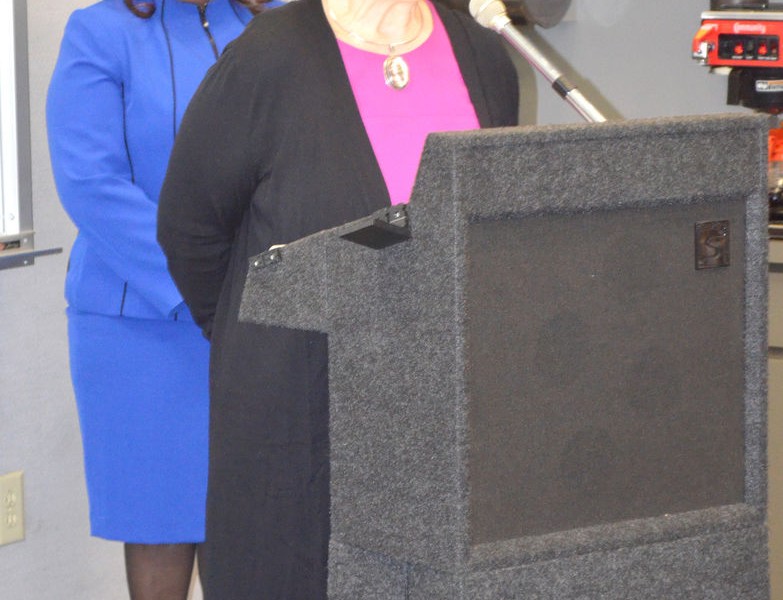
Albany Mayor Dorothy Hubbard listens to a report on recent community flooding by Albany Fire Department Chief Ron Rowe during Tuesday’s Albany City Commission meeting. (Staff Photo: Carlton Fletcher)
Author

Related Articles
Federal agency to investigate Monday paragliding fatality
The death of a 63-year-old man who was killed in a paragliding accident on Monday is under investigation by the National Transportation Board, according to Dougherty County Coroner Michael Fowler.
Audit of police surveillance cameras results in arrests of five former APD officers
“The bottom line is when we find people who have misused resources that they have, we’re going to hold them accountable. These resources help fight crime, but we will not tolerate when they are misused.”

New commander takes helm as Marine Corps logistics adapts to evolving battlefield
Brig. Gen. Kevin G. Collins assumed command of Marine Corps Logistics Command during a change of command ceremony at Marine Corps Logistics Base Albany, succeeding Maj. Gen. Keith D. Reventlow after four years leading the organization responsible for sustaining Marine forces around the globe.
