Rural economy on minds of metro Albany lawmakers
Legislators discussed priorities for up coming General Assembly
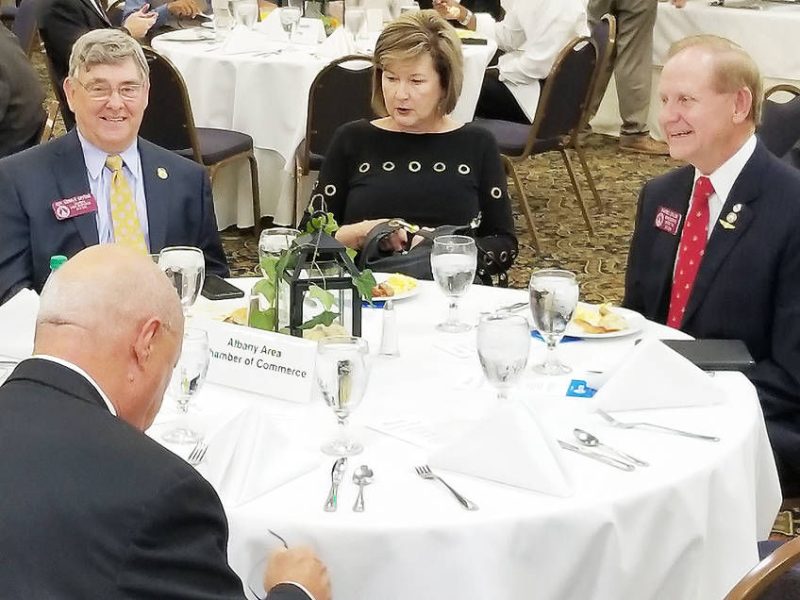
Clockwise from front left, state Rep. Ed Rynders, Rep. Gerald Greene, Albany Area Chamber of Commerce Vice Chair Legislative Affairs Cynthia George and Rep. Darrell Ealum await their turns to speak Wednesday at the chamber’s annual Legislative Affairs breakfast. (Staff Photo: Terry Lewis)
By Terry Lewis
ALBANY — Workforce development and education were at the top of state lawmakers’ lists Wednesday during the Albany Area Chamber of Commerce’s annual Legislative Affairs Rise ‘N’ Shine Breakfast.
State Reps. Darrel Ealum, D-Albany; Winfred Dukes, D-Albany; Gerald Greene, R-Cuthbert, and Ed Rynders, R-Leesburg, were on hand to give the large gathering a peek at what to expect when the state Legislature convenes in January.
State Sen. Freddie Powell Sims, D-Dawson, also attended the early morning event, but left early because of a previous commitment and did not address the audience.
The legislators have a combined experience of 85 years under the Gold Dome in Atlanta.
“That may be a record in number of years because of the turnover see every election because of cities like Atlanta,” Greene, who was first elected to the House in 1982, said. “You will not find very many members in the Georgia General Assembly now who stay for such a long time, and that’s one of the things we have going for us in Southwest Georgia.
“On any day in Atlanta, they could out-vote us on any issue. But because south Georgia has a large number of committee chairmen, that is one of our pluses that has made a difference in the ways we have been conservative with your money and your way of life.”
Green compared the Legislature to a big kitchen.
“There is a big stove with a big pot on it and every day legislation is added to the pot and it’s cooking. Sometimes it just simmers, sometimes it boils over and other times it is a complete mess,” Greene said. “We in Southwest Georgia have opportunities we are looking forward to.”
He pointed to the House Rural Economic Development Council (HREDC), which met in Albany Wednesday and will meet again Thursday at Albany Technical College.
“It is a commission by Speaker David Ralston to not only look at development of rural Georgia, but all of the state,” Greene said. “He’s trying to balance the haves and the have-nots. Much of the state’s area of growth has been in the cities of Atlanta, Augusta, Savannah and Columbus.
“Seemingly, we have been left out. This committee, one of which is Ed Rynders will represent us in southwest Georgia. We are delighted they are looking at all aspects of the problems that we face. We know the problems, give us the solutions”
Next up was Rynders, who after the Chamber was to attend the HRDC meeting.
“The biggest lie when you get into politics is when people say, ‘It’s just a 40-day session.’ I have four meetings Thursday,” Rynders said. “But Speaker Ralston actually started the initiative of the Rural Economic Development Council. We are so glad the Senate is partnering with that as well as the Georgia Chamber. But we have been blessed to be the No. 1 state to do business in for five years in a row. People ask why and I tell them we have a good business climate, Hartsfield (airport), the port of Savannah. It’s just a very good atmosphere to do business in.
“But we hear it all the time from people griping about all of ‘my tax dollars going to Atlanta.’ There truth of the matter is just five of the state’s 159 counties — Clayton, DeKalb, Fulton, Gwinnett and Cobb — are donor counties. So they look at us sometimes and ask, Why can’t you carry your own weight?”
Rynders, however, pointed out that the growth in Georgia has not been universal and that was the idea behind the HREDC.
“The general feeling is this is not your standard study commission that’s limited to five days,” Rynders said. “It will tell you how serious it is when the two co-chairs are also the chairman of Appropriations (Terry England, R-Auburn) and Ways and Means (Jay Powell, R-Camilla).
“At the end of these meetings, we will furnish the speaker with a report. But it is important to remember this isn’t just a one-year process. This, to me, is an ongoing work unlike anything we’ve seen in the past, and we welcome all suggestions. But it is vitally important that we work together regionally.”
Dukes focused on education in relation to the HREDC.
“Our challenge is not getting people to stay here, our challenge is getting them to stay here for a purpose,” Dukes said. “We develop those people. They are here. The Dougherty County School System and the other schools we have in our community are creating magnificent students, but, unfortunately, once we create them, they leave. I’m glad when we see one of our students come back to participate in making our community better.
“We are confronted with a number of challenges, but I’m excited about it, I really am. Because people are finally taking a look at the challenges of rural Georgia and they see that we do have issues. Now it is in the forefront of the people in Atlanta. That says a lot. At least we brought it to everybody’s attention.”
Dukes said the solutions to the community’s problem were in the Merry Acres Event Center on Wednesday morning.
“We have to create an environment where people and businesses feel like this is the place to be,” Dukes said. “More than 70 percent of Georgia’s jobs are created by small businesses. As we educate people, one of the things we have to instill in them is that we are educating the leaders of the world.”
A retired Marine, Ealum is a member of the house Military and Veterans Affairs Committee and focused on the state’s military bases.
“In the past two years I have been in the House, I have really begun to focus on our military bases. I was blessed to be placed on our military affairs working group on the Defense Committee in the House,” Ealum said. “We all know that our Marine base is the largest employer in the area, so it is extremely important that we keep that Marine base. What this committee is looking at is BRAC (Base Realignment and Closure). The last BRAC was in 2005 and at that time we had three bases in Georgia that were closed.
“We love our military, but we have to do things to reach out and we’re doing that. We actually are leading the country in some of the things we are doing, like our biomass program with Procter and Gamble. In the next 24 months, we are going to be at net zero off the grid, and that’s really exciting.”
Ealum said the committee visited all nine of the state’s military bases and accumulated a great deal of information.
“We took that information and got 12 bills passed,” Ealum said. “Two of the most important were military wives who are teachers or nurses can carry over certification from their last assignments, and the other was school choice for their children.”
Related Articles
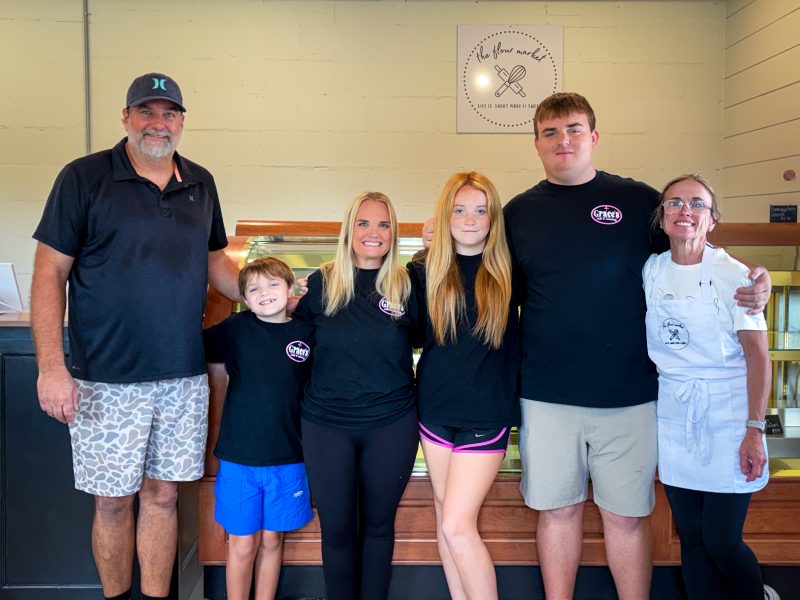
Regional catering business finds new home at Warrior Creek Mercantile
For months, Marchbanks said she had been asking God for an opportunity to serve others. “I just kept praying, ‘God, use me as a servant,'” she recalled. “I didn’t care what it was. I just wanted to be used to help people.”