
Year’s first Georgia loggerhead sea turtle nest shows up on time
For the third year, the state’s loggerhead nesting season starts on Cumberland Island
From Staff Reports
BRUNSWICK – The loggerhead sea turtle nesting season in Georgia started on time this week, wildlife officials say. And, as has been the case the last two years, it started on Cumberland Island.
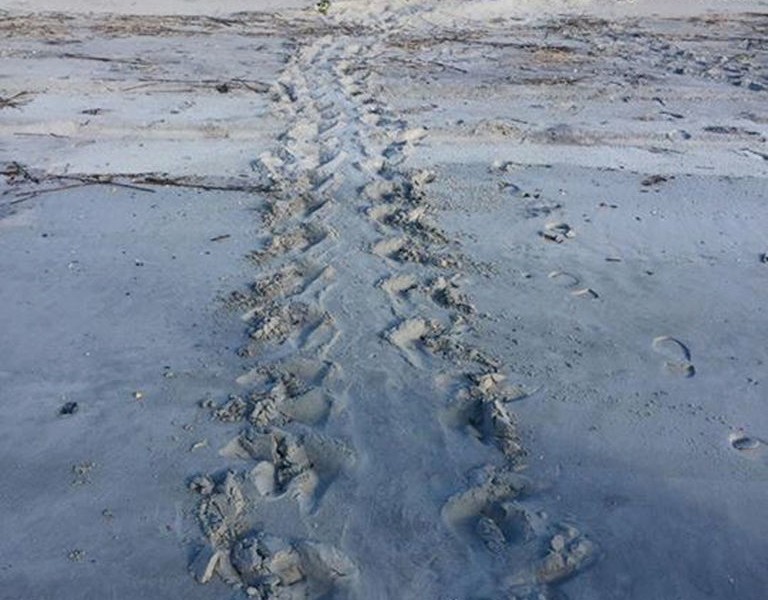
Wildlife biologist Doug Hoffman of the National Park Service confirmed Tuesday the state’s first loggerhead nest of the year at Cumberland. Georgia Conservancy’s Laura Buckmaster, who manages the organization’s Cumberland Trail Restoration Project, had spotted the turtle tracks, called a “crawl,” earlier that morning.
The most southern barrier island in Georgia, Cumberland also had the first nest in 2014 and 2015.
Sea Turtle Program Coordinator Mark Dodd of the Georgia Department of Natural Resources said loggerhead nesting usually begins in early May and hits full stride by June.
The massive reptiles are the state’s primary marine turtle and a federally threatened species. After a turtle crawls ashore on a barrier island beach, it digs a hole at the base of dunes and lays its eggs, usually at night.
The Georgia Sea Turtle Cooperative, a DNR-coordinated network of about 200 volunteers, researchers and agency employees, patrols Georgia’s barrier island beaches daily during nesting season. Working under a federal permit, they mark, monitor and protect sea turtle nests.
The cooperative documented a record 2,333 nests in 2015, with at least 2,319 laid by loggerheads. The remaining nests were allocated to green, leatherback and Kemp’s ridley sea turtles, along with a handful of “unknowns.” The previous loggerhead high was 2,289 nests in 2013.
Statistically, DNR officials say, loggerhead nesting is increasing about 3 percent a year in Georgia. Nesting in Florida and the Carolinas also is trending upward. The recovery goal, set in a National Oceanic and Atmospheric Administration Fisheries plan, is 2 percent a year for 50 years. That would results in about 2,800 nests a year in Georgia, a mark that could be reached around 2020.
Dodd, who works for DNR’s Nongame Conservation Section, predicted another strong showing this summer.
“We usually have a low year and two medium to high years,” he said. “We had a low year in 2014. So we’re expecting a good year.”
Those patterns are backed by University of Georgia genetic analysis documenting the number and relatedness of loggerheads nesting on the state’s coast. As with other nests, one egg was collected from the Cumberland nest for research, less than 1 percent of the average clutch size on the island. Hoffman covered the nest with a screen to protect the eggs from coyotes and other predators.
In preparation for the nesting season, Dodd and staff have been training interns, working with volunteers and partner agencies and organizations, and teaming with the DNR Law Enforcement Division, which enforces regulations that include the use of turtle excluder devices in commercial shrimping.
DNR’s Nongame Conservation Section works to conserve sea turtles and other rare wildlife not legally fished for or hunted, as well as rare plants and natural habitats. The agency does this largely through public support from fundraisers, grants and contributions. Key fundraisers, DNR officials say, include sales and renewals of the eagle and hummingbird license plates.
Related Articles

James Rubino installed in new role at Marine Corps Logistics Command in Albany
James L. Rubino recently assumed the role as executive deputy of Marine Corps Logistics Command in Albany. In his new role he will oversee integrated logistics support.

Rain depresses voter turnout in Dougherty County
“A lot of people don’t vote when it’s raining. People don’t do a lot of things when it’s raining.”
City of Albany faces shortfall for police, fire salaries
“We can’t tell staff to hire more police officers and then complain at what it costs.”
