
Looking for a pet? Why not try a llama?
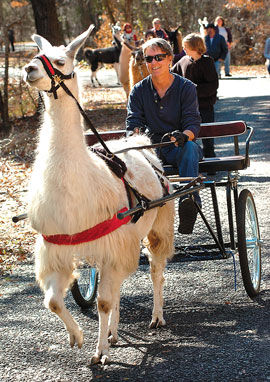
Photo by Laura Williams
Terry Lewis
ALBANY. Ga. — Kathy Devaul, owner of Terra Bulah Llama farms in Leesburg wants people to understand one important point about the South American pack animals — llamas do not lay eggs.
Saturday afternoon at Pirate’s Cove in Lee County, Devaul, Trella Whaley of Windy Hill Farm in Shellman and Carolyn Wood combined to bring 15 llamas together for a “llama walk” along the creek.
A llama walk always draws a crowd and this one was no exception.
Everybody on hand got a leash and proceeded on a leisurely stroll with his or her llama.
“We used to do this a lot more,” Devaul said, “but things kept getting in the way. Now we try to do it at least once a month.”
Devaul, who has been raising the animals for the past 18 years, said the llamas always attract attention.
“We don’t usually have this many llamas,” she said. “Usually we have about four or five. When we walk them along the riverfront walk people are always surprised. I think it’s cool. the kids run up and want to pet them, but most of the parents are afraid a llama will spit at them. But llamas rarely spit at people, they usually save that for other llamas.
“What’s funny is that people have begun to look for us. They say ‘oh, the llamas are here!’ and people start gathering around us. It’s not something you see every day.”
People ask questions about the animals.
“The funniest one we get is when someone asks ‘what color are llama eggs?'” Devaul said, laughing. “And I’m thinking ‘did you really just ask that question?’ For some reason people think Emu (the bird) when they think of llamas. Then we have to explain that llamas are mammals and have live births.”
Devaul bought her first llama in 1993 and has since expanded her herd to 26 animals – including five rescued llamas.
“I’ve always been into animals and I bought my first, “Indy” in 1993. He was pet quality. I bought a female a couple of months later and Indy sired some babies of good stock.”
Because of their gentle nature, many people own llamas as pets, but Devaul is quick to point out that’s not the only thing the animals are good for.
“We have show llamas, halter llamas, pack llamas, herd and guard llamas,” Devaul said. “We know people who camp a lot and take their llamas with them to pack all their gear into the camp site. We’ve usually found that campsites that allow dogs will also allow llamas.”
According to wikipedia, The height of a full-grown llama is between 5.5 feet and 6 feet tall at the top of the head. They can weigh between approximately 280 and 450 pounds. Llamas are very social animals and like to live with other llamas as a herd. Overall, the fiber produced by a llama is very soft and is naturally lanolin free. Llamas are intelligent and can learn simple tasks after a few repetitions.
Devaul say llamas can also be used as herd animals.
“The females (llamas) are very good with sheep,” Devaul said. “They have a very strong herding instinct and one-on-one can hold their own with a coyote or dog.”
A pair of llamas can fit very easily on an acre of land.
“It doesn’t even have to be a pasture,” Devaul said. “It can be a wooded area. Plus they’ll clean it up by eating the underbrush and low-hanging limbs. And they are much better at it than briar goats.”
Devaul added while the llama is a very versatile beast, don’t expect to find a llama omelet anytime soon, because they still can’t lay eggs.
Related Articles

Albany Herald – June 20, 2026
City Albany faces shortfall for police… Women’s Anchorage tentatively set to… Commissioner, school leaders clash over…

Classifieds – June 20, 2026
ALBANY HERALD CLASSIFIEDS JUNE 20, 2026

Public safety drives Leesburg’s $4.2 million Fiscal Year ’27 budget
The adopted spending plan reflects modest growth in city revenues and continued emphasis on maintaining core municipal services, particularly public safety and sanitation, which together account for a significant share of general fund expenditures.
