
Marine Corps Logistics Command cuts ribbon on thermal energy system
Borehole thermal energy storage system introduced as part of energy-efficient mandate
Jennifer Parks
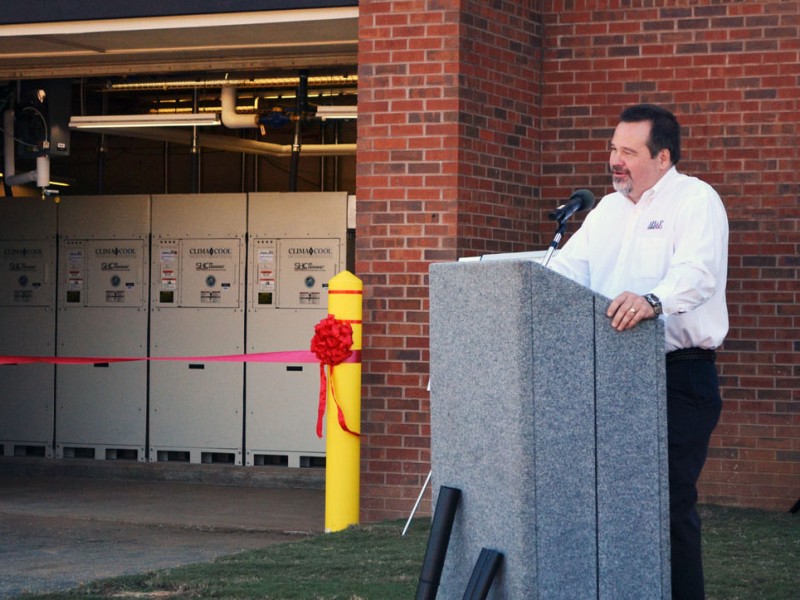
MCLB-ALBANY — A new heating, ventilating and air conditioning (HVAC) system has been introduced at Marine Corps Logistics Command’s headquarters building that will act as a geothermal or Cold Borehole Thermal Energy Storage (BTES) system to offer a greener way of powering one of the key buildings on Marine Corps Logistics Base-Albany.
A ribbon-cutting ceremony took place Monday afternoon to officially unveil the $4.9 million project.
The system has 300 boreholes drilled more than 200 feet into the ground that are connected to the HVAC system in the LOGCOM building allowing cold water to be stored underground during the milder fall, winter and spring months. This stored cold water can be harvested each summer to reduce the cost of air conditioning to the three-story building by as much as 50 percent.
Col. James Carroll III, commanding officer of MCLB-Albany, said the project reflects the commitment of the installation to be good stewards of resources.
“This has positioned MCLB-Albany well into the future,” he said. “We are being a good stewards of the environment and good stewards of taxpayer dollars, no doubt.”
During the summer, warm water will be stored on the outskirt while cold water is pulled through the air conditioning from the center of its circle to cool the building. In the winter, cold water is stored and warmer water is pulled through to heat the building.
What was expected to be a 30-ton project ended up becoming a project that was more than 400 tons, Charles Hammock with Andrews, Hammock and Powell, the engineering company involved in the project, said Monday afternoon.
Plans were set into motion to bring BTES to MCLB while Brig. Gen. Terry Williams, then a colonel, was the commanding officer of the base. It was designed under the Department of Defense’s Environmental Security Technology Certification Program, and is the first BTES to be installed in the U.S.
“We hope to demonstrate a system today that will get the Department of Defense’s attention,” Hammock said at the ribbon-cutting.
It is also the first use of a large scale, permanent fiber optic temperature sensing system to monitor the underground temperatures, allowing the building’s control system to oversee 1,300 temperature points to inform control systems on when to charge or discharge the system.
The removal of the cooling tower and the substitution of adiabatic dry-coolers allows the cooling water consumption of the LOGCOM building to be reduced by at least 2.4 million gallons per year.
“We are not burning anything anymore,” Hammock said, “Instead of sourcing heat out of the air, we are sourcing it out of the ground.”
Computer modeling has indicated that at least a 30 percent savings in HVAC system energy was possible, but the energy has to be monitored for at least a year after installation to determine actual savings. Currently, the system is running 52 percent below the energy consumption from last year, Hammock said.
Construction was completed by Artesian Contracting Company under a contract with the Marines via Naval Facilities Engineering Command Southeast and MCLB.
“It’s important for everybody … it’s an honor for me to be a part of this,” said said Lt. Jose Centenorosado, director of the MCLB-Albany Facilities Engineering and Acquisition Division.
A plan on the table to put a wider system by the base’s Marine Corps Exchange is currently in the design phase, Centenorosado said.
A combination of factors put in motion the expectation that MCLB will produce as much renewable energy as is used on the installation by 2017, which would place the base in “Net Zero” status three years ahead of the 2020 federal mandate.
Related Articles
Chamber celebrates new businesses, invites community to Coffee and Connections event
The Terrell County Chamber of Commerce is continuing its efforts to strengthen local business relationships through community celebrations and networking opportunities, recently recognizing two new businesses with ribbon-cutting ceremonies and announcing its next “Coffee & Connections” event in Sasser.

Regional catering business finds new home at Warrior Creek Mercantile
For months, Marchbanks said she had been asking God for an opportunity to serve others. “I just kept praying, ‘God, use me as a servant,'” she recalled. “I didn’t care what it was. I just wanted to be used to help people.”
Houston, Ford advance in contentious Lee County school board race
According to unofficial election results, challenger George Parrish Houston led the three-candidate field with 534 votes, or 42%, followed by incumbent Donna Ford with 478 votes, or 37.6%. Candidate Lavendra Shootes received 261 votes, or 20.5%.
