
Marker commemorating 1868 Camilla Massacre shines spotlight on largely forgotten event
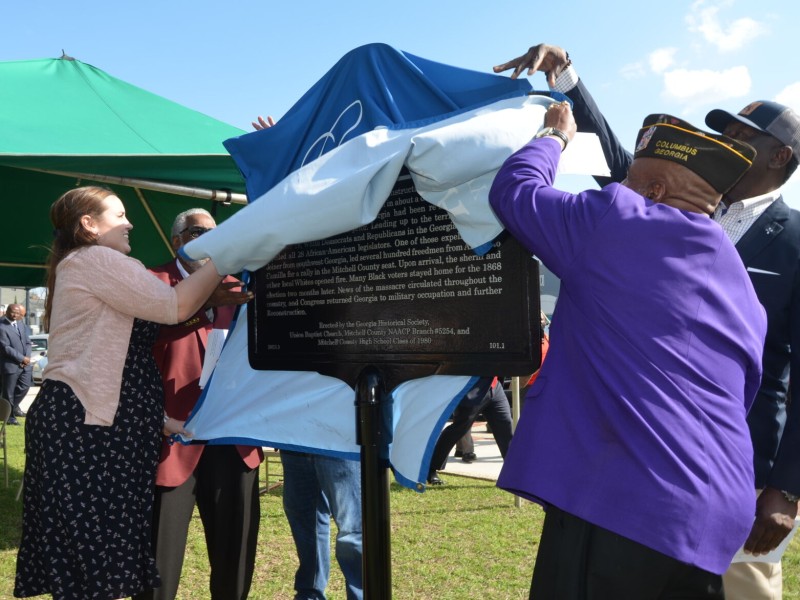
Staff Photo: Alan Mauldin
By Alan Mauldin
alan.mauldin
@albanyherald.com
CAMILLA — For more than 150 years, people have driven by or done business inside the Mitchell County Courthouse without knowing it was the site of one of the most grisly Reconstruction episodes in the state of Georgia.
That will be hard to do now after the Monday dedication of a historical marker on the lawn of the south side of the building giving an account of that day in 1868.
Initially dubbed a “riot,” the slaying of at least a dozen black people who had arrived in Camilla on Sept. 19, 1968, to attend a Republican Party political rally was big news at the time but had largely faded from history.
“I grew up here,” Albany State University history professor Joshua Butler, who was among those who spearheaded a multiyear effort to bring the historical marker to the site, said during an interview after the dedication ceremony. “I didn’t hear about it until I went to college (during a) history class at Valdosta State University.”
Butler, 39, later worked with Lee Formwalt, a former Albany State professor considered the national expert on the massacre, while writing his master’s thesis, which covered the Camilla Massacre, and his doctoral dissertation that dealt heavily with material related to the area. He took part in a re-enactment of the march, from the Camilla railroad depot to the courthouse, in 2018 and committed himself to bringing a historical marker to the site.
The collision course that ended with shots that rang out at the courthouse square started the previous day in Albany. Albanian Philip Joiner was one of 28 black politicians elected in 1868 during the state’s first election held after Georgia was removed from Radical Reconstruction.
During the constitutional convention held prior to the election, white delegates objected to a provision declaring that black residents could be elected to office on the grounds that there was no similar provision guaranteeing that white politicians could be elected, Butler told the audience at the ceremony.
However, upon the election of the first black members of the state legislature, the script was flipped, and the newly elected Freedmen were removed because, the whites said, the constitution did not state that they could serve.
Joiner, accompanied by two whites, Northern Republicans Francis F. Putney and William P. Pierce, a bandwagon and several black marchers, made their way from Albany to Camilla, stopping at a plantation the night before the massacre, according to an account written by Formwalt.
After they arrived in Mitchell County the next day, they received three warnings to turn around, including one from the sheriff. Once they arrived at the county seat, shots rang out.
Beyond that, a lot is lost to history, but what is known is that members of the group were shot at the scene. Putney, who in 1910 made a $25,000 donation to establish what became Phoebe Putney Memorial Hospital with the stipulation it be named in honor of his mother, was among those who were injured.
“We know that the first shot that day was fired at the bandwagon,” Butler said. “After that, interpretation comes in. … What we know is that at least 12 people died that day. Two or three weeks later, people were still being hunted.”
After the ceremony, Butler told a reporter that the effects were felt throughout the state, with black people declining to participate in subsequent elections out of fear. Several hundred black Dougherty County residents had voted in the election prior to the 1868 presidential contest.
“I think only one black man cast a ballot in Dougherty County,” Butler said of the fall 1868 election.
The effort to place the monument got a boost a couple of years ago from Camilla native and former Albany State Rams football player Marvin Broadwater, who was at the Monday ceremony.
“It was just a process,” Mitchell County Commission Chairman Benjamin Hayward said during an interview following the ceremony. “Once the commission started working on it, it took about two years.”
Although the occasion marked a terrible chapter in U.S. history, it was also one that should be remembered, he said.
“I think this was a great day for Camilla, for southwest Georgia, for the state and the whole United States,” Hayward said. “There was a wrong done here.
“If you don’t know where you came from, you don’t know where you’re going. This will be remembered a long time in this community, what we did today.”
While the day of public remembrance was a few years in coming, lifelong Camilla resident Winston Ross said it was not totally unknown to him. He remembers Mary Jo Haywood, a former mayor, performing a solo vigil at the site.
“I knew about it before 2018,” he said.
“For years, Mary Jo Haywood would come here and light a candle to commemorate the Camilla Massacre. Sometimes it takes time for something like this to get done. It was just something that we heard about, but not something we could put our fingers on.”
Author

Related Articles

How Trump’s Endangered Species Act revisions could affect Southwest Georgia
Earlier this month, the Trump administration finalized a rule rescinding the long-standing regulatory definition of “harm” under the Endangered Species Act, removing language that had interpreted the law to include significant habitat modification or degradation that actually kills or injures protected wildlife.
Mitchell County official refutes charges made by group opposing rezoning of land to be purchased by energy giant
“At no time has NextEra mentioned a data center,” James Eubanks said of negotiations with the world’s largest electric utility holding company.

Mitchell County group fights NextEra Energy project
On June 29, the Mitchell County Board of Commissioners voted to approve a rezoning request that would change 300 acres in the northern part of the county from Agriculture to Industrial.
