
MARY BRASWELL: Looking Back at Easter

Mary Braswell
Each week Albany Herald researcher Mary Braswell looks for interesting events, places and people from the past. You can contact her at (229) 888-9371 or [email protected].
Christians across the world are celebrating the resurrection of Jesus Christ today. Here is a look at that event, as well as other symbols commonly associated with Easter.
READ ALL ABOUT IT (THE RESURRECTION)
— It happened … Matthew 28: 5-6
— It was unexpected … John 20: 1-18
— Many appearances … 1 Corinthians 15: 1-8
— Jesus predicted it … John 2:19 and Mark 8:31
— Foretold in the Psalms … Psalm 16: 10-11
— Proclaimed by the apostles … Acts 2:32; 3:15
FUN FACTS: RABBITS AND BUNNIES
— When rabbits “binky,” it is an expression of happiness and joy. They will run, jump into the air, twist their body and flick their feet.
— Rabbits stand on their hind legs to give themselves a better lookout for predators. A rabbit will warn others of danger by thumping his hind legs.
— A female rabbit is called a doe. A male is called a buck, and a baby is called a kit.
— The average length of a rabbit’s ears is four inches.
— The life expectancy of wild rabbits is 10 years. Domesticated (pet) rabbits can live as long as 16 years.
— In the Chinese Zodiac, the rabbit represents graciousness, kindness, sensitivity, compassion, tenderness and elegance.
— Rabbits only sweat on the pads of their feet.
— The idea of the Easter Bunny was brought to America by German immigrants who settled in the Pennsylvania Dutch Country in the 1700s.
THE INCREDIBLE (SOMETIMES EDIBLE) EGG
— Each of the estimated 280 million laying hens in the U.S. produces 250-300 eggs each year, about 10 percent of the world supply.
— Computers control the lighting in modern hen houses, which triggers egg laying. Most eggs are laid between 7 and 11 a.m. A hen requires 24-26 hours to produce an egg.
— There are as few as seven and as many as 17 tiny pores on an egg’s shell surface. Eggs can absorb refrigerator odors through the pores, which is why it is recommended that they be kept in their original containers.
— Yolk color depends on the plant pigments in the hens’ feed. Artificial colors are not permitted for commercial growers.
— Egg size and grade are two entirely different things. Size is determined by the weight per dozen. Grade refers to the quality of the shell, white and yolk.
— Eggs can be refrigerated for up to three weeks after purchase with no significant quality loss. Properly handed and stored, eggs rarely spoil and are more likely to eventually just dry up. Left out, however, an egg will age in one day as much as it will in a full week in the refrigerator.
— If for some reason you are not sure if an egg is raw or hard-boiled, give it a spin. A hard-boiled egg will spin easily. A raw egg will wobble.
— Double-yolked eggs are often produced by young hens whose egg production cycles are not yet synchronized.
— Before the advent of commercial egg dyes and food coloring, onion peels, tree bark, flower petals, beet juice, and fruit juices were among the most common sources of coloring for eggs.
— The custom of giving eggs at Easter has been traced back to Egyptians, Persians, Gauls, Greeks and Romans, for whom the egg was a symbol of life.
— The tradition of the White House Easter Egg Roll on the front lawn was started by President Rutherford B. Hayes in 1878.
— In medieval times, a festival of egg throwing was held in church. The priest would throw a hard-boiled egg to one of the choirboys. It was then tossed from one choirboy to the next and whoever held the egg when the clock struck noon was the winner and could keep it.
— Beeping Easter eggs are Easter eggs that emit various clicks and noises so that visually impaired children can easily hunt for Easter eggs.
EASTER HYMNS
— “Christ the Lord is Risen Today” was written by Charles Wesley and published in 1739. The original title was “Hymn for Easter Day” and the “Alleluia!’ was added later.
— “Alas! and Did My Savior Bleed” was written by Isaac Watts and published in 1707. In fact, Watts published an entire volume of hymns that year, mostly written in his late teens and early 20s. Another favorite by this composer is “Marching to Zion.”
— “The Old Rugged Cross” was written by George Bernard, a traveling evangelist, and was published in 1913. Bernard worked on the song several months and when finished, sang it for friends in their home. He asked, “Will it do?” The couple was so moved that they helped pay the fees to have it printed.
THIS ‘N’ THAT
— In November 1978, Highland Manufacturing and Sales Co. Inc. was issued a patent for its invention that would change egg hunts forever — hollow, plastic, brightly-colored eggs.
— Each year, approximately 90 million chocolate Easter bunnies are produced.
— Enough jelly beans are produced for the Easter season to fill a nine-story office building … about 16 billion of the candies.
— According to the Guinness Book of World Records, the largest Easter egg ever created was just over 25 feet high and made of chocolate and marshmallow. The egg weighed 8,968 pounds and was supported by an internal steel frame.
— In the original German folklore, the Easter Bunny was a hare that could — and did — lay eggs.
EASTER ISLAND
— Also known as Rapa Nui, Easter Island is in the Pacific Ocean and became a special territory of Chile in 1888.
— Easter Island is home to 887 massive statues, called moai, which were sculpted and erected by early inhabitants of the island.
— Population on the island peaked at around 15,000 between 1100 and 1680. Diseases brought by Peruvian slave raiders and sailors reduced the population to just 111 in 1877. By 2012, the number had risen to 5,800.
— In 1995, Easter Island became a World Heritage Site with most of the island protected in the Rapa Nui National Park.
QUIK QUIZ ANSWER
(d) 50.8 percent
Related Articles

Dougherty Commission considers $104 million budget for 2026-2027 budget year
“The other side of the coin is you could have higher revenues than projected. We’re very conservative in budgeting revenues. That also reduces the need to use fund balance”

PHOTOS: Albany State Summer Success Academy
Photos by Reginald Christian, Albany State University
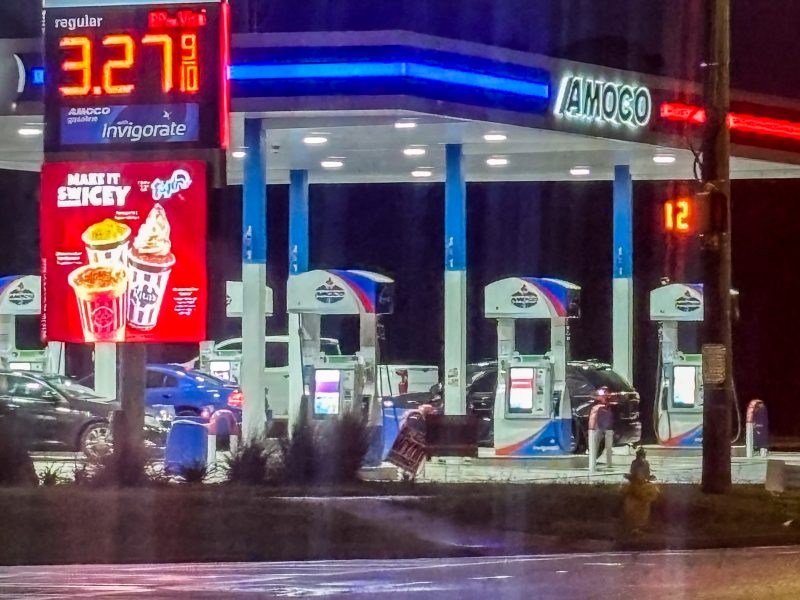
Albany gas prices among Georgia’s lowest as summer fuel costs decline
According to AAA, the average price for a gallon of regular gasoline in the Albany metro area was approximately $3.45 this week, making Albany the second-least expensive metro market in Georgia behind Dalton at $3.41 and slightly ahead of Brunswick at $3.48.
