
MICHAEL LOMAX: ‘American Sniper’ stays in the cross hairs
Michael Lomax
Making a film based on true events requires a certain vision and objectivity or the story will either fall flat or become shameless propaganda. “American Sniper” threatens many times to stray in the direction of the latter, but by virtue of manly man director Clint Eastwood and a bulked-up Bradley Cooper, the film is able to stay relatively true to its intention as a psychological portrait of the deadliest sniper in American military history.
Cooper portrays real life Navy SEAL Chris Kyle as a mild-mannered Texan with a strong faith in God and an unwavering allegiance to both his family and country. Raised to be a sheep dog, the protector of the flock, Kyle left behind a life of rodeo to provide sniper cover for Marines during the Iraq War. But the hazards of his obligation would ravage him over time, with the smallest ticks — from a lawnmower to a mechanic’s tools to a barking dog — triggering PTSD episodes.
His wife Taya (played by Sienna Miller) watches this unfold over years, and she urges him first to leave the military and later to seek professional help once he does. But Kyle’s world cannot be fully corrected in the armchair of a VA psychologist. As an angel of death from above, he bypasses many of the atrocities of ground combat but instead must endure the heartless burden of the long-range assassin. It is this unimaginable pain that Eastwood poignantly highlights.
Think about it for just a second. To pull a trigger here and watch something die over there almost removes you from the entire process — at least emotionally. In a way it divorces you from sensitivity and turns you into a cold and ruthlessly rational killer. You shoot one man to protect dozens more, losing a sliver of your humanity each time, and after shooting scores of such men (and women and children, too) how much of you is left intact? I don’t know, but I can take a guess that it’s not very much at all.
It’s for this reason alone that I can forgive Eastwood for the at times startling lack of depth in his antagonists. The insurgents Kyle fights are brutal savages with no redeeming qualities whatsoever. To be fair, anyone who takes a drill to a child’s skull is probably irredeemable, but it would still be nice on a cinematic level to at least know where this brutality originates.
But if you accept the film as a focused depiction of Kyle’s worldview, it all makes sense. He believes the people he fights to be savages, so they are. In this way the other characters of the film become accessory parts in Kyle’s own life — characterizations that deteriorate and prove paper-thin as his own mind begins to lose touch with reality. In a massive sandstorm near the end of the film, the slate is finally scrubbed clean, and he turns his weary patriotism back home to confront the final battle within himself. And eventually he wins a measured victory.
“American Sniper,” like its subject, is far from perfect. It takes an often meandering look at a man who became a SEAL for all the right reasons and found himself questioning them all by the end. We must similarly turn a critical lens towards ourselves. As the globe becomes an increasingly frightening place, we have to decide if what we’re doing is truly right and act with conviction. Kyle eventually found himself divided within, and he almost paid the ultimate price for it. And if we are not willing to put ourselves in the line of this self-critical fire, we will no doubt find ourselves at the end of enemy cross hairs. Whoever that enemy might be.
Michael Lomax is a writer-filmmaker and recent graduate of Yale University with a degree in Film Studies. He graduated from Westover High School in 2010 and is working on a feature-length film to be set and shot in Albany.
Related Articles
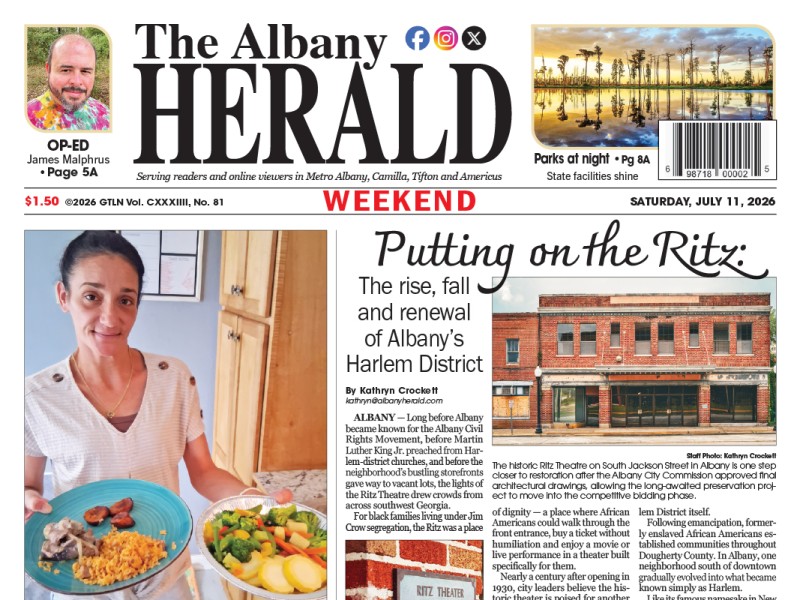
Albany Herald – July 11, 2026
Putting on the Ritz… Food, mini menagerie provide… Albany City Commission set to vote on… Following Lee’s lead, Terrell County hits…

Classifieds – July 11, 2026
Albany Classifieds and Legals: Real Estate; Merchandise, Misc…

Small actions can help save big on utility bills
The high temperatures of July and August can bring scorching utility bills as air conditioners hum to keep houses cool. Albany Utilities Residential Conservation Auditor Willie Jackson offered some tips on making summer cooling bills more manageable.
