
Minor leaguers among Georgians swept up in organized labor wave
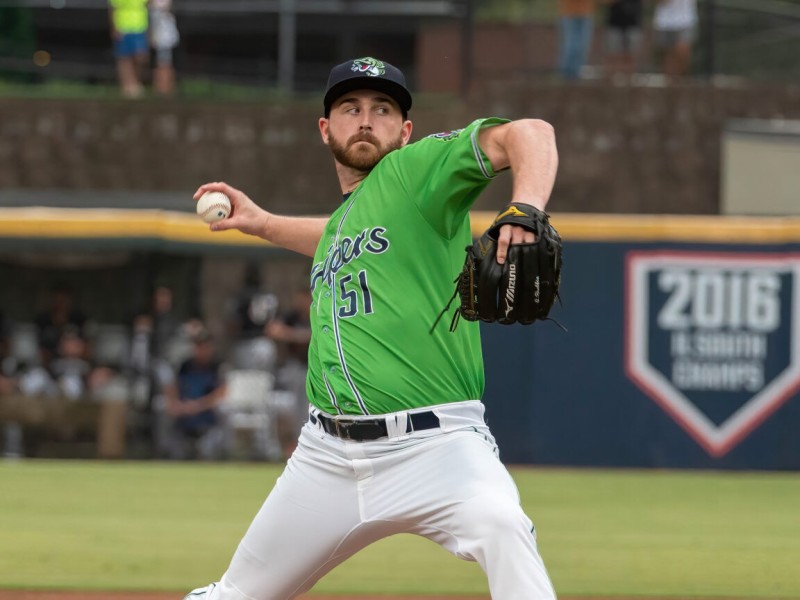
Bernie Connelly/Gwinnett Stripers via Georgia Recorder
By Ray Glier
Georgia Recorder
ATLANTA — The rise in union organizing around the U.S. because of a tight labor market has swept up in its wave the most egregious employer in all of American sports, minor league baseball.
On Labor Day, minor leaguers — there are about 3,500 of them — are signing union authorization cards signaling their support for organizing around a union, a bid to join their big brothers in the Major Leagues who belong to the most powerful union in sports.
The stories are legendary of six minor leaguers crammed into a two-bedroom apartment because of their pitiful salaries, pitchers ordering a pizza during a rain delay and finding out the pizza delivery kid makes more than a professional athlete, or the 6-foot-7 pitcher sleeping all spring training on a couch 6-feet long because he wasn’t paid by the team for that six weeks of work.
In 2018, Congress passed the “Save America’s Pastime Act,” which exempted minor league players from the protections of the Fair Labor Standards Act. It meant teams were not obligated to meet federal minimum wage standards and could regard players as “seasonal” employees, and not have to pay them for spring training before the season started. The roots of the poor labor standards for minor leaguers goes back to the 1930s.
Players for the Gwinnett Stripers, a minor league team of the Atlanta Braves, were opening emails Wednesday from the Major League Players Association asking them to unite. The Stripers were encouraging each other to back the union, several players said.
“I think it’ll be great for minor league players to have a voice,” Connor Johnstone, 27, a right-handed pitcher for the Gwinnett team, said. “There’s way more minor league guys then there are major league players. We’re the ones that are going to be filtering through eventually. I feel like if we actually have a voice, the game will change for the better.”
The minor leaguers are joining the vortex of workers in 2022 taking advantage of a tight labor market in the U.S, and Georgia, in particular. The state’s 2.8% unemployment rate is historically low and beats the national average by nine-tenths of a percent in the most recent reports available. Employers need help, and employees have an uncommon upper hand.
The movement also has steam because Americans are rallying to unions, according to a new Gallup poll. CEO pay has risen 1,322% since 1978 and that fuels the rank-and-file discontent.
College athletes also are cashing in on the sudden strength of workers in the country. Even concession workers at stadiums are starting to organize, not just grumble.
Matt Knepper, assistant professor in the Department of Economics at the Terry College of Business at the University of Georgia, said there is a sort of “contagion element” in shops like Starbucks and Apple, where employees are petitioning for better pay and better benefits.
“There is a resurgence and renewed interest in unionization,” Knepper said. And it applies to a variety of sectors across the economy, including baseball, he said.
Major League Baseball, an $11 billion-a-year enterprise, took steps to cut costs in the minor leagues two years ago. The league essentially took control of the minors and cut 43 teams from its feeder system and reduced the draft from 40 rounds to 20 rounds.
But the union surge nationwide, not to mention sustained pressure from lawsuits against MLB on how it treated its farmhands, seems poised to cost the industry some money.
It’s about time, said Johnstone. The Stripers pitcher, who lives in Smyrna in the offseason, said he makes between $1,100 and $1,200 every two weeks. He is not paid for staying in shape for the offseason, which is part of his job.
Many minor leaguers who are not in “big league camp” in spring training typically are not paid for those six weeks. Johnstone was in big league camp last spring, and he received the meal money that big leaguers got and was able to pay some expenses with that.
“From the talk in the clubhouse, everybody’s excited and everybody’s signing to make sure this happens,” Johnstone said. “It would just be so big for the game of baseball to give all these guys in the minor leagues something to look forward to.
“If you think Triple-A pay is bad, the guys in high-A ball get half of that. If those guys can get something where they can have enough money to just train in the offseason and afford rent, and afford food, and strictly try to get better, the game is only going to elevate.”
Johnstone’s time in A ball in Kissimmee, Fla., one summer included an attic apartment in a house for $500 a month, which is all he could afford. The landlady locked the thermostat on 80 and would not adjust it, even with the heat rising to the attic.
Johnstone has a physics degree from Wake Forest, so he has a Plan B. Actually, he has a Plan B and Plan C. He started a woodworking business in his garage and sold everything from cutting boards to furniture to make ends meet in the winter.
Union organizing has heated up around Labor Day. Delta Air Line pilots, who say they have not had a raise in three years, picketed at Hartsfield-Jackson Airport on Thursday. Starbucks and Amazon workers continued to press their organizing activities around the country.
“There’s a lot of momentum in this movement,” said UGA’s Knepper. “Groups that historically have not participated are participating.”
Like the minor leaguers.
Author

Related Articles

Terrell County invites community to celebrate Independence Day with July Fest
Families from across Southwest Georgia are invited to gather in Dawson on July 4 for an afternoon of food, fellowship and fireworks as the Terrell County Recreation Department hosts its annual July Fest celebration.
DOT says delay in Oglethorpe Bridge opening should be brief
“We know it’s not going to be July 22. We don’t think it’s going to be much later than that.”

City of Albany has big July 4 celebration planned for Saturday
“It’s going to be a lot of moving and shooting them off in a short time. It’s going to be a big show.”
