
Oglethorpe Boulevard bridge replacement project reaches halfway mark
“Once the concrete is poured, it should go up pretty fast.”
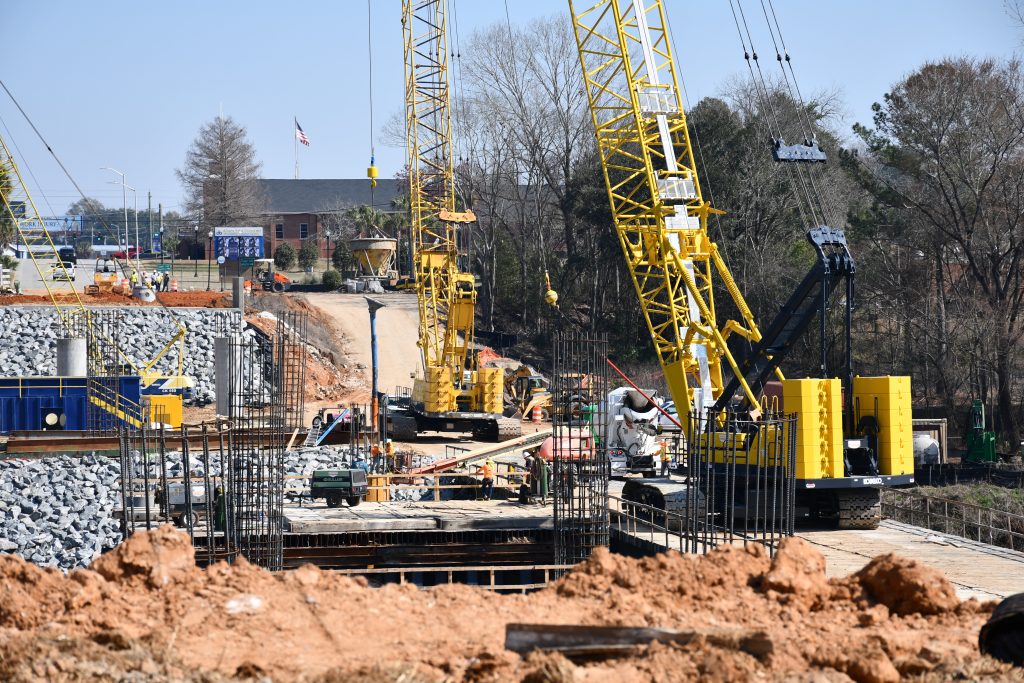
Staff Photo: Alan Mauldin
ALBANY – Albany area drivers who have experienced traffic congestion while the Oglethorpe Bridge has been closed can take some solace in the fact that the bridge replacement project has reached the halfway mark for re-opening the new structure to traffic.
The bridge has been closed since July 22, when the demolish-and-replace project got under way, and the schedule calls for it to open for traffic this summer.
“They say they’re on track for July,” Albany Assistant City Manager Bruce Maples said.
Maples said that although the entire project will not be completed by that time, traffic is scheduled to be flowing by the July deadline.
Currently, a subcontractor is drilling the caissons, the watertight restraining structures used to work on the bridge foundations.
Those caissons are drilled 40 to 60 feet into the ground to provide stability for the bridge, according to the DOT. Nine of the 16 caissons have been drilled so far, and that work was started first due to restrictions on when work can be performed underwater due to the mussel breeding season.
“The required mussel sweeps and the bitter cold that this area has recently experienced have impacted construction,” DOT spokesperson Juanita Birmingham said in an email. “Mussel sweeps couldn’t begin when originally planned because the Flint (River) was too high and the water was too swift. Concrete can’t be poured in very cold or freezing weather.”
The Oglethorpe Boulevard structure is the main bridge linking east Albany to the downtown area and points farther west.
The four-lane bridge, completed in 1953, ferried more than 20,000 cars per day, according to DOT figures. The bridge was rated as being in “fair” condition and in danger of scouring during the most recent DOT assessment.
Scouring is an engineering term meaning the erosion of soil surrounding a bridge foundation. It occurs where fast-moving water removes sediment from around the bridge foundation. That process can eventually compromise the integrity of the structure.
The closure has caused traffic congestion, as the only option for crossing the Flint River downtown is the two-lane Broad Avenue bridge.
The congestion is most pronounced in the early-morning and afternoon hours when people are traveling to and from work.
Once the caissons are completed, workers will start building the bridge columns and installing the bridge caps, the reinforced concrete horizontal piece that sits on top of the columns and supports the 150-foot bridge beams, the DOT said.
“Once the concrete is poured, it should go up pretty fast,” Maples said.
Author

Related Articles

Brie’s Gift offers a helping hand for families affected by leukemia
“I think that would be beautiful. Brie loved her school, she loved her city. I think that would be wonderful.”

Classifieds – June 30, 2026
JOBS: Full-Time – Fire Fighting Pilot for Thrush Aircraft, LLC… SERVICE … DIRECTORY: Health – Private Caregiver… Home Repair/Remodeling: Enhanced Remodeling & Drywall…

Albany Herald – June 30, 2026
Albany Commission approves $358.2
million budget… State Bar of Georgia honors Willie Lockette with… Red light violations will bring citations at…
