
Out of order? Albany Commission set to vote on rules for conducting meetings
Staff Photo: Alan Mauldin
By Alan Mauldin
[email protected]
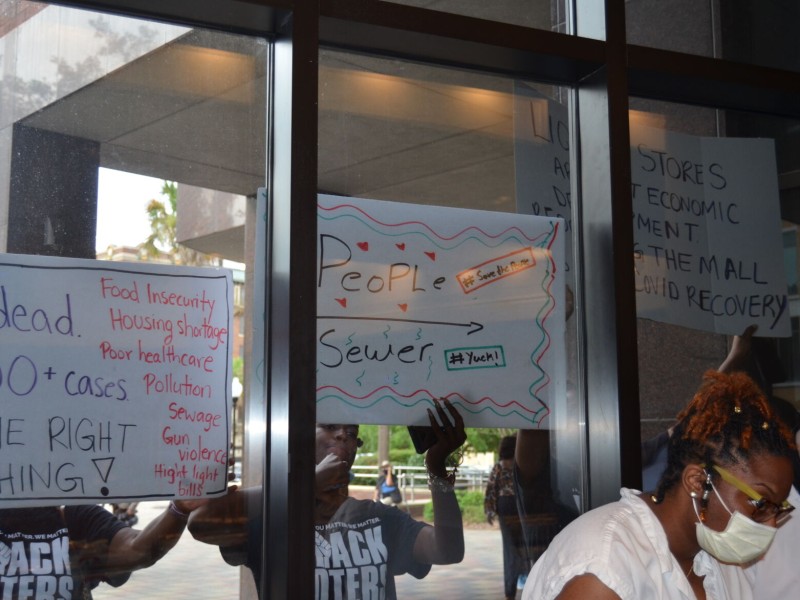
ALBANY — In September 2020 and again in June 2021, anger spilled into an Albany City Commission meeting, with protesters loudly making their voices heard on issues related to COVID-19.
The 2020 discussion centered around a controversial face mask ordinance that narrowly passed in a 4-3 vote, and the second involved the city’s 2020-2021 budgeting of federal coronavirus relief funds for sewer/stormwater system repairs.
After the June meeting, during which protesters banged on the windows at the back of the meeting room and chanted so loudly commissioners had a hard time hearing each other, Ward IV Commissioner Chad Warbington led the call for a revamping of the city’s meeting procedures. The commission had a lengthy discussion at a retreat earlier this year, and a set of rules formulated as a result is up for a Tuesday vote.
During the pandemic, the commission has held meetings with as few as three members attending in person and a majority attending online, although more commissioners have been attending in person in recent months.
To accommodate the unusual situation, Mayor Bo Dorough and the commission have adopted a procedure of holding a round of questions for each presenter who addresses the board and then another round of comments from commissioners.
At times the result has been a 30-minute presentation and question-and-answer period for a single speaker, and limiting such episodes appears to be one of the issues addressed in the new rules of commission procedure and comportment.
Under the draft presented to commissioners this month, the number of speakers allowed to comment during work sessions on matters that are not on the agenda is limited to two, and residents are encouraged to first contact city staff and his or her commissioner before bringing a concern to the full commission.
City residents who wish to address the commission would be required to fill out a speaker appearance form and would have five minutes to comment followed by a five-minute period for commissioners to ask questions, for a maximum of 10 minutes per speaker.
The five-minute question period could be extended by the mayor, but a majority of four commissioners could overrule that decision.
In work session matters that are on the agenda speakers would be given three minutes to speak with no time set aside for questions from commissioners.
In all cases, speakers would be required to follow rules of conduct.
“All speakers appearing before the Commission on any matter or issue must be respectful and courteous in their language and comportment and must not engage in or comment on personalities or indulge in derogatory remarks or insinuations in respect to any member of the commission, or any member of the staff or the public, but must always confine their remarks to those facts which are germane and relevant to the question or matter under discussion,” the draft document states.
The rules also prohibit speakers from endorsing or making derogatory comments about a candidate in a political comment, and the mayor would have the authority to manage or limit those who violate the commenting rules.
Other sections deal with the media, specifying that reporters are to sit in a specified area and prohibiting movement beyond the speaker’s podium in the meeting room.
Another section prohibits commissioners from recording or broadcasting meetings while being involved as part of the meeting quorum.
One concern raised by Warbington following the June meeting was a person with a camera who filmed commissioners while on the dais where commissioners sit.
While stating that behavior was “a little out of order,” Ward VI Commissioner Demetrius Young said the overall intent of the new rules will have a chilling effect on public input and participation.
He also questioned the initiative to make changes after residents protested spending $10 million in federal coronavirus recovery funds on stormwater/sewer renovations when there was no such move after the September 2020 meeting. During the 2020 meeting, he said, protesters also banged on the windows and one unruly audience member had to be escorted out of the meeting by police.
“Part of it is trying to silence the voices of some people in the community,” Young said. “It was only after the black community spoke out (that) they wanted to get all these rules. These rules, all they are doing is trying to control or squelch voices people don’t agree with. At best, it’s unnecessary; at worst, it’s political retribution.
“Those voices aren’t going to go away. It does signify a hostility that this current board has toward dissenting voices.”
Young, who has recorded meetings in the past and posted them live on social media during meetings, said he does not intend to abide by the prohibition on such activity that is included in the ordinance.
Prior to the arrival of COVID-19, Young pushed for having meetings recorded and broadcast, a measure that was approved by the commission. That initiative has been beefed up during the pandemic, during which the city and Dougherty County Commission have provided live feeds of meetings.
“I will not be controlled in my right to record a public meeting,” Young said. “If that’s what they establish as a rule, I will not be following. People should be able to respond to what commissioners are doing during those meetings. It will be interesting in how they enforce those rules.”
Ward I Commissioner Jon Howard said he is comfortable with most of the draft document. However, if there are any sticking points, he said he would be amenable to delaying a vote while changes are made.
For Warbington, the rules are not so much about control as making meetings more orderly and giving a framework in which the mayor can make rulings on the conduct of the sessions. It also allows a majority of the commission to overrule a decision.
For example, the mayor would be allowed to waive the five-minute rule on questions for speakers to give more time, but if challenged, a vote of the majority could override that decision and end the question period, he said.
“I’ve been an advocate for more order, more structure,” Warbington said. “This lays out very clearly how we conduct our meetings, how we conduct ourselves.
“Really, as long as all of us as commissioners are showing respect to each other and showing respect to constituents, it’s not silencing anybody. With our meetings being broadcast, sometimes people are really speaking to the camera. Our meetings are to conduct city business, not speak to a certain group.”
In the past, there has been no specific set of rules governing meetings, City Attorney Nathan Davis said. Meetings have been conducted under Roberts Rules of Order, with the mayor as the arbiter in disputes.
“We have no formal written policy,” Davis said. “I think the overall importance is now there’s an established procedure. It establishes a framework that has not existed before. It’s good to have it in writing.”
Ultimately, Warbington said, the ordinance would give a framework for meetings, from how items are placed on the agenda to how commissioners conduct debate.
“What this does, it gives us the power to check ourselves,” he said. “As an elected body, we are representatives of the citizens. Sometimes our emotions or our political side is a detriment to the citizens. It’s time. We need to pass it.”
Author

Related Articles
Albany Herald – June 4, 2026
Albany Police Chief Michael Persley to retire…Regional catering business fines new… Albany officials ponder future…

Classifieds – June 4, 2026
CLASSIFIEDS: JUNE 4, 2026
Dougherty Commission OKs agreements for trash traps, Radium Springs Grant effort
The placement of two traps will help take a bite out of the amount of trash making its way into the Flint River. The Flint Riverkeeper and partners will be involved in placing, monitoring and monitoring the traps as well as removing and disposing of trash and recyclables.

