
OUTDOORS FEATURE: To cull or not to cull
Bob Kornegay
The deer-hunting public’s interest in deer management increases each year, as evidenced by countless print articles and video productions that discuss management-related topics. Ongoing needs for increased doe kill, protection of young bucks, and improved deer habitat are extensively detailed.
Many deer hunters have grasped these concepts and implemented them on their hunting properties. They have improved the habitat on their leases or landholdings as well as the quality of their deer herds. Their herds are in balance with the habitat, the buck-age structure is much improved, and the adult buck-to-doe ratio is well balanced. Many groups are completely satisfied with their progress, but some hunting organizations want to go farther.
One of the main reasons for dissatisfaction with a deer management program is the size and shape of antlers on the bucks observed and killed each year. Bucks that do not possess what are deemed “normal” antlers are judged inferior by many deer hunters and managers. In their opinions, any buck that does not meet a specific minimum for antler size must surely be genetically inferior since it is subjected to the same environmental and habitat conditions as bucks with bigger, better-formed antlers. Removing these deer as “culls” to improve a herd’s antler genetics is the logical next step in many hunters’ and managers’ minds.
According to wildlife biologist Chris Cook, there are two important questions to answer before proceeding with a culling program: “Are the problem antler traits genetically caused?” and “Will culling correct the problem?” The answers to both questions are difficult, if not impossible, to answer in most situations.
“Determining the cause of a free-ranging buck’s antler ‘abnormality’ or ‘deficiency’ by looking at the live deer on the hoof is practically impossible,” Cook said. “Deer are subjected every day of their lives to many things that carry a potential impact on antler development. Injuries, drought, and poor habitat quality all can cause a buck’s antlers to develop abnormally. Many of these factors are completely out of managerial control, even for an expert. For these reasons, most bucks, especially those 2
Related Articles

Classifieds – June 20, 2026
ALBANY HERALD CLASSIFIEDS JUNE 20, 2026
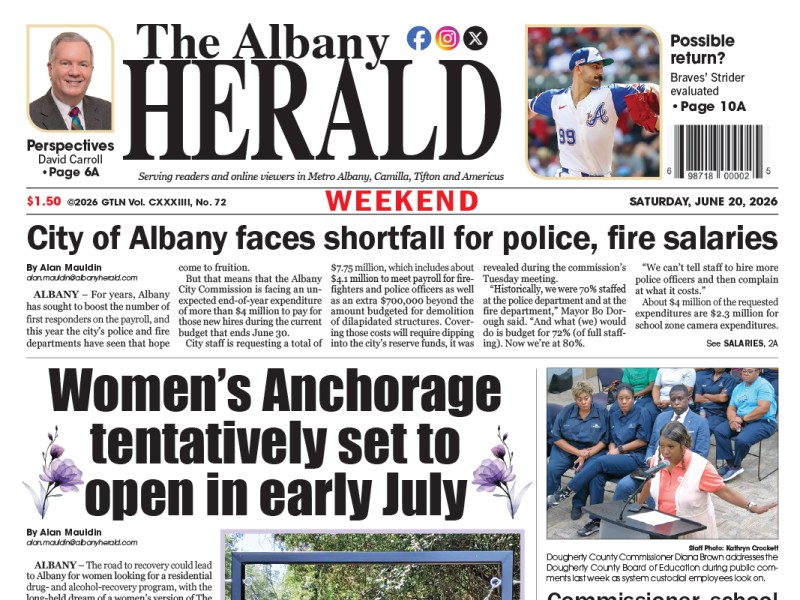
Albany Herald – June 20, 2026
City Albany faces shortfall for police… Women’s Anchorage tentatively set to… Commissioner, school leaders clash over…

Public safety drives Leesburg’s $4.2 million Fiscal Year ’27 budget
The adopted spending plan reflects modest growth in city revenues and continued emphasis on maintaining core municipal services, particularly public safety and sanitation, which together account for a significant share of general fund expenditures.
